


My father was a mechanic his whole life. I am not speaking figuratively —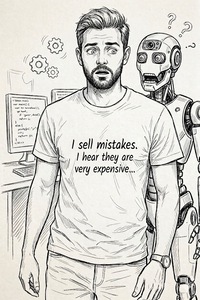 I am talking about a man who lived with his hands inside engines, who could tell by sound alone whether the bearing was on the right or the left, who could diagnose a car by listening to it start from cold, like a doctor listening to a patient's heart without an ultrasound scanner, using only a stethoscope and years of experience accumulated in silence. He knew things that nobody had ever written down, things you wouldn't find in any manual, things you only knew if you had spent long enough under cars, in the cold, with skin cracked from grease and winter.
He never had a website.
Listen to the dialogued audio summary
I realise now, with the distance of years, that he would never have imagined he might need one. Clients came by word of mouth — a neighbour would recommend him to another, someone who knew him from the neighbourhood would bring along someone from another neighbourhood, and this invisible, organic, almost tribal network worked well enough to fill his yard with cars to repair. But it worked within the limits of his physical world, bounded by the radius a rumour could travel from person to person. Beyond that, he didn't exist. He was, in the most technical sense of the word, invisible.
I think about this often — more often than I would have imagined — since I started working in web services. I have been working for nearly eight years with public institutions and private businesses in Romania, mostly small firms, neighbourhood businesses with serious ambitions or serious businesses with the humility of not knowing that Google Business Profile exists. And throughout all that time, I have watched how we — small agencies, independent consultants, people like me — repeatedly commit, with an almost impressive consistency, seven mistakes that cost us clients, cost us relationships, and ultimately cost us the meaning of our work.
I didn't catalogue them myself. I lived them. Some I made personally.
The invisible market — not what you think it is
There is a temptation in the world of digital services, one I felt myself in the early years: to keep looking upwards, towards the 'big' clients, towards contracts with a decent budget, towards companies that have marketing departments and people who know what a brief means. It is a natural temptation, because you are starting out, you want to validate yourself, you want to feel that your work matters on a visible scale.
The problem is that those big clients already have partners. They have agencies with twenty people in an open-plan office, with fifty-slide PowerPoint presentations and glittering portfolios. They have procurement processes, decision committees, budgets locked in for years. There is you, with your laptop and your enthusiasm, and there is them, with all that apparatus that already functions without you. You can break in, but it is difficult, it is slow, and it is, more often than not, dehumanising.
Meanwhile, behind you — literally behind you, in the town where you live, on the street where you go shopping — there is a market that nobody is serving properly. The plumber with twenty years of experience who has his phone number written in marker on the window of a battered Logan [a budget saloon popular in Romania]. The neighbourhood barbershop running entirely on word-of-mouth from the locals. The car repair garage that can fix things which authorised dealerships declare beyond repair, but whose name doesn't appear on Google for any relevant search.
These businesses are digitally invisible. Not because they don't deserve to be visible. Not because their businesses aren't solid — some are more solid than many 'start-ups' that get written about in the press. They are invisible because nobody has come to them with a proposition they could understand, afford, and see the results of with their own eyes.
And we, the small agencies, did come to them. But we came in the wrong way.
Mistake one: you sell them an expensive website before showing them that you've understood their real problem
I remember the first meeting with a client I now refer to, in my own mind, as the Meeting with the Plumber. I don't remember his exact name, or perhaps I do but it doesn't matter — what matters is that he was a man of about fifty, with hands calloused from physical work, with a small heating and plumbing business he had built over twenty years, and that he sat in front of me with a polite scepticism, the kind that people practise when they have been let down often and have learnt to be cautious without being hostile.
I had come with a portfolio. With examples of websites. With a quote prepared for a 'premium presentation' project — or something along those lines; I don't remember the exact wording, but I know it was a sophisticated phrasing, one that sounded good in the world I inhabited and meant nothing to him.
I lost him. Not dramatically — he didn't slam the door; he said he would 'think about it' and never answered the phone again. Which is, in practice, the same thing.
What had I done wrong? I had sold him a technical solution before understanding what his problem was. I had shown him attractive websites without first asking how many new clients he wanted to bring in per month, where his current clients came from, how many calls he was losing because potential clients searched for him on Google and couldn't find him.
The fundamental error is this: the agency sells technology whilst the client needs results. A website is a tool, not an end in itself. A website without a content strategy, without local visibility, without a correctly set-up Google Business Profile, is like a car without an engine — it looks fine in the car park, but it doesn't take you anywhere.
The solution is not complicated, though it took me years to truly understand it: you start with his problem, not your solution. 'How many extra clients do you want ringing next month?' is a better question than any portfolio presentation. 'What happens now when someone searches for you on Google?' is a question that opens real conversations. You propose a minimal package — a simple, functional website with a few articles that answer the questions his clients actually ask, with a properly completed Google Business Profile — and you say: 'In three months, we'll see whether the phone rings more often. If it does, we carry on. If it doesn't, we've both lost something, but you'll have lost very little.'
That is a proposition he can understand. That is a proposition he can say yes to.
Mistake two: you use a language that makes them feel like strangers in their own business
I have a friend — I've known him for years, since school — who works in sales and once told me something that has stuck with me: 'The worst thing you can do with a new client is make them feel foolish for not knowing what you know.'
I think about that every time I hear a young consultant talking to an SME [small and medium-sized enterprise] owner about 'omnichannel strategies', 'ROAS', 'conversion funnels', and 'brand synergies'. I see the faces of the people behind the counter — faces that register the terms without understanding them, and that draw the conclusion that the person in front of them is either too expensive for their needs or is talking about things that don't apply to them.
Jargon is not a demonstration of professionalism. It is a barrier. People who are genuinely good at what they do know how to explain complex things in plain language — not because they underestimate their audience, but because they themselves understand what they do well enough to translate it into any idiom.
The small client wants to talk to someone who understands their business. They want to feel that the person in front of them has listened, has understood what they do, knows the difference between a client who rings about an emergency and a client who is searching on Google to compare prices. They want authenticity, not terminology.
The practical translation is simple: instead of 'we increase the conversion rate of organic traffic', you say 'more people who find you on Google will ring instead of clicking away'. Instead of 'we optimise your presence in search engines', you say 'we make you appear when someone in your town searches for the exact service you offer'. The same thing, different words, different reception.
Mistake three: you treat a small budget as a problem rather than a starting point
This embarrasses me, even now, in retrospect — that I made this mistake too at some point, that I looked at a monthly budget of a thousand lei [the Romanian currency; roughly equivalent to £170 at mid-2020s exchange rates] and quickly calculated how unprofitable that client would be relative to the time I would invest.
What I didn't understand then is that for that person, a thousand lei are not 'a small amount' in any absolute sense. They are the first money he has ever invested in digital marketing. They are an experiment in trust — he is testing whether you are worth bringing him more money back, not testing whether you can afford to work with him.
There is an enormous difference between being a client with a small budget and being a client at the beginning of a journey. The first pays you little and will always pay you little — perhaps they don't understand the value, perhaps they genuinely can't, for structural reasons. The second pays you little now because they haven't seen the results yet, because they don't yet trust you, because they are cautious — and this caution is perfectly rational.
If you show them concrete results — if after three months his phone rings with five new people a month who found him on Google — the budget grows organically, without you having asked for anything. It grows because he wants more of what is working.
And this is what I remember from conversations with my father, even though he never spoke explicitly about marketing or business growth strategies — I remember that his first loyal clients didn't come from adverts or hoardings, but from the fact that he solved a problem others had declared unsolvable, that he delivered more than he had promised, that he was honest about what he could do and what he couldn't. Loyalty is earned through results first, not through contracts.
Mistake four: you measure success in metrics that the client neither understands nor feels
I can picture the scene with an almost physical clarity: the owner of a car repair garage opens the monthly report email, sees a table with columns — 'impressions: 12,400', 'CTR: 2.3%', 'average position: 14.7', 'sessions: 287' — and has no idea whether that is good or bad. He doesn't know whether he should be satisfied or worried. He doesn't know, above all, what connection those figures have to whether this month went well or badly for him.
You send him a performance report and you produce anxiety, not clarity. That is not good service, however technically correct the report may be.
The client doesn't want to know about impressions. He wants to know how many new people rang this month because they found him online. He wants to know how many of those eventually became paying customers. He wants to know whether he has saved time — whether the people who ring are better informed, whether they ask fewer basic questions that he used to answer ten times a day on the phone, because the answers are now written on his website.
This is the useful report: 'This month, eleven people rang after finding the site on Google. Seven became clients. Two asked about a service you don't offer. One came from Iași even though you're based in Botoșani, which means people outside your town are finding you too. Let's get some reviews from satisfied customers — that will double the rate.'
That is a report the man can read before his morning coffee and actually understand.
Mistake five: you propose a 'brand awareness' strategy when he needs clients tomorrow
There is a type of proposition I have seen many times and have avoided by instinct every time — an instinct I can now name: the proposition that sells a distant future to a man who lives from the immediate present.
'We build brand awareness.' 'We create brand consciousness.' 'We develop the brand community.' These sentences are perfectly suited to a multinational company that already has clients, whose cash flow is covered for twelve months, and that can invest long-term without immediately feeling the pressure of results.
They are not propositions for a plumber who has to pay his suppliers in a fortnight.
The Romanian SME — especially the local one, especially the one in a small or medium-sized town — operates from month to month. It has no large financial buffer, no strategy department thinking five years ahead. It needs the phone to ring. That is its unit of measure for success: the phone ringing with a new client.
And there are tools that produce exactly that, quickly and cheaply, if you apply them correctly: a fully completed and optimised Google Business Profile — address, opening hours, real photographs, correct primary category, replies to reviews — appears in local searches and brings phone calls within days, not months. Content that answers the real questions clients ask — 'how much does a central heating installation cost for a studio flat', 'how do I know if my boiler is dying' — attracts people who are actively looking for a solution and are ready to buy. Genuine reviews from satisfied customers quickly build the social trust that convinces a stranger to ring.
Brand awareness comes later. It comes on its own, once this foundation is in place and working. Not before it.
Mistake six: you don't help them overcome their fear of exposure — you ignore it or play it down
Of all seven mistakes, this is the one that has cost me the most. Not in terms of lost contracts — but in terms of collaborations that started well and stalled halfway through because of it, because I never addressed it directly and it remained there, underground, sabotaging everything we were building.
The fear of exposure is real and it is specific. It is not cowardice, it is not a lack of professionalism — it is a human response to a new and vulnerable situation. The man who has built his business through physical labour, who has never thought of himself as a 'brand', who has never spoken publicly about what he does and how he does it, who has spent his whole life communicating face to face, person to person — that man is suddenly confronted with the proposition of appearing on the internet, with his name, his face, his story, in front of strangers.
'I don't want to appear with my face.' 'I don't know what to write.' 'I'm worried it will look like I'm showing off.' 'I'm not good with words.'
And what did I do? I would say: 'That's not a problem, we'll handle it.' Or: 'You don't need to worry about that.' And I would carry on, as though the objection had been resolved. It hadn't been resolved. It had been deferred, and it would come back later, stronger.
The solution is to address it head-on, with genuine empathy — not the empathy of a sales manual. To say: 'I understand exactly what you feel. Most of the people I've worked with said the same thing at the beginning. And here's what I've found: clients don't want to see a model. They want to see the real person — overalls on, in his workshop, explaining something with his hands. That's what convinces them, not a studio photograph.'
And then to propose small steps: a short text about how the business began, no photos; a photo of hands at work, no face; a photo of the workshop from the back; and only later — if and when he is ready — a photo showing his face. Each step that is taken and doesn't bring the world crashing down builds confidence. In the end, the best clients he has ever had didn't come from an advertising campaign, but from someone telling another person what it had been like to work with him.
Authentic content is not a marketing trend. It is the mechanism through which people like him have always won clients — told by others about them, not by themselves. Now, for the first time, they can tell the story themselves. It doesn't need to be literary. It needs to be true.
Mistake seven: you win three small clients and apply large-agency processes that eat your profit
This is the mistake made chiefly by slightly larger agencies, or by small agencies that grow quickly and don't reorganise in time — but any independent consultant who doesn't think about how they deliver their service, not just what they deliver, makes a version of it too.
You win three or four clients with small budgets. The initial enthusiasm — having a client portfolio, doing something concrete — turns within a few months into an operational nightmare: weekly meetings that last an hour to settle things that could have been communicated in a three-sentence email; requests for changes at every step because no clear framework was established from the outset; laborious invoicing for small sums; and constant communication that takes up half your working day. At the end of the month, you do the sums and discover you have worked harder than on a large contract, earned less, and are more exhausted.
And then you draw the wrong conclusion: that these clients aren't worth it, that this market isn't profitable, that it is better to go back to chasing big clients.
The right conclusion is different: your operational model is not suited to this segment. The clients are not the problem — your process is the problem.
The solution is to build a distinct, standardised, scalable delivery model. Fixed packages with defined content — not endless negotiation. Three clear options: 'Start', 'Growth', 'Domination' — or whatever you choose to call them; the important thing is that the client chooses from a menu rather than ordering à la carte. A content calendar set monthly, approved once, executed without individual approvals for every headline. A weekly written update, two or three sentences, sent on Tuesday morning — not an hour-long meeting that nobody attends prepared. A single communication channel, a single point of contact.
When delivery is standardised and processes are clear, you can operate with healthy margins even on small budgets — because you invest one hour per week per client, not five. And the client receives a better service, not a worse one, because predictability and consistency are, in practice, more valuable than improvised creativity.
What a well-made mistake looks like
There is a phrase I heard from an older entrepreneur, which he used to describe failed projects: 'a well-made mistake.' Not a mistake you refused to acknowledge, not a mistake you repeated without learning from it — but one you lived through completely, analysed honestly, and turned into capital of understanding.
The seven mistakes I have described are not exceptions — they are the rule. New agencies make them, experienced consultants make them, I have made them, I have seen them made by people who are far more technically skilled than me. They are the symptoms of a way of thinking built for a different type of client, a different time, perhaps a different economy.
The real market of local Romanian SMEs does not operate according to the logic of LinkedIn content or marketing conference presentations. It operates according to the logic of the mechanic who does a repair properly and gets recommended to the neighbour, the logic of the plumber who answers the phone and shows up when he says he will, the logic of the barber who knows it's your birthday and tells you that you look well when you don't really look that well at all. It is an economy of personal trust, built slowly, layer by layer.
What we offer, as digital service providers, cannot replace that logic. But it can amplify it, extend it beyond the physical boundaries of the neighbourhood or the town. It can make the plumber with twenty years of experience findable not only by the neighbour who heard about him from someone else, but also by the person at the other end of town who is searching on Google at eleven at night because their boiler has broken down.
For that, we need to speak to them in their language, not ours. To propose solutions they can afford now, not ones they might eventually be able to afford. To report their success in words they understand. To respect their fear of exposure and show them that vulnerability — paradoxically — is the most powerful marketing tool they have.
And to organise our work so that we can deliver consistently and profitably, rather than exhausting ourselves on projects that satisfy us emotionally but ruin us financially.
I think again of my father. Of what a good website could have done for him — not a complicated one, not a 'brand awareness' campaign, but a simple website, a few articles written by him or about him, a phone number clearly visible, a handful of reviews from the people whose cars he had repaired for twenty years. People from neighbourhoods he had never set foot in might have found him. Someone could have found him searching 'mechanic gearbox Golf 4 Botoșani' — a search I am certain someone makes every month, somewhere, and which nobody answers.
I never built him that website. Not because I didn't know how — I did know. But because I didn't understand in time that this is, in fact, the work that matters most: not the big projects, not the clients with big budgets, but real people, with real businesses, who need someone to explain to them that they can be found, that they deserve to be found, and that it isn't complicated.
It isn't complicated any more, if you do things in the right order.
Comparative table — How an agency that loses the client thinks versus one that wins them
| Dimension | The mistake (loses the client) | The solution (wins the client) |
|---|---|---|
| Initial offer | Complex website at €5,000 | Start package: simple website + 5 articles + Google Business |
| Language used | 'Omnichannel strategy', 'KPIs', 'ROAS' | 'How many more clients do you want ringing next month?' |
| Success metric | Impressions, traffic, CTR | Number of calls received, new clients, hours saved |
| Treating the budget | 'It's too small, not worth it' | 'It's the first step. When you see results, we grow' |
| Client objection | 'That's not a problem, we'll sort it' | 'I understand the fear. Here's how I've helped others like you' |
| Operational process | Weekly meetings, endless personalisation | Fixed packages, written weekly update, standard process |
10 justificatory questions — direct answers
1. Why do you say that local SMEs are 'digitally invisible'? Don't they simply have poor websites?
It's not quite the same thing, though on the surface it might seem to be.
A poor website exists — it's there, it can be found if you know exactly what you're looking for, it leaves an unfavourable impression. Digital invisibility is something else: it is complete absence, a total lack of any trace that would allow someone who doesn't know you to reach you through digital means. The plumber without a website, without a Google Business Profile, without a single online review — he doesn't have a poor website. He has nothing. He exists only in the physical world, within the radius a rumour can travel by word of mouth.
And that, paradoxically, is less visible than a poor website. A poor website can be improved. Total absence has nowhere to start from if there is no starting point at all.
The article addresses precisely this population — those who haven't taken even the first step — because they represent the real opportunity that small agencies are missing. Not clients with mediocre websites, who more than likely already have someone managing them (badly, but managing them), but those who are entirely outside the digital ecosystem, as though they were living in a different decade.
2. Isn't it natural for a client with a small budget to receive less? Isn't that the basic economic logic of any service?
Natural, yes. Always right, no.
The economic logic is simple and, in itself, correct: a small budget means limited resources, so you deliver less. The problem arises when we apply this logic without distinguishing between two types of small-budget client who are fundamentally different.
The first type is the client who doesn't understand the value and never will — they want a great deal for very little and will not increase their budget regardless of results. For them, your economic logic applies perfectly: you deliver what you can, you both earn a little, you go your separate ways.
The second type is the client who has never seen what a functional digital service looks like, who has no point of comparison, who is cautious not out of ill will but out of rational ignorance — they don't know what they are buying, so they don't know what it is worth. For them, the economic logic of the moment is deceptive, because you are looking at a starting point and evaluating it as though it were the final destination.
The article tries to make this distinction. It doesn't say that every small-budget client is valuable. It says that agencies don't make the distinction and reject the second category in bulk — the category they could convert into a long-term client — precisely because they look at today's budget rather than the likely trajectory.
3. But isn't technical language sometimes necessary? How do you communicate seriously about complex services without specialist terms?
You use specialist terms between yourself and your colleagues. Not with the client standing behind the counter who doesn't know what ROAS means.
There is an enormous difference between knowing the terminology and using it as your only communication tool. A good doctor knows exactly what 'acute myocardial infarction with ST-segment elevation' means — and equally knows when to simply say 'you're having a heart attack and we need to act now.' The same information, two registers, used according to the interlocutor.
It's not about simplifying the ideas — the ideas remain just as complex. It's about translating complexity into concrete benefits. 'We increase the conversion rate of organic traffic' is a technically accurate and true statement. 'More people who find you on Google will ring instead of clicking away' says the same thing, but the client can understand it and evaluate it in their own terms.
If you can't make this translation, it means you don't yourself understand what you are selling well enough to explain it in any way other than jargon. And that is a deeper problem than language.
4. The article criticises selling 'brand awareness' to small clients. But don't you actually build a brand even when doing local SEO and Google Business?
Yes, but there is an important distinction between building a brand as a secondary effect of actions with immediate impact and selling 'brand awareness' as the primary objective of a contract.
When you optimise a plumber's Google Business Profile, when you write articles answering the questions his clients ask, when you help him receive and respond to reviews — all of this builds, over time, something that might be called a local brand. But that is not what you are selling. You are selling extra phone calls next month. You are selling visibility in local searches. You are selling new clients.
'Brand awareness' as a primary proposition is a problem because it shifts the time horizon for results — it moves them from a few months (visible, measurable) to a few years (vague, difficult to attribute). The small client doesn't have the patience or the financial reserves for that horizon. Not because they lack vision, but because they live from monthly cash flow, not from venture capital.
Therefore: you do build the brand, but that is not the product you are selling. The product you are selling is the action with immediate impact. The brand comes as a bonus, not as the main promise.
5. When you talk about clients' 'fear of exposure', isn't it their responsibility to overcome it, not yours?
In theory, yes. In practice, if you wait for them to overcome it themselves, you lose the collaboration.
There is a tendency in the industry to separate 'technical deliverables' from everything related to the client's psychology — as though you are responsible for the website, the articles, the SEO, whilst everything else (including the client's willingness to contribute authentic content) is their problem to resolve before they can benefit from your services.
The problem with this logic is that it doesn't work in practice. A 55-year-old plumber who has never appeared on the internet will not overcome his fear of exposure by reading a motivational article on LinkedIn. He will overcome it through small, concrete steps, accompanied by someone who explains each time that the world hasn't caved in, that people are responding positively, that results are coming.
You, as the service provider, are that companion. Not because you were asked to be, but because without that, your technical product cannot function as it should. Authentic content — real photographs, real stories, the real voice of the person — is the fuel that powers all the tools you have built for them. Without it, the engine runs in neutral.
So it's not about taking on his responsibility. It's about recognising that your responsibility extends beyond code and copy.
6. The article proposes 'fixed packages' instead of personalisation. But doesn't the client lose a product tailored to their specific needs?
They lose something in surface-level personalisation. They gain predictability, consistency, and a supplier who isn't burnt out by the second month of the collaboration.
There are two types of personalisation: strategic personalisation, which concerns a deep understanding of the client's business, their clients, their local market — and operational personalisation, which concerns how many article titles you approve, exactly what the contact button looks like, what colour the background is.
Fixed packages eliminate operational personalisation — the kind that consumes the most time and that, in practice, makes no difference to results. The strategy remains personalised: you know that the plumber needs content about heating emergencies, not industrial installations. You know that the neighbourhood barbershop needs its hours and location to be clearly visible, not articles about styling trends from Milan.
When delivery is standardised, you have more energy for what genuinely matters: understanding the client's business, measuring what is working and what is not, adjusting the strategy. And the client receives a more consistent service — not excellent today and absent next week because you are overwhelmed with change requests from other clients.
7. Why do you think small agencies repeatedly make these mistakes? Haven't they seen the effects and corrected course?
They have seen them, but they have drawn the wrong conclusions.
When you lose a small client who didn't understand your proposition — or when you win one, deliver, exhaust yourself operationally, and give up — the easy conclusion, and the wrong one, is that this market isn't worth it. That these clients are difficult, that they don't understand value, that they're not worth the effort.
The right conclusion — that your proposition was ill-suited to them, that your processes weren't calibrated for this segment, that you were speaking a language they didn't understand — is harder to accept because it requires admitting that the problem lies not with the client but with you.
It is easier to say 'the local SME market isn't profitable' than to say 'my business model isn't suited to the local SME market.' The first version asks nothing of you in terms of change. The second does.
And there is something else: small agencies look at each other and do what they see. If everyone around you is selling complex packages, talking about omnichannel strategy and chasing clients with large budgets, there is a social and professional pressure to do the same — even if it doesn't work for you.
8. The article uses the story of your father the mechanic. Isn't that a rhetorical device — a personal story placed strategically to create an emotional response?
It is both rhetoric and truth. The two are not mutually exclusive.
Yes, I chose to open with a personal story because I know it works rhetorically — it anchors the abstract idea of 'digital invisibility' in a concrete person, with a concrete trade, with calloused hands and a client network that operated only within physical space. That is not accidental.
But the story is also true. My father was a mechanic, he never had a website, clients came through direct recommendation, and his field of activity was limited to the distance a rumour could travel. That is his reality and the reality of tens of thousands of people like him.
The fact that I choose to tell it at the beginning of an article about web services does not turn it into fiction. It turns it into an argument. And the argument has two layers: one emotional — to make you feel something before I explain something — and one logical — the story illustrates perfectly precisely what I define as 'digital invisibility', better than any abstract definition could.
If we could separate rhetoric from truth cleanly and definitively, we would all live differently.
9. The authentic content you describe — the photo of hands in the engine, the story of a difficult client successfully resolved — is that not, in the end, a form of marketing too? Aren't you deceiving yourself that it is something else?
I am not deceiving myself, but it is a good question.
Yes, it is marketing. But there is an important distinction between marketing that simulates authenticity — that is, the production of content constructed to appear organic but conceived from the outset as disguised advertising — and authentic content that comes to serve a marketing function as well, without that being its primary intention.
A plumber who writes (or dictates, or tells verbally for me to transcribe) how he solved a problem that others had declared unsolvable is not doing marketing in the strict sense of the word. He is doing what tradespeople have always done: demonstrating through concrete examples that he knows what he is doing. The fact that this example appears on a website and can be found through Google doesn't change its nature — it merely extends its radius of dissemination.
Simulated marketing produces content that resembles authentic experience without being so — it is constructed strategically to create an impression, not to convey a reality. Authentic content starts from reality and accepts that it may also be persuasive. It is not the same thing, even if on the surface the two look similar.
The reader feels the difference, in the end. Not always immediately, not always consciously. But they feel it.
10. Why didn't you write this article as a practical guide — clear steps, lists, concrete instructions — rather than a personal reflection with philosophical digressions?
Because I wasn't writing for someone who needs a practical guide.
Practical guides with clear steps exist — they are useful, and there are many people who write them well. If someone searches 'how to win SME clients for my web agency', they will find five-point lists, proposal templates, sales scripts. All perfectly valid.
I was writing for a different person: for someone who is already doing the technical things correctly, who knows the tools, who knows how to deliver — and who nonetheless keeps losing these clients without quite understanding why. For someone who feels that something isn't working but can't put their finger on exactly what.
Those people don't usually need more practical steps. They need a different angle from which to look at the problem — a story that makes visible something they already knew but hadn't thought about in those terms.
That is why I chose the form of personal reflection, with all its digressions, with my father the mechanic, with the honesty about the mistakes I have made myself. Not because it is more literary or more elegant — but because, for the reader I had in mind, it was the only form that could reach where it needed to reach.
Bibliography
-
Petru Cojocaru — 'The Invisible Tradesman: Why Local Businesses Need a Blog, Not an Expensive Website' — petrucojocaru.ro
-
Cory Doctorow — 'The "Enshittification" of the Internet' — Pluralistic, 2023 — pluralistic.net/2023/01/21/potemkin-ai
-
Cult Research / Life is Hard — 'Study: Obstacles 2023 and Trends 2024 in the Digitalisation of Romanian SMEs' — digitalromania.ro
-
Google — 'Google Business Profile Help: Get started with Google Business Profile' — support.google.com/business
-
DigiTech Sync — 'SME Digitalisation: 7 Essential Steps for 2025' — digitechsync.com