Featured

The border that told us everything from the beginning

Initial title: From Primăverii to the Theatre, with Four Children and a Notebook of Grievances

A July walk through a small Romanian city, or on how a town deflates beneath the feet of its own children


The border that told us everything from the beginningWe set off at about half past five in the afternoon. The hour was chosen because, in July, Botoșani[^1] has two faces and neither belongs to it: at midday the tarmac breathes like a frying pan left on a switched-off hob, while late in the evening, around nine, a false quiet settles in, of the sort in which every car that passes down Strada Primăverii seems to be crossing your sitting room. Half past five was, as my father used to put it, the hour at which "the sun packs up its tools". He spoke of the sun as though of a workshop colleague finishing his shift, and those words come back to me every time I decide to leave the house in summer. My father was a car mechanic and he had his own way of measuring the world: in spanners, in stroke, in millimetres of play. A great many fragments of this vocabulary have dissolved into the way I look at cities. The millimetres I sometimes look for in the kerbs of Botoșani's cycle infrastructure. I don't find them, but that's a separate conversation, and one I'll come to soon enough.

We had agreed to start out from my flat on Strada Primăverii and walk, at a Sunday-afternoon pace, to the Mihai Eminescu Theatre.[^2] It wasn't Sunday; it was a plain Wednesday. But we each had one reason more to go, and several reasons fewer. The one reason more was a play we wanted to reach early, to secure good seats on the left of the auditorium where the acoustics swallow less. The reasons fewer were, in turn, the fatigue, the humidity in the air, a piece of political news that had spoilt the morning for all of us, and, further down, a refusal to take the car once more for less than two kilometres. That, I think, was the initial decision from which the rest flowed: a small form of resistance, in which I did not want to contribute yet another vehicle to the already thick air of the town.

The friends arrived one by one. Andrei with Ilinca, his daughter of eleven, holding a skateboard she is not allowed to ride in the places she would like to ride it. Mihai with Tudor, a tall boy of thirteen, already almost one metre seventy, with an adolescent's stride. And Cristi with Sara, ten years old, her hair caught up in a high ponytail, on a folding bicycle she guards as she would an exotic object. The fourth pair was me and V., my son, sixteen years old, who over the last month has grown again so that his trousers now sit short on his ankles. I saw him each evening at supper, and yet that growth I only registered on stepping out into the street, when I looked at him properly and was startled, as though only now was I seeing him as he was.

Four men between forty and fifty, four children between ten and sixteen, eight pairs of shoes of eight different kinds and eight different walking rhythms. These were, in short, the conditions of an urban design experiment which no designer in Botoșani appeared to have anticipated.

Featured

Let's celebrate the visible investments and ignore the absence of the invisible ones — the railway, the expressway, real digital connectivity

End of the Line: How a Romanian Town Lost Two Trade Routes and Gained a Railway Station. Let's celebrate the visible investments and ignore the absence of the invisible ones — the railway, the expressway, real digital connectivityBeing a chronicle of five centuries of commercial geography, one catastrophic infrastructure decision, and a tunnel that has never carried a single passenger


Editor's note for international readers: Botoșani (pronounced approximately boh-toh-SHAN) is a city of roughly 80,000 to 90,000 people in north-eastern Romania, close to the borders with Ukraine and the Republic of Moldova. It sits in the historical region of Moldavia — not to be confused with the independent Republic of Moldova to its east. For most of the medieval period, it was one of the most important commercial hubs in south-eastern Europe. Most people outside Romania have never heard of it. This is, in part, what this article is about.


Begin with what is known.

In November 1871, the railway arrives. It arrives and does not quite arrive. It reaches Leorda, hesitates, then pushes on to Botoșani. Forty-four kilometres of track from the junction at Verești. End of the line. The station building is designed by a local engineer named Elie Radu — a Botoșani man who had built bridges and roads across half the country. He designs his own city's station with his own hand. He builds, in other words, the architectural monument to its own marginalisation. Small irony. No moral attached.

The town celebrates. Naturally.

Only a certain Armenian merchant — call him Hagigian, for the name matters less than the gesture — a certain Armenian merchant with a cloth shop in the old commercial quarter stands in his doorway and watches the locomotive with an unease he cannot name. He is not against progress. He is not a fool. He is simply a man who knows that his goods arrive from one direction and depart in another, and that this locomotive does not serve either.

Featured

On the need to be useful and respected within one's own community

If Nobody Says Good Morning to You

Translated and adapted from the Romanian by the author. Cultural notes appear inline where necessary for an international reader.


The SceneOn the need to be useful and respected within one's own community

It was March 1965, the Great Lent was under way, and Gheorghe Gheorghiu-Dej had died.[^1] Lică[^2] was eleven years old and had come home from school in tears. Not genuine tears — he was crying from fear, from imitation, from the dull pressure a regime exerts on children through teachers and classmates and the general atmosphere of a day that demanded grief. At home, his father — a man with calloused hands and the word-economy characteristic of his generation — looked at him for a moment and slapped him. Not hard. But precisely.

"Don't cry for nothing. That man never wept with us over our dead on the bier."[^3]

Then he set him to work making small baskets. Little things, woven from thin scalded reed, with a single handle — nothing more. Their size was calculated for the food carried to church to be blessed on the eve of a feast.[^4] The work was not difficult, but it required attention: the reed had to be scalded for exactly the right amount of time, or it would snap when bent; the handle had to be firm without being inelegant. It was craft, not chore.

Lică's father did not explain further. He said one sentence: "Be useful, so the village knows you."

And that was the whole philosophy of the day.

I have thought of that scene every time I heard the saying that Lică remembered from a great-great-grandparent — a man whose name even Lică could no longer recall precisely: "If you set out in the morning and nobody says Good Morning to you, you might as well not have woken up." It is not an aphorism. It is not a school maxim. It is an observation pulled directly from the texture of rural communal life, without philosophical pretension, yet with a precision that any philosopher might envy.

[^1]: Gheorghe Gheorghiu-Dej (1901–1965) was the Communist leader of Romania from 1947 until his death. His passing on 19 March 1965 was the occasion for state-mandated public mourning — schools, workplaces, and public institutions were expected to perform visible grief. He was succeeded by Nicolae Ceaușescu, under whose dictatorship Romania remained until 1989.

[^2]: Lică is an informal Romanian diminutive of the name Lica or Vasile, common in rural northern Moldova (the historical region in north-eastern Romania, not to be confused with the neighbouring Republic of Moldova). It signals affection and familiarity.

[^3]: "Dead on the bier" (morții de pe năsălie): the bier is the wooden frame on which a coffin is carried to church and to the cemetery. In Romanian Orthodox village tradition, the community gathers for the entire funeral process, which can last several days. The father's point is stark: the party leader had never shared in their real losses, so no real tears were owed.

[^4]: Food blessed at church (mâncare de ajun dusă la sfințit): in Romanian Orthodox practice, certain feast days — particularly those during the Great Lent and around Christmas and Easter — involve bringing food to church for a blessing before it is eaten. The baskets carrying this food are small, carefully made objects that pass through a ritual circuit: from home, to the altar, back to the table. They are simultaneously practical and sacred.

Featured

Who choose to leave the house - Oh, there's nothing to do in this Botoșani of ours!

Provincial towns, and who choose to leave the house - Oh, there's nothing to do in this Botoșani of ours!From the Armchair to the Hour of Magic: Habit as a Form of Knowing.

An essay on attention, provincial towns, and the people who choose to leave the house.


"Ernu excavated the everyday, Teodorescu articulated the province, Lungu ironised inertia, Braniște photographed the interior void. Neill maintained a habit, Collins measured a flywheel, Clear mapped a mechanism, Sullivan observed a shift in attention. Each saw the same thing through a different window."


Where This Begins — Or: How a Man in an Armchair Wrote a Manifesto Without Meaning To

Before I write anything of my own, I need to give the floor to someone else. Cristian Stăncescu published a short text on cojocarupetru.info — something between a Friday evening diary entry and an inadvertent provocation. It carries no philosophical pretensions. It cites no one. It is simply the account of a man who went out and found something there.

I reproduce it here in translation, because it is the foundation on which everything that follows rests.


"Oh, there's nothing to do in this Botoșani of ours!" — How many times have you heard that? Do you say it yourself? Let me ask in return: what are you doing to have something to do in Botoșani? Sitting in the armchair, watching your favourite series, waiting for something to happen — a miracle, perhaps — that's unlikely to work. You searched online for something you were interested in, didn't find it, and gave up, didn't you?

Go out. Walk around. Step into a café. Find the shade of a terrace. Socialise. You'll discover there's a public speaking and leadership club — Toastmasters Botoșani. You'll find that people gather at the "La Mâțe" café to discuss ideas and meditate, not merely to order coffee. You'll learn you can play backgammon and chess in the park, that you can learn to dance and feel the rhythm of Latin American music in your body, that you can learn to paint, to sing, to sew, to... Everything begins with wanting to step outside your little box.

Today I accepted an invitation. At 18:45, I was at the place where the Piața Volantă — the Flying Market — takes place every Sunday. Irina Ghilian welcomed me and led me into a beautiful, warm, welcoming room. Some of the exhibits sat quietly in their places, ready to be admired and tried. Others were still finding their spot on the tables. Everything was arranged thoughtfully, by category.

The presentation began, and for me, the hour of magic began. Amway products, marketing programmes, water purification systems, supplements, vitamins... "I've shed fifteen years off myself!" I closed my eyes. What would it be like to shed fifteen years off myself? I became more attentive.

— How do you wash your fruit and vegetables? What products do you use?

— What water do you drink?

The demonstrations and explanations began. Did you know there are varieties of cherry grown exclusively for their vitamin C content? Acerola cherries! I felt like I was watching Teleenciclopedia. You know that feeling — when you don't want it to end?

I looked around the room and asked myself: where are all the people from Botoșani who say there's nothing to do here?"

— Cristian Stăncescu


That is Stăncescu's. From here, the text is mine.

Not because he gets anything wrong — quite the opposite. But good texts do what good doors do: they open and stop at the threshold. What follows is an attempt to step through.

Featured

On yield, public ownership, and the art of caring for what is not yours.

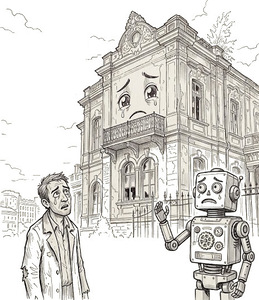
The Building Stirs. Management Sleeps.

"Men care less for what they hold in common with others than for their own concerns." — Aristotle, Politics, Book II


Yield. "This building isn't performing! We should sell it!" Wrong.On yield, public ownership, and the art of caring for what is not yours. It is your management of this building — and of other buildings in the municipality and across the county — that is not performing. You and those you work with, your so-called "team", are either incompetent or acting in bad faith. The building stirs. It is waiting to be brought to life, to receive working people, to shelter them — warmth in winter, cool in summer, protection from wind and rain. What must decision-makers do? It is simple: think about every action concerning public assets and liabilities as though those assets belonged to you personally — cherish them, develop them. What stops them? Pride, self-interest, friendships and the party. No — not the party! The party never takes responsibility. — Cristian Stăncescu

[Translator's note — the source text]Cristian Stăncescu is a Romanian civil society commentator who publishes short, polemical observations on public administration, political culture and civic life — typically under 200 words, in the tradition of the Romanian journalistic "notă" (brief note). "Randament" — the Romanian word used as the title of the original piece — translates literally as "yield" or "return on investment", but carries a specific administrative register in Romanian: it is the language used by public managers when they declare assets unproductive and recommend disposal. Stăncescu turns the word back on the managers themselves.


The concrete scene: a building and an inverted diagnosis. Sometimes a short sentence cuts deeper than a hundred-page report. Stăncescu is not writing a case study. He is writing a correction — rapid, clear, almost violent in its precision. The first word of his response is decisive: Wrong. Not a qualification, not a polite amendment, but a complete reversal of the diagnosis. The problem is not the building. The problem is the person who framed the problem.