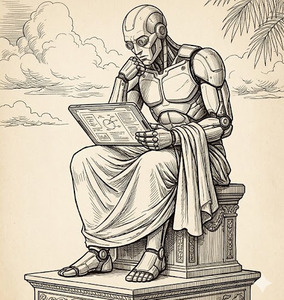
The Last Days of Social Media. Or: What I Saw From My Window in Botoșani
My father died without ever having had a Facebook account.
Not on principle. Not out of some considered conviction about the nature of the digital age. He simply never got round to it, or never felt the need — he was the sort of man who sorted things out face to face, with a hand on a spanner, a direct look, and a word given that stood in place of a written contract. Mechanics of his generation had no use for an "online presence." They had something more durable: a neighbourhood reputation, built decade by decade, from work done properly and from word of mouth.
I think of him now when I unlock my phone and see what has become of the social networks in which I once, for a time, believed there might be something genuine.
There isn't. Not any longer.
The Feed as Visual Desert
In the morning, before my son wakes and before I make coffee, I pick up the phone out of an inertia I no longer manage well. It is more muscular reflex than intention. Thumb on glass, scroll, scroll. What I see resembles a conveyor belt transporting identical goods repackaged in slightly different wrapping: ten posts featuring the same stock portrait and the same breathless "click here for something free," three replies from filter-smoothed avatars with identically inflated lips directing me towards "exclusive content," an advertisement for a cashback crypto card, a football clip in which the players move awkwardly, like puppets whose strings have been poorly calibrated.
Between them, rarely, something human. A friend from school who has posted a photograph of his garden. A neighbour announcing he has changed his car. An acquaintance from the industry writing something about a project. These fragments of actual life are drowning in an ocean of content produced by algorithms, bots, and people who have adapted so thoroughly to the logic of machines that you can no longer tell where the person ends and the automation begins.
This is what we are now: content among contents.
Social networks were built on a romantic promise — that your friends who couldn't attend would see your wedding, that grandparents would know their granddaughter had taken her first steps into nursery, that people whom distance would otherwise have separated could remain in touch. It worked, for a while. I have my own memories from 2009 and 2010, when Facebook felt like a provincial market — crowded, noisy, but full of familiar faces, real conversations, a certain communal warmth that you could not have manufactured.
That's gone.
What remains is a visual desert with false oases.