


The Digital Mirror
It was a Thursday evening when I understood, with quiet unease, that TikTok knows me better than I know myself. 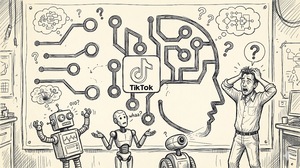 I was scrolling absently, hollowed out after a long day, when a video appeared about burnout in the creative industries. I had never once searched for that subject on the platform. I didn't follow anyone who talked about mental health. And yet the algorithm knew. It had registered that in recent days I'd been lingering on cat videos — my digital refuge when the world presses too close. It had noticed how I skipped past aggressive motivational content without pausing, but stopped at origami tutorials. Somewhere within its vast matrix of data, a map of my inner state was taking shape — one I hadn't consciously charted myself.
That feeling of being seen by an algorithm raises questions that cut deep. When a platform becomes so attuned to our emotional needs that it anticipates desires we haven't yet articulated, where does usefulness end and addiction begin?
The Anatomy of the Algorithm — How It Learns to Know Us
The First Encounter
The TikTok algorithm is, in essence, a learning system that evolves alongside us. In those first moments of interaction, the platform casts a wide net, testing the waters of our preferences with a calculated diversity of content. It is rather like a first conversation with a stranger — polite, exploratory, unburdened by assumption.
In this phase, every gesture counts. Watching a video to the end signals interest. A rapid scroll communicates indifference. A replay suggests fascination. The algorithm catalogues each micro-decision, assembling the first rough sketches of our digital profile. It is a subtle dance of revelation and discovery — one in which we believe we are exploring the platform, whilst all along it is quietly exploring us.
The Refinement of Taste
As interactions accumulate, the algorithm begins to detect patterns. Not merely in the broad categories — comedy, education, lifestyle — but in the fine grain of our preferences. It may observe that we prefer absurdist humour at weekends but gravitate towards educational content on Monday mornings. That we linger over animal videos when it is raining outside. That we have a weakness for acoustic covers of nineties songs, though only when sung by women.
This granularity of understanding transforms the algorithm from a simple recommendation engine into a kind of digital companion — one that seems to intuit not only what we wish to see, but why we need to see it at that precise moment.
The Language of Microgestures
Beyond obvious metrics such as watch time, TikTok analyses an entire symphony of microgestures. The speed of our scrolling communicates our state of mind — quick and restless when we are agitated, slow and contemplative when we are seeking quiet. The time of day we open the app, the length of our sessions, the frequency of our pauses: all of this becomes data, feeding an ever more nuanced understanding of our behaviour.
A recent study from MIT demonstrated that the algorithm can detect shifts in users' emotional states with an accuracy of 73 per cent, drawing solely on patterns of interaction. It is a form of digital mind-reading that goes well beyond predicting content preferences.
From a Generic "For You" to an Intimate One
The transition from a generic feed to a deeply personalised one unfolds gradually, almost imperceptibly. In the first weeks, the "For You" page reflects the platform's general currents, with occasional insertions based on detected preferences. But as data accumulates, the balance shifts dramatically.
After roughly eight hours of active use, the algorithm reaches what researchers call the "personalisation inflection point" — the moment at which recommendations become more about the individual than about general trends. The feed transforms into a digital mirror reflecting not only our declared interests but our unconscious desires, our unspoken anxieties, our secret aspirations.
The Neurochemistry of Engagement
The Dopamine Circuit
To understand how an application can become so consuming, we must look beyond the interface and into the brain itself. TikTok, perhaps more than any other social platform, has perfected the art of stimulating our neurological reward systems.
Every swipe is a pull on the digital slot machine. Unlike a predictable chronological feed, the algorithmic nature of TikTok introduces an element of surprise — precisely the mechanism that most powerfully triggers dopamine release. Neuroscientists call this phenomenon variable ratio reinforcement, the same mechanism that makes gambling so difficult to walk away from.
Dr Anna Lembke of Stanford has put it plainly: "Our brains are not built for this level of constant stimulation. When dopamine is repeatedly released in response to digital stimuli, the receptors become desensitised — they require ever larger doses to produce the same effect." It is a cycle that closely resembles the tolerance developed in classical addiction.
The Gambling Parallel
The comparison with gambling is no accident. Both exploit the same cognitive vulnerability: our inability to resist unpredictable rewards. In a casino, you never know when you'll win. On TikTok, you never know when you'll encounter the perfect video — the one that makes you laugh out loud, or cry, or feel as though something essential about your own life has just been articulated.
This unpredictability is amplified by the brevity of the videos themselves. In fifteen to sixty seconds, the brain processes a complete narrative, receives a dose of satisfaction or disappointment, and is immediately primed for the next one. It is a rhythm that far exceeds the brain's natural capacity to process and integrate information.
Recent Research on Neurological Change
Longitudinal studies are beginning to reveal the profound impact of intensive platform use. A 2024 study published in the Journal of Behavioral Addictions followed 500 users over eighteen months, using MRI imaging to observe changes in brain structure.
The results were striking: users who spent more than three hours daily on the platform showed a significant reduction in grey matter in the prefrontal cortex — the region responsible for self-control and decision-making. At the same time, hyperactivity was observed in the nucleus accumbens, the brain's reward centre.
Dr Michael Chen, the study's lead author, was careful: "We don't see these changes in moderate users. There appears to be a critical threshold beyond which use shifts from benign to potentially problematic."
Digital Flow State vs. Genuine Addiction
It is important to distinguish between flow — that pleasurable immersion in an activity that absorbs us completely — and authentic addiction. Digital flow can be a genuinely positive experience: we discover educational content, connect with communities that matter to us, find creative inspiration.
The crucial difference lies in control and consequence. In flow, we choose to remain engaged because the experience is enriching. In addiction, we continue scrolling even when the experience turns negative — when it interferes with our responsibilities, when we feel worse after closing the app than we did before opening it.
The Evolution of Demand — From Entertainment to Necessity
Phase One: Initial Curiosity
"I'm just having a quick look to see what it's about." That is how it begins for most users. TikTok arrives as a cultural curiosity — the platform everyone is talking about. Those first interactions are exploratory, detached. We laugh at viral videos, perhaps save an interesting recipe. It is a casual relationship, free of expectation or commitment.
At this stage, the brain processes TikTok as it would any novelty. The reward system responds, but within normal parameters. We can close the app without difficulty and often forget to reopen it for days at a time.
Phase Two: Pleasant Habit
Gradually, TikTok becomes part of the daily routine. It might begin as a post-dinner ritual, or a way of filling dead time on the bus. The app finds a comfortable place in our digital ecosystem, alongside checking email or reading the news.
At this point, the algorithm has learnt enough about us that its hit rate — the proportion of videos that genuinely captivate — rises considerably. Each session becomes more satisfying than the last. We begin to develop positive expectations of the experience.
Phase Three: Anticipatory Craving
Here something subtly but significantly shifts. We no longer open TikTok only when we have free time; we begin actively creating moments for it. Perhaps we extend our lunch breaks, or delay going to bed with "just ten more minutes."
The brain begins to anticipate the reward. Studies show that at this stage, dopamine levels rise not in the moment of watching, but in anticipation of opening the app. It is the same mechanism that makes the smell of coffee wake us up before the caffeine has entered our bloodstream.
Phase Four: Perceived Necessity
The transition to necessity announces itself through anxiety in the app's absence. Forgetting one's phone at home — once a minor inconvenience — becomes a source of disproportionate stress. It is no longer simply about missing content; it is about losing a reliable source of stimulation and emotional comfort.
At this stage, many users report the phenomenon of phantom scrolling — the automatic movement of the thumb in the scrolling gesture even in the absence of a phone. The body has integrated the gesture at a motor level, much as smokers automatically raise their hand to their mouth.
Phase Five: Behavioural Addiction
In the final phase, TikTok use becomes compulsive and dysfunctional. The characteristics include:
- An inability to limit time spent on the platform, despite negative consequences
- Neglecting responsibilities in order to continue watching
- Withdrawal symptoms when access is restricted — irritability, anxiety, restlessness
- Continued use even when the experience is no longer pleasurable
- Negative impact on relationships, work, or health
It is crucial to note that not every user progresses through all five phases. Many remain at phases two or three, maintaining a relatively healthy relationship with the platform. Genetic predisposition, life stress, social support, and awareness of the risks all influence the individual trajectory.
The Myths and Realities of Digital Addiction
What Is Myth
The myth of direct comparison with substance addiction — Although parallels exist, digital addiction differs fundamentally from substance dependency. There is no external chemical compound directly altering the brain's chemistry. Instead, we are dealing with the exploitation of existing neurological mechanisms. As Dr Rachel Anderson of Harvard clarifies: "It is closer to gambling addiction than to drug addiction. The stimulus is behavioural, not chemical."
The myth of the lost generation — Popular media frequently paints an apocalyptic picture of a generation entirely enslaved to their phones, incapable of authentic human connection. The reality is far more nuanced. Studies consistently show that most young people are perfectly capable of navigating between digital and physical space, developing social competencies in both. What is more, for many people TikTok becomes a space of genuine connection: marginalised communities find representation; young people with social anxiety practise interaction in a less threatening environment; creative individuals find their audience.
The myth of inevitability — Not all intensive users develop an addiction. Protective factors include:
- Satisfying offline activities
- Strong interpersonal relationships
- A sense of purpose and meaning beyond the digital
- Mindfulness practices and self-reflection
- Functional, self-imposed limits
What Is Reality
Measurable shifts in attention patterns — Research confirms that intensive use of short-form video platforms modifies the capacity for sustained attention. An experiment at University College London demonstrated that heavy TikTok users have significantly greater difficulty maintaining focus on tasks lasting more than three minutes. These changes are not permanent — follow-up studies show improvement after periods of digital abstinence — but they are persistent enough to affect academic and professional performance.
The impact on sleep — Perhaps the best-documented negative effect is sleep disruption. It is not simply about the time lost scrolling into the small hours. Blue light suppresses melatonin, but more damagingly, constant cognitive stimulation makes the transition into sleep extremely difficult. Dr Matthew Walker, author of Why We Sleep, puts it well: "The brain needs a period of decompression before sleep. TikTok, with its rapid and relentlessly varied stimulation, is the precise opposite of that necessary winding down."
The amplification of FOMO — Fear of missing out is nothing new, but TikTok has transformed it into an omnipresent force. Unlike traditional platforms, where you can more or less catch up with what you've missed, the algorithmic and temporal nature of TikTok means that every moment of absence represents content lost for ever. This perpetual FOMO generates a constant background hum of anxiety — a form of digital vigilance that never quite permits full disengagement.
The Creator–Consumer Paradox
One of the most fascinating dimensions of the TikTok ecosystem is the way it dissolves the boundary between creator and audience. Unlike traditional media with its clear barriers to entry, TikTok has democratised creation to the point where anyone with a phone can go viral.
This omnipresent possibility fundamentally transforms the nature of consumption. We are no longer passive spectators; we are potential performers. Every video we watch becomes simultaneously entertainment and inspiration, or provocation. I could do that becomes a persistent mental refrain.
The platform actively cultivates this mentality. The creation tools are intuitive, templates proliferate, and the algorithm rewards authenticity over production value. A teenager in their bedroom can compete for attention with professional studios — and frequently wins.
But this democratisation carries a psychological cost. When everyone is a potential creator, everyone becomes a critic. Validation becomes quantifiable — views, likes, shares, followers. For many, particularly young people, these metrics become the barometer of personal worth.
Sarah, nineteen, told me: "I started out just watching, but then I saw a girl my age with a million followers. I thought, why not me? My first video got forty-seven views. My second got twelve. I felt like a complete failure — even though I'd been perfectly happy just watching before."
This cycle of aspiration–creation–disappointment–consumption becomes yet another layer of the platform's addictive potential. We no longer consume purely for pleasure; we consume to learn, to compare, to search for the secret formula of virality. Consumption becomes infected with the anxiety of comparison.
Strategies for Balance — Between Use and Abuse
Applied Digital Minimalism
Cal Newport's concept of digital minimalism offers a valuable framework for navigating our relationship with TikTok. It is not about total elimination; it is about intentional use. Practical strategies include:
Value audits — Ask yourself periodically what genuine value TikTok actually brings to your life. Are you learning new things? Connecting with communities that matter to you? Or are you merely filling pockets of boredom?
Scheduled use — Rather than unlimited, open-ended access, establish specific windows for TikTok. Perhaps thirty minutes after dinner, when you know you need some decompression. Paradoxically, limiting access tends to increase satisfaction — each session becomes more precious.
Periodic digital cleansing — Once a month, take a forty-eight-hour break. Observe what you genuinely miss and what was mere habit. Many people discover that the initial anxiety transforms rapidly into relief and mental clarity.
Mindful Scrolling
Mindfulness, so often associated with meditation, can be applied just as usefully to digital consumption. Practical techniques include:
Regular check-ins — After every ten videos, pause and ask yourself: How do I feel? Why am I continuing to scroll? What am I actually looking for?
The transition breath — Before opening the app, take three conscious breaths. Set an intention — entertainment, learning, connection. When the session ends, repeat the exercise, reflecting on the experience.
Selective engagement — Rather than passive scrolling, choose actively. Save videos to watch later, leave thoughtful comments, follow creators who consistently offer something of value.
Redesigning the Digital Environment
Small frictions can make a significant difference. Environmental strategies worth trying:
- Move the app off your home screen
- Disable notifications
- Use time-tracking apps for honest awareness
- Install apps that block access after a set period
- Leave your phone in another room at night
Mark, a user in recovery of sorts, described his experience: "The biggest change was moving TikTok to a third screen, inside a folder labelled 'Time Wasters'. Just those extra two seconds of navigation were enough to make me pause and ask whether I actually wanted to go in."
A Glimpse of the Future — Quo Vadis, Algorithm?
Extreme Personalisation
The current trajectory suggests a future in which algorithms become even more sophisticated in their capacity to read and anticipate our desires. Integration with wearable technology could allow TikTok to adjust content based on heart-rate variability, stress levels, or even sleep patterns.
Imagine an algorithm that knows you are stressed — from your cardiac data — and automatically serves calming content. Or one that detects sadness and offers precisely the sort of comedy calibrated to your emotional state. It is a prospect simultaneously thrilling and deeply unsettling.
Ethical Implications
As these systems grow in power, the ethical questions become more pressing. Who decides what is "good" for us? How do we balance personalisation with exposure to diversity? Is there a point at which algorithmic intimacy becomes manipulation?
The European Union has begun to address these questions through the Digital Services Act, requiring greater transparency in how algorithms operate. But regulation continues to struggle to keep pace with technological innovation.
The Necessity of a Conscious Digital Diet
Just as we have learnt to think about nutrition and physical exercise, the future will require a similar literacy about what we might call digital nourishment. Schools in Finland have already begun teaching digital wellness as part of their curriculum.
The concept of a "digital diet" is not about drastic restriction — it is about conscious consumption. Like a balanced physical diet, it might include:
- Digital proteins — educational and developmental content
- Digital carbohydrates — entertainment for a quick energy boost
- Digital vitamins — genuine social connection
- Digital junk food — mindless content, perfectly acceptable in moderation
A Reflective Closing
I return to that Thursday evening, when the algorithm served me the burnout video. Looking back, I understand now that it was not telepathy. It was a reflection of the thousands of micro-decisions I had made in the digital space — every pause, every replay, every restless scroll contributing to an ever more detailed map of my inner life.
That realisation does not diminish the power of the experience. If anything, it sharpens our sense of the complexity of our relationship with these systems. TikTok, like so many transformative technologies, is neither saviour nor destroyer. It is an extraordinarily powerful tool that amplifies our existing tendencies — towards connection or isolation, towards growth or stagnation, towards conscious consumption or compulsive spiral.
The question is not whether TikTok addiction is myth or reality. For some, it is profoundly real, with measurable consequences for wellbeing. For others, the platform remains a space of expression, learning, and community. Most of us navigate somewhere between those poles — in the grey zone of use that is problematic but not pathological, pleasure entangled with discomfort, genuine value shadowed by wasted time.
Perhaps the more important question to sit with is not whether TikTok creates addiction, but what that potential addiction reveals about ourselves. In an ever more fragmented, ever faster, ever more demanding world, what voids are we trying to fill with the infinite scroll? What fundamental needs remain unmet in our offline lives, leaving us vulnerable to algorithmic seduction?
I invite every reader to examine their own relationship with the algorithm — not with judgement or self-criticism, but with the gentle curiosity of an anthropologist studying their own culture. Observe the patterns. Notice the feelings. Experiment with limits. And perhaps most importantly, remember that behind every swipe lies a choice — small, nearly imperceptible, but yours.
In the end, the power lies neither in the technology, nor in regulation, nor in any external solution. It lies in our profoundly human capacity to observe, to understand, and to choose. In every moment that we become aware of our digital automatisms, we reclaim a fragment of autonomy. And perhaps, step by step, swipe by swipe, we can learn to dance with the algorithm without losing ourselves in its hypnotic music.
Questions and Answers
Eloquent responses drawn directly from the substance of the article.
1. How does the TikTok algorithm function in the first moments of interaction?
In the initial phase, the algorithm casts a wide net, testing the user's preferences through a carefully calculated diversity of content. Every gesture — a video watched to the end, a rapid scroll, a replay — becomes a catalogued signal. The user believes they are exploring the platform; in reality, the platform is exploring them.
2. What are digital microgestures and what information do they yield?
Microgestures are subtle behavioural signals: the speed of scrolling communicates mood; the time of day we open the app indicates emotional context; the frequency of pauses suggests level of concentration. An MIT study demonstrated that the algorithm can detect shifts in users' emotional states with 73 per cent accuracy, drawing solely on these patterns of interaction.
3. What is the "personalisation inflection point" and when does it occur?
It is the moment at which the "For You" feed shifts from reflecting the platform's general trends to mirroring the individual. Researchers have placed it at approximately eight hours of active use. From that point onwards, recommendations no longer follow what is popular but pursue the specific user's unconscious desires, unspoken anxieties, and secret aspirations.
4. Why is TikTok compared to gambling from a neurological perspective?
Both exploit the mechanism of variable ratio reinforcement — the brain's inability to resist unpredictable rewards. In a casino, you never know when you'll win; on TikTok, you never know when the video that will move you deeply will appear. This unpredictability triggers the most powerful dopamine release, creating a cycle that closely resembles the tolerance developed in classical addictions.
5. What did the 2024 study published in the Journal of Behavioral Addictions reveal about the brain?
The study followed 500 users over eighteen months using MRI imaging and found that those spending more than three hours daily on the platform showed a significant reduction in grey matter in the prefrontal cortex — the region governing self-control and decision-making — alongside hyperactivity in the nucleus accumbens, the brain's reward centre.
6. What is the essential difference between a "digital flow state" and genuine addiction?
The difference lies in control and consequence. In flow, the user chooses to remain engaged because the experience is enriching. In addiction, they continue scrolling even when the experience turns negative, when it interferes with responsibilities, when they feel worse after closing the app. Flow implies autonomy; addiction implies compulsion.
7. What are the five phases through which a user's relationship with TikTok evolves?
Phase One — Initial curiosity: detached exploration; the app can be ignored for days. Phase Two — Pleasant habit: it becomes a daily ritual; the hit rate of sessions rises. Phase Three — Anticipatory craving: the user actively creates moments for the app; dopamine rises in anticipation of opening it, not in the act of watching. Phase Four — Perceived necessity: anxiety in absence; phantom scrolling appears — the unconscious scrolling gesture performed without a phone. Phase Five — Behavioural addiction: compulsive and dysfunctional use, with withdrawal symptoms and neglect of responsibilities.
8. What is phantom scrolling and what does it signify neurologically?
It is the automatic movement of the thumb in the scrolling gesture even in the absence of a phone. The body has integrated the gesture at a motor level, much as smokers automatically raise their hand to their mouth. It signifies that digital behaviour has descended from the conscious to the reflexive — indicating a deep, and potentially problematic, integration of the gesture into the user's neurological architecture.
9. What myths surround TikTok addiction?
Three principal myths: The myth of direct comparison with drugs — digital addiction involves no external chemical substances, only the exploitation of existing neurological mechanisms (it is closer to gambling addiction). The myth of the lost generation — the majority of young people navigate functionally between digital and physical worlds; for marginalised communities, TikTok can be a space of authentic connection. The myth of inevitability — not all intensive users develop addiction; genuine protective factors exist.
10. What are the protective factors against TikTok addiction?
The article identifies: satisfying offline activities, strong interpersonal relationships, a sense of purpose and meaning beyond the digital, mindfulness practices and self-reflection, and functional self-imposed limits. Genetic predisposition, levels of life stress, and social support also shape each user's individual trajectory.
11. How does TikTok affect the capacity for sustained attention?
An experiment at University College London demonstrated that heavy TikTok users have significantly greater difficulty maintaining attention on tasks lasting more than three minutes. These changes are not permanent — follow-up studies show improvement after periods of digital abstinence — but they are persistent enough to affect both academic and professional performance.
12. Why does TikTok disrupt sleep more profoundly than other technologies?
It is not only the blue light suppressing melatonin. More damagingly, the constant rapid cognitive stimulation prevents the natural transition into sleep. Dr Matthew Walker, author of Why We Sleep, notes that the brain requires a period of decompression before sleep — and TikTok, with its fast-moving and endlessly varied stimulation, is the very antithesis of that necessary winding down.
13. What is amplified FOMO and why does TikTok intensify it more than other platforms?
Unlike traditional platforms where you can more or less catch up with what you've missed, the algorithmic and temporal nature of TikTok means that every moment of absence represents unique content lost for ever. This perpetual FOMO generates a constant background anxiety — not an episodic unease but a structural one, woven into the fabric of daily life — a form of digital vigilance that never fully permits disengagement.
14. What is the creator–consumer paradox on TikTok?
TikTok democratises creation at an unprecedented level — anyone with a phone can go viral. This transforms every video watched into entertainment, but also into inspiration or challenge. Yet when everyone is a potential creator, everyone also becomes a critic; validation becomes quantifiable in views, likes, and followers. For many, these metrics become the barometer of personal worth — adding an additional psychological layer to the platform's addictive potential.
15. How does the article describe the aspiration–creation–disappointment cycle?
The user observes a creator of similar age achieving massive success and wonders why not them. They produce content, receive minimal views, feel like a failure — despite having been perfectly content as a viewer beforehand. Disappointed, they return to consumption, but now with a different gaze: no longer seeking pleasure, but the secret formula of virality. Consumption becomes infected with the anxiety of comparison.
16. What does Cal Newport's digital minimalism propose when applied to TikTok?
Not total elimination, but intentional use. Practical approaches: periodic value audits (what does this platform genuinely bring to my life?), scheduled use within specific time windows (paradoxically, limiting access increases satisfaction), and monthly forty-eight-hour digital cleanses — during which many users discover that initial anxiety rapidly gives way to relief and mental clarity.
17. What is mindful scrolling and how is it applied in practice?
It involves applying mindfulness principles to digital consumption. In practice: check-ins after every ten videos — how do I feel, why am I continuing? A transition breath before opening the app, setting a clear intention (entertainment, learning, connection). Selective engagement rather than passive scrolling: save videos, leave thoughtful comments, follow creators who consistently offer something of value.
18. What is a "digital diet" and how does it resemble physical nutrition?
The concept involves not drastic restriction, but conscious consumption. The article proposes the analogy: digital proteins — educational content; digital carbohydrates — entertainment for a quick energy boost; digital vitamins — genuine social connection; digital junk food — mindless content, acceptable in moderation. Schools in Finland have already begun teaching digital wellness as part of their curriculum.
19. What does the future integration of TikTok with wearables imply?
Algorithms will be able to adjust content based on heart rate, stress levels, or sleep patterns. An algorithm that detects you are stressed and automatically serves calming content, or that identifies sadness and offers comedy calibrated to your emotional state. A prospect simultaneously fascinating and unsettling — raising the fundamental ethical question: who decides what is "good" for us?
20. What is the philosophical conclusion of the article on TikTok addiction — myth or reality?
Addiction is neither purely myth nor universal reality. For some, it is profoundly real, with measurable consequences. For others, the platform remains a space of expression and community. The vast majority of us navigate the grey zone — use that is problematic but not pathological. The deeper question the article points towards is not whether TikTok creates addiction, but what unfulfilled voids in our offline lives make us vulnerable to algorithmic seduction. The power lies not in the technology or in regulation, but in our human capacity to observe, understand, and choose — swipe by swipe.
The twenty questions are calibrated for active retention: each answer contains a precise factual core — figures, authors, studies, mechanisms — alongside a conceptual key that makes the information anchor itself rather than slip away.