


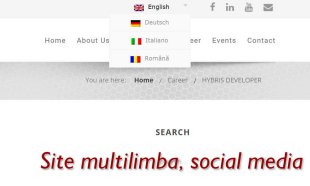
When Your Business Speaks Only One Language. There is a scene I have witnessed enough times in my work to know it is not a coincidence, not an anomaly, not something that happens to other people's websites. Someone arrives on a page. They look at it — genuinely look, as people do when something catches their eye — and then they leave. Not because the product fails to interest them. Not because the price is unreasonable. They leave because they do not understand what they are reading. Or, more precisely, they leave because they have understood exactly one thing: that this page was not made for them.
Language is not merely a vehicle for information. At some deeper level, language is a form of recognition. When you address someone in their own tongue, you are telling them, before anything else: I know you are there. I anticipated you. I prepared something with you in mind. When you do not — and this is the part we most consistently overlook — you are not transmitting neutrality. You are transmitting exclusion.
A website available exclusively in Romanian is, from the perspective of a potential client in Germany, Italy, or Hungary, precisely what a website available exclusively in Finnish would be for you. You can sense that it sells something. You can see the photographs, note the telephone number, register that a human being exists somewhere behind the page. But you cannot buy. You cannot enquire. You cannot, in any meaningful sense, engage.
And yet the resistance to translation persists. I have heard it in dozens of conversations with owners of small and medium-sized businesses across north-eastern Romania. My clients are all from here. We don't export. We have no foreign partners. What would be the point? The answer to these questions is not simple, and I have no interest in pretending otherwise. But it exists, and it deserves to be set out carefully.
The Myth of the Local Audience
The first objection — the most honest one, I think — is that the target market is local. Botoșani. Suceava. Iași. Why should it matter that a Danish visitor cannot read the site?
The answer has several layers, and not all of them are immediately visible.
The first layer: the diaspora. Romania currently has several million citizens living and working abroad. Many of them shop from home — gifts, family services, products they cannot find where they are. A site in Romanian is accessible to them, certainly. But a site in Romanian and Italian or Spanish — the languages many of them inhabit every single day — speaks to them twice over. It speaks both to where they come from and to where they have arrived.
The second layer: business partnerships. Even if you sell exclusively on the domestic market, you may well have suppliers, distributors, or collaborators who do not speak Romanian. A bilingual site in Romanian and English is not, at this level, an international marketing strategy. It is a functional business card. An elementary instrument of professional communication.
The third layer — and this, perhaps, is the subtlest — is the perception of competence. There are studies confirming what most of us would intuit if we paused to think about it: a website available in multiple languages is perceived, almost automatically, as belonging to a more serious, more stable, more trustworthy business. Not because the languages themselves add real competence — but because they add signals of competence. And in the attention economy of the digital world, signals carry enormous weight.
What Translation Actually Means — and What It Does Not
Something needs to be established from the outset, because this particular confusion costs more than most people realise: translating a website does not mean pasting your text into Google Translate and copying the output onto new pages.
I have seen enough examples of automatically translated sites, with no human review whatsoever, to know exactly what they do. They distort. Not merely grammatically — though they do that, systematically — but in register, in tone, in the quiet texture of meaning. A text written in Romanian with a particular dry wit, a rhythm specific to the north-east of Moldova, will emerge from automatic translation as something robotic and rigid, a thing that no longer resembles what it set out to be.
And here a paradox arises: a poorly translated site does more damage than an untranslated one. At least the untranslated site is honest about its limitations. The poorly translated site communicates something worse — that you care so little for your customer that you would hand them a text you yourself would not read.
There is a distinction that professionals in communication make consistently and that those of us who build websites for small businesses ignore far too readily: the distinction between translation and localisation. Translation moves words from one language to another. Localisation moves meaning, tone, and cultural context from one world to another.
Localisation means that the date is no longer written as day/month/year if you are addressing an American. It means that currency and units of measurement change. It means that a photograph of two people shaking hands — a perfectly natural gesture in Romanian business culture — may carry different connotations elsewhere. It means that an ironic headline in Romanian may fall completely flat in a literal English rendering, because irony operates differently across cultures.
Not everyone requires full localisation. But everyone needs to understand the distinction. And to make a conscious decision — not to stumble into one by accident.
The Numbers Nobody Tells You
There are several statistics that circulate in the relevant literature, and I have verified them across multiple sources before citing them here — not because I am fond of numbers for their own sake, but because sometimes reality requires a figure before it becomes visible.
According to CSA Research — one of the most frequently cited institutes in the field of digital localisation — 72.4% of consumers are more likely to purchase when product information is available in their own language. Not 20 per cent. Not 30. Nearly three quarters.
The same body of research shows that 60% of shoppers rarely or never buy from English-only websites — and this is speaking about the most widely used language on the internet. Extend the logic: if English, with all its global reach and prestige, loses 60% of non-native buyers, what does Romanian do with visitors who do not speak it?
Multilingual websites record, on average, a conversion rate increase of approximately 70% compared to their monolingual equivalents. This is not a mathematical guarantee. It is a documented tendency, with variation depending on industry and target audience. But the order of magnitude is consistent: we are talking about a significant impact, not a marginal one.
Companies that have made the transition to multilingual sites have experienced an increase in sales of at least 25%, with some websites seeing a 70% increase.
96% of companies that invested in localisation reported a positive return on investment, with 65% seeing at least a threefold return on what they spent.
The question, at this point, is no longer whether investing in translation is worthwhile. It is how much longer you can afford to wait.
The SEO Argument — The Most Overlooked Case of All
If the arguments above feel too abstract or too distant from your immediate reality, allow me to offer one that is concrete, technical, and verifiable in Google Search Console within a few months of implementation.
Search engines index every page on your website. When you have versions in multiple languages — built correctly, with hreflang tags, with URLs structured across subdomains or subdirectories — you are, in effect, creating an entirely new set of indexable pages. Each translated page is a new entry in the search engine, capable of appearing in results for users searching in that language.
If you sell, say, handcrafted solid-wood furniture, and you have a page in Romanian, another in English, and another in German, your site can appear in Google.ro, Google.co.uk, and Google.de — simultaneously. Without additional advertising campaigns. Without extra marketing expenditure. Simply because you are visible in the places where people are searching.
Successful localisation efforts are associated with 20% higher conversion rates, 47% increases in search traffic, and up to 3x ROI within the first year.
The reverse also holds: sites that are partially or technically incorrectly translated can be penalised. A page with incorrectly configured hreflang tags may be ignored by Google or, worse, treated as duplicate content. Translation must therefore always be accompanied by a minimum of technical configuration.
The simple principle: each language added correctly to your website is a new channel of organic traffic. Free, once it has been implemented.
The Mistakes Everyone Makes — and Why They Persist
I have noticed that the mistakes associated with website translation are not, in general, mistakes of ignorance. They are mistakes of psychology. Of comfort. Of structured postponement.
The first mistake: partial translation. Half the site is in Romanian, half in English. The home page has been translated, but the contact page has not. The products carry bilingual descriptions, but the returns policy exists only in Romanian. The result is incoherent. A user who arrives expecting English content will encounter, at some point, a paragraph they cannot read. They will leave. And they will leave more confused than if there had been no translation at all.
The second mistake: neglecting metadata. The page title, the meta description, the alternative text of images — all of these are, from a search engine's perspective, as important as the visible text. A site with translated content but Romanian metadata will not be correctly indexed for searches in the translated language. It is rather like putting up a bilingual sign on the door whilst keeping all the contractual documentation in a single language.
The third mistake: updating the Romanian version and forgetting the others. This is probably the most common, and the most insidious. At launch, the site is fully translated. Coherent and complete. Three months later, a new product is added. The description is written in Romanian. The English version is forgotten. Two months after that, another addition. Again, only in Romanian. Gradually, the English version becomes a museum of the launch moment — a photograph that no longer corresponds to any present reality.
The fourth mistake: translation without cultural adaptation. Humour, irony, local references, proverbs — these are products of a specific cultural context. They function within it. Exported without adaptation, they become, at best, opaque. At worst, inadvertently offensive.
Choosing Which Language to Translate Into
There is no universal answer to this question, and anyone who claims otherwise is either selling something or simplifying beyond usefulness. The choice of languages must be a strategic decision, not an emotional one.
English is, in almost every case, the logical first step — not because it is the world's most widely spoken native language (it is not), but because it is the lingua franca of international business. If a partner from anywhere in the world wants to find out about you, they will search in English first.
Translating your website into the following eight languages allows you to reach 80% of global online purchasing power: English, Chinese, Japanese, Spanish, German, French, Portuguese, and Italian.
For Romanian businesses specifically, there are additional considerations. The Romanian diaspora in Italy and Spain is substantial. If your products or services might appeal to this population, Italian and Spanish are not exotic choices — they are direct lines of communication with an audience already predisposed to engage.
German is particularly relevant for technical, industrial, and construction business partnerships. Many suppliers and partners from the German-speaking world prefer documentation in German, even when they also speak English.
The guiding criterion is this: who are your current clients, and who might become clients if the language barrier were removed? The answer to that question indicates the languages.
The Correct Process — From Decision to Implementation
Assuming the case for translation has been made, the practical question becomes: how does one proceed? There are several steps I recommend consistently — not as a rigid formula, but as a logical order.
Step one: content audit. You do not translate everything. Before anything else, you identify the pages that merit translation — those that deliver real value to a visitor: the home page, service or product pages, the about page, the contact page. The blog can be translated selectively or not at all, depending on its relevance.
Step two: choosing the method. A human translator remains the quality standard. It is more expensive and slower, but it is the only method that guarantees cultural coherence. AI tools — DeepL, Google Translate — are useful as a starting point or for high-volume, low-stakes content. The current optimal combination is: high-quality automatic translation (DeepL, particularly) followed by human review from a native speaker. The cost is lower than full human translation; the quality is significantly higher than unreviewed automatic translation.
Step three: technical configuration. Subdirectory (site.ro/en/), subdomain (en.site.ro), or separate domain (site.com) — each option carries advantages and disadvantages from an SEO and maintenance perspective. The subdirectory is generally recommended for small and medium-sized sites, as it keeps domain authority consolidated. The hreflang tags are non-negotiable — they instruct search engines that a page exists in another language and what the relationship between the versions is.
Step four: editorial synchronisation. A clear protocol is established: any new content published in Romanian is assigned a realistic deadline for the translated version. Not perfectionist, not perpetually deferred — a deadline that is actually met.
Translation as Investment, Not Expenditure
The final resistance, and the most tenacious, is economic. It costs. I do not know whether it is worth it.
I understand this. And I have no wish to minimise the reality that professional translation carries a genuine cost. But there is a straightforward calculation worth making together.
How many international visitors does your website receive at present? How many of them leave without engaging, simply because they cannot understand the content? How many potential clients have gone instead to a competitor who spoke their language?
The opportunity cost of not translating is invisible by its very nature — it appears in no report, no lost client ever rings to explain why they chose someone else. But it is there, consistent and silent, week after week.
The initial investment in translation — whether a few hundred pounds for a straightforward presentation site or considerably more for an e-commerce operation with an extensive catalogue — amortises over time through additional organic traffic, improved conversions, and partners who perceive you as a serious interlocutor. It is not a marketing expense. It is digital infrastructure.
Businesses that localise content can see returns on investment of up to 345%, and the International Data Corporation notes that businesses investing in localisation are 1.5 times more likely to gain market share compared to those that do not.
The Question You Need to Ask Yourself
I have written all of this in order to arrive, in the end, at a single simple question. Not a rhetorical trick. Not a trap. A genuine question, directed honestly at you:
How many people visited your website today, failed to understand what you were offering, and left without your ever knowing?
You do not know. I do not know for you. Nobody knows with precision. But if your website is available exclusively in Romanian, and if there are people in the world who might buy what you sell — and there are, almost certainly there are — then the answer is not zero.
Translation is not the cure for everything in digital business. It will not rescue a weak product, a poorly communicated offer, or a broken user experience. But for a business that knows what it does and wants to be understood by as many people as possible, translation is the simplest and most consistently underestimated step forward.
Questions and Answers
For Reference
1. Why does an untranslated site communicate exclusion rather than neutrality? Because the absence of the visitor's language signals implicitly that they were not considered — not that there is no preference, but that they were simply not thought about at all.
2. What percentage of consumers prefer to purchase in their native language? Approximately 72–76%, according to CSA Research, the most frequently cited study in the localisation industry.
3. What is the difference between translation and localisation? Translation moves words from one language to another. Localisation adapts meaning, tone, cultural references, and visual elements to suit the cultural context of the target market.
4. Why does a poorly translated site do more damage than an untranslated one? Because it communicates negligence towards the user — it signals that the intention to communicate exists, but without genuine effort or care.
5. What is hreflang and why is it essential? It is an HTML attribute that instructs search engines that language variants of a page exist and defines the relationship between them. Without it, translated versions may be treated as duplicate content.
6. What are the three URL structures for multilingual websites? Subdomain (en.site.ro), subdirectory (site.ro/en/), and separate domain (site.com). The subdirectory is generally recommended for small and medium-sized sites to maintain consolidated domain authority.
7. Why is the Romanian diaspora relevant to the translation argument? Millions of Romanians in Italy, Spain, and Germany live their daily lives in another language. A site in Italian or Spanish speaks to them directly — bridging both where they came from and where they now are.
8. What is the opportunity cost of not translating? The potential clients lost due to the language barrier — invisible in reports, but entirely real in their economic impact.
9. What percentage of websites globally are multilingual? Approximately 5%, which means the decision to translate places a business immediately within a minority with a significant competitive advantage.
10. What translation methods exist and how are they best combined? Full human translation (the quality standard), automatic translation (DeepL, Google Translate — fast and inexpensive but imperfect), and the current optimal approach: high-quality automatic translation combined with native-speaker human review.
11. What is editorial synchronisation in the context of a multilingual site? The protocol by which any new content published in the primary language is assigned a clear deadline for its translated version — preventing the gradual drift between language versions.
12. How does a multilingual site affect brand perception? A site available in multiple languages is perceived as belonging to a more professional, more stable, and more trustworthy business — regardless of the company's actual size.
13. Why is partial translation more dangerous than no translation? It creates an incoherent experience: a user operating under a linguistic expectation encounters, mid-journey, content they cannot read. They leave more confused than they would have been had the barrier been clear from the outset.
14. How does translation affect the bounce rate? A site a visitor cannot understand generates a high bounce rate — users leave quickly, signalling to search engines that the page is not relevant to the query that brought them there.
15. What is the most overlooked technical argument in favour of translation? International SEO: each correctly translated page becomes a new entry, indexable by search engines in that language — additional organic traffic with no incremental advertising cost.
16. Why is English alone insufficient in every context? 60% of non-native buyers rarely purchase from English-only sites. Depending on the target market, German, Italian, or Spanish may be considerably more relevant.
17. What non-textual elements require localisation? Images, cultural symbols, date and time formats, currencies, units of measurement, colours with culture-specific significance, and sometimes even the informational architecture of the page itself.
18. How is the ROI of a translated site measured? Through growth in organic traffic from target markets; conversion rates compared by language; sales growth in regions covered by the new languages; and a reduction in bounce rates on translated pages.
19. What role does localisation play in customer loyalty? 94% of customers feel more loyal to brands that provide content in their own language — localisation creates a sense of being recognised and considered as an individual.
20. What is the most concrete first step for an owner wanting to translate their site? A content audit: identifying the priority pages that merit translation — not the entire site at once, but in layers, beginning with the highest-impact pages: home, services or products, contact.
Author's Note
On Limits, Tensions, Comparisons, and Rhetorical Instruments
I write this note with a particular awkwardness I have no intention of concealing. There is something faintly absurd about composing an essay on translation — on how words must cross a linguistic border and remain alive on the other side — without acknowledging that the text itself has its own limits of passage. The Romanian version of this piece has its own specific gravity, its own rhythm shaped by the north-east, its particular way of sitting with silence before making an argument. This English version is not a translation of that piece. It is a parallel construction — the same house, built in different materials.
On limits. This article is written from a practical perspective, oriented towards small and medium-sized businesses. Through that choice — deliberate, not accidental — I have sacrificed nuances that deserved more space. I have not addressed literary translation, where the stakes are entirely different. I have not gone into the technical specifics of individual CMS platforms — Joomla, WordPress, Shopify — each with its own ecosystem of multilingual plugins. I have not treated the case of institutional websites — local councils, hospitals, schools — which carry different legal obligations with respect to linguistic accessibility. These omissions are not accidental gaps; they are the consequence of having chosen a target audience, and of having the honesty to stay within that choice rather than pretend to encompass everything.
On tensions. There is a fundamental tension at the heart of this subject that I felt throughout the writing and did not entirely resolve. It is the tension between the economic argument — translation brings customers, therefore it is worthwhile — and the ethical argument, deeper and harder to instrumentalise: to address someone in their own language is a form of respect, not a strategy. I chose to build the economic case because it is more immediately actionable in the context of a business article. But I cannot close this note without acknowledging that behind the statistics and the conversion rates, there is something simpler and older: the human desire to be understood in one's own language. This needs no validation through percentages.
There is a further tension, which an attentive reader will have noticed: the tension between the appeal to professional translation and the economic reality of many small business owners who simply do not have the budget for a native-speaker translator, human review, hreflang configuration, and everything else that follows. I have tried to offer an alternative — the automated translation plus review combination — but I know that even this has a cost. I have no perfect solution to this tension. I have only the honesty to name it rather than paper over it with optimism.
On comparisons. I used comparisons at several points to render the abstract visible. The comparison with the Finnish-language website — which a Romanian speaker cannot read — is designed to produce empathy through analogy: to place you in the position of the visitor who does not understand, rather than in the position of the business owner wondering whether the effort is worth it. It is a classic perspective-shift, used consciously rather than for ornament.
The comparison with infrastructure — translation is infrastructure, not a marketing expense — is a deliberate mental reclassification. Infrastructure is not questioned; it simply is. If translation can be moved, mentally, from the category of optional costs into that of basic equipment, the decision to implement it becomes considerably easier to make. I am aware this is a rhetorical manoeuvre. Any reader who wishes to flag it is welcome to do so.
On rhetorical instruments. The article employs several narrative strategies I want to name explicitly, for the reader interested in composition as well as content.
The final rhetorical question — how many people visited your website today and left without your ever knowing? — is a classic question to which no honest answer is zero. I am not asking something you can dismiss; I am asking something to which the only truthful response is I don't know, but probably more than I think. It is a technique of persuasion through the admission of uncertainty — which, in my experience, is far more effective than certainty.
The statistical accumulation in section four is constructed as a crescendo: I do not deliver all the figures at once, but dose them, each slightly weightier than the last, to produce a cumulative effect of impossible to dismiss. This is standard practice in data journalism, adapted here to an editorial register.
The confessional voice — I have seen enough examples, I have heard it in dozens of conversations — anchors the argument in direct experience rather than abstract authority. It is a choice of rhetorical ethos: I build credibility not from credentials or academic citations but from accumulated field observation. This voice comes naturally to me, perhaps because it is the only voice I actually trust.
One final thing, which the article itself does not say directly: I wrote this with the conviction that translating a website is an act of opening. Not towards algorithms, not towards conversion rates — though these follow. But towards the other person. The one who is there, in another language, and who deserves to understand what you are offering them. Everything else is technical detail.
Bibliography
Primary Research
CSA Research — Can't Read, Won't Buy (2014, 2020) The most extensively cited study in the localisation industry. Surveyed over 8,000 consumers across 29 countries. Key finding: 76% of shoppers would choose a product with a description in their own language when given the choice between two similar products. → csa-research.com
CSA Research — A Practical Guide to Building the ROI for Localization (2025) Demonstrates that many organisations still treat translation and localisation as sunk costs rather than strategic investments. Documents frameworks for measuring localisation ROI. → csa-research.com/Blogs-Events/CSA-in-the-Media/Press-Releases/ROI-for-localization-translation
CSA Research — Ten Post-Localization Trends for 2025 (December 2024) Industry trend analysis covering AI-human hybrid models, ROI accountability, and the evolution of translation quality expectations. → csa-research.com/Portals/0/Documents/2025%20Trends.pdf
Industry Reports and Surveys
DeepL — State of Localization Report (2023/24) Survey of B2B leaders: 96% reported positive ROI from localisation efforts; 65% saw at least a threefold return on investment. → deepl.com
Weglot — Multilingual Website Stats and Localization Trends for 2025 Comprehensive compilation of consumer behaviour data and industry trends. Key figures: 60% of shoppers rarely or never buy from English-only sites; 73% prefer to purchase in their native language; companies transitioning to multilingual sites report at least 25% sales increases. → weglot.com/guides/multilingual-website-stats-and-localization-trends
Nimdzi Research — Language Industry Market Data (2024) Documents the localisation industry reaching $71.7 billion in 2024, projected to reach $75.7 billion in 2025, growing at approximately 7% per year. → nimdzi.com
International Data Corporation (IDC) Businesses investing in localisation are 1.5 times more likely to gain market share compared to those that do not. Cited across multiple industry analyses.
Analytical and Applied Sources
Translated.com — Multilingual Website ROI: A Comprehensive Guide to Revenue Impact and Performance Analysis (2025) Framework for understanding and measuring multilingual website ROI, including KPIs, direct revenue growth analysis, and customer acquisition metrics. → translated.com/resources/multilingual-website-roi-revenue-impact-performance-analysis
Translated.com — E-commerce Localization ROI: Doubling International Revenue (2025) Analysis of localisation impact on e-commerce, including the 76% native language preference figure and 47% customer loyalty increase data. → translated.com/resources/e-commerce-localization-roi-doubling-international-revenue
Phrase.com — Proving Localization ROI: From Cost Centre to Growth Engine (2025) Covers the shift from treating localisation as a cost centre to recognising it as a measurable growth driver. → phrase.com/blog/posts/localization-roi-global-growth/
Lokalise — Measuring the Return on Investment of Localization (2025) Practical guide to the key performance indicators relevant to localisation ROI, including sales, SEO rankings, page views, conversion rates, and social media engagement. → lokalise.com/blog/localization-roi/
Wordminds — How a Full-Service Localisation Partner Drives Global ROI (2025) Summary of conversion-critical research: 72.1%–76% of consumers prefer websites in their native language; 60% of non-English speakers rarely or never buy from English-only sites. → wordminds.com/blog/how-a-full-service-localization-partner-drives-global-roi
Comtec Translations — The Case for Localisation: How to Measure the Impact of Translations by Industry (2025) Includes documented case study: client Achilles (supply chain solutions) saw an 18% traffic increase and a 3.8% reduction in bounce rate following localisation for six new markets. → comtectranslations.co.uk/content-hub
Recite Me — The Importance of Multilingual Websites (2025) User behaviour analysis: 71% of users leave sites they find difficult to use; 81% of users prioritise ease of use over price. → reciteme.com/news/the-importance-of-multilingual-websites/
Emplicit — How Language Impacts Ecommerce Conversion Rates (2025) Documents shopper behaviour and brand loyalty data, including the finding that 94% of customers feel more loyal to brands providing localised content. → emplicit.co/how-language-impacts-ecommerce-conversion-rates/
Localazy — 4 Key Findings That Confirm You Need to Go Multilingual for Global Reach (2024) Language distribution data: 52.1% of web content is in English; Spanish accounts for 5.5%; German for 4.8%. → localazy.com/blog/4-key-findings-multilingual
Redokun — 2025 Translation Industry Trends and Statistics (2025) Compilation including the CSA Research finding that 65% of non-native English speakers prefer content in their native language even when proficient in English. Also documents the translation potential: translating for four key countries (US, China, Japan, Germany) provides access to approximately 50% of worldwide online sales potential. → redokun.com/blog/translation-statistics
Centus — 2025 Localisation and Translation Statistics and Trends (2025) Industry overview drawing on Nimdzi and CSA Research data, including LSP market size analysis and technology adoption trends among translation professionals. → centus.com/blog/localization-statistics-and-trends
Technical Reference
Google Search Central — Internationalisation and Localisation Documentation Official guidance on implementing hreflang tags, URL structures for multilingual sites, and international SEO best practices. → developers.google.com/search/docs/specialty/international
Weglot — 7 Reasons Why Having a Multi-Language Site Benefits Your Business Technical overview including URL structure options, metadata translation requirements, and integration with major CMS platforms. → weglot.com/blog/reasons-why-a-multi-language-site-benefits-your-business