Featured

On selective modernisation, uninstalled bus shelters, and the citizen as spectator of their own governance.

Citizens and... Others!

"A city's infrastructure is not a technical problem. It is a statement of intent towards its citizens." — Street observation, Botoșani, 2026


Citizens and... Others! Yesterday, the mayor of Botoșani municipality, whilst unveiling the new electric busesOn selective modernisation, uninstalled bus shelters, and the citizen as spectator of their own governance. on which the dear citizens of Botoșani will henceforth be able to travel — on routes 101 and 102 only — announced that development is continuing! Routes 101 and 102 were perfectly adequate before, between ourselves! I spent the whole night on tenterhooks [translator's note: the Romanian idiom is "ca pe ace" — literally "as if on needles," equivalent to "on tenterhooks" or "on pins and needles"], kept awake by the World Cup matches, thinking about the journey I would make the following morning. Half past seven. The stop at "La Cornișa" ["The Cornice" — a local landmark name attached to a Chinese goods shop, itself a small marker of post-communist provincial commerce]. A green bus was just pulling away. Smart. New! I decided to take the Number 3 instead. Red. Dusty. It draws up. I climb aboard: the door tied shut with a piece of string, inside — an oven! The ticket: four lei [approximately 80 pence or one US dollar at current exchange rates]. — "Could you put the air conditioning on?" I venture. The driver presses something. The window on the right goes down a little. Inside... a picture of misery! I alight at the "End of Line 1" stop — a thoroughly modern stop, as can be seen from the photograph. A few steps further along, another stop, equally "modernised." "We continue... the non-installation!" That is what the campaign ought to be called. Ahh, if only they'd had a majority on the Local Council [translator's note: the "Consiliul Local" is the municipal deliberative body, directly elected, with authority over service contracts and public expenditure] — what oversight they would have exercised, what penalties they would have written into the service contract, which runs until 2028, what... anything! Forgive me! They do have the majority on the Local Council! Well, they won't be invited to the businessmen's galas! Citizens? Some are pleased (on routes 101 and 102), others...! We continue the non-installation! — Cristian Stăncescu

Featured

I prefer shorter summaries

The cold comes first. Before you see anything, before you read the station's name on the freshly painted sign, the cold finds you — a May evening cold, not the brutal, declarative cold of January, but something more insidious: the cold of a night that has not yet decided whether to become summer. It seeps through the new glass of the waiting room, through the renovated walls still smelling of emulsion paint and institutional ambition. I pull my jacket tighter and watch.

The platform is empty.

Not the emptiness of a station between trains — something more absolute, more settled. The emptiness of a terminus. This is the end of the line, in the most literal administrative sense: a provincial town in the north of Moldova, a town whose railway exists because someone, decades ago, signed a decree. The track stops here. Beyond the buffers, there is only field and the darkening sky above the plain.

The station has been renovated. This must be said, because in Romania it is not a trivial matter. The walls are the colour of a governmental idea about cheerfulness — pale yellow, the yellow of cheap margarine. The floor tiles are large and white and still clean, which means the renovation is recent. The ceiling lights are LED, and they hum slightly, that modern hum which is not quite sound and not quite silence but which occupies the room like a low-grade anxiety. There is NO mural painted on the eastern wall: a locomotive, hills, and something meant to be optimistic, rendered in the municipality's colors. It's not ugly. Effort DOES move you, if you let it.

I sit on a bench and wait for something to happen.

Featured

They waited for the event to pass—for time itself to pass without being consumed by them

A stop at the end of June, ten in the evening.

Project The Last Bus


I hear them before I see them.

Two male voices, that particular tone of men discussing something important out of doors, at the hour when the city cools and conversation becomes wider than the day has permitted. One of them is gesticulating — I can see him now, they have reached a street lamp — his right hand tracing something in the air, an arc, perhaps the route of a bus, perhaps the surface of a solar panel, perhaps simply the magnitude of a number.

Sixty-four, I hear distinctly.

Sixty-four electric buses. This is the project. I have heard it mentioned before — in local news, in the council's Facebook posts, in the queue at the chemist's. A European project, non-reimbursable funds, charging infrastructure, real-time information panels, emissions reduction, complete modernisation of urban transport. The figures are large and round and luminous. Sixty-four.

The two men have stopped exactly beside the shelter, two metres from the concrete plinth with its cable wrapped in black insulating tape. They do not see it, or if they see it, they do not look at it. They look at each other and talk about the future, which in their imagination is already the present: silent buses gliding through streets, passengers with the app on their phones knowing to the second when the next service comes, cleaner air, a more vibrant city.

One of them — the one gesticulating — is a man of perhaps fifty, jacket thrown over his shoulder in the evening heat, tie loosened. He speaks with the conviction of someone who has read the documents, who may even have attended a meeting. The other listens, agrees, asks short questions. Both smile slightly, with the smile of people sharing good news.

Featured

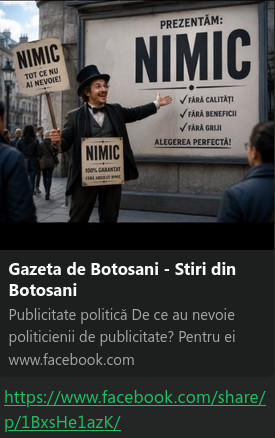
Why Do Politicians Need Advertising?

A Global Reckoning With the Industry of Political Image-Making


There is a question that the Romanian writer Cristian Stăncescu poses three times in a single short text, each repetition heavier than the last: Why do politicians need advertising? He does not ask it once in order to receive an answer. He asks it three times in order to force the reader to feel the full weight of the absurdity. The first iteration is almost naïve — a genuine query about democratic logic. The second is ironic. The third is an accusation. And by the time we reach the end of his text, we understand that the question was never looking for an answer. It was the answer.

Why Do Politicians Need Advertising?That text, born in the context of Botoșani — a city in north-eastern Romania, population roughly 100,000, blessed with history and burdened by the familiar provincial neglect of post-communist governance — turns out to be something far larger than a local editorial grievance. It is a prism. What it refracts, once you hold it up to the light, is a global crisis of democratic legitimacy that researchers, regulators, philosophers and ordinary citizens are wrestling with from Washington to Warsaw, from São Paulo to Seoul.

This essay attempts that refraction. Starting from a local provocation, I want to trace the global architecture of political advertising — what it has become, how much it costs, who benefits, what it conceals, and why, in every democracy that has allowed it to metastasise unchecked, it has done the same damage to the same things: trust, accountability, and the basic social contract between those who govern and those who are governed.


The Democratic Premise and Its Perversion

Representative democracy operates on an elegant and morally satisfying logic: citizens delegate authority to elected representatives, those representatives govern on their behalf, and at the end of a defined term, citizens evaluate the results and decide whether to renew or revoke the mandate. The whole architecture of democratic accountability rests on this feedback loop.

Political advertising, in its modern form, is an instrument designed to interrupt, distort and ultimately short-circuit that loop.

It does so not by lying outright — though it certainly does that — but by replacing the substance of governance with the performance of governance. What matters is no longer what has been built, reformed or protected, but whether the impression of having built, reformed or protected something can be sustained long enough to survive the next electoral cycle. The image supplants the deed. The brand displaces the record.

Featured

A Study in Style — Permission to Decide, or: The Lingering Scar That Doesn't Show

This is not a good piece of reportage, nor a successful literary essay. It is a stylistic exercise that takes a banal local news item — revealing precisely because of its simplicity — and smothers it under layers of literature. Rather than letting the facts and the quotation speak for themselves, the author intervenes obsessively with his own voice, his own metaphors. The result is a text that takes itself very seriously but, on cool analysis, looks more like a selfie than a genuine contribution to understanding Romanian public administration.

The conference room of the Botoșani County Council smells of cold coffee and air conditioning. The natural-wood chairs are upholstered in blue velvet with small stars; the edges are not worn, they look cared for. On the table, a few glasses of water that nobody has touched. Outside, on Cuza Vodă Street, an overloaded lorry rumbles past unlawfully and makes the windows tremble.

Valeriu Iftime is speaking. His statements often seem improvised, assembled more loosely than the standard official communiqué. He circles back to ideas, introduces additional explanation, and talks in a way that feels close to ordinary conversation. He speaks less like a traditional politician and more like an entrepreneur. His sentences are plain, free of bureaucratic padding. He has, in general, no taste for the technical or the academic. He prefers to carry ideas through experience and common sense. In his public remarks you also notice references to people, to community, to responsibility.

This vocabulary belongs more to management than to traditional political rhetoric. If his style could be summed up in a phrase, Valeriu Iftime's manner of speaking might be described as: direct, conversational, pragmatic, results-oriented, shaped strongly by management culture, and relatively light on formal political language. He is not, as a rule, a solemn or ceremonious speaker. He tries to come across as approachable and genuine, even if the expression is sometimes less than rigorous by the standards of rhetoric.

He has been speaking for a while. His is the voice of a man accustomed to occupying a room's acoustic space, to furnishing it with words until silence becomes impossible. The journalists are making notes. Some are filming. Others listen with that particular variety of professional attention that resembles sleeping with one's eyes open.

And then he says something.

He says something that makes one person in the room smile, then another, and suddenly the whole room vibrates with that suppressed, discreet laughter — the kind that anyone who has ever lived inside a system and dared to think for themselves will instantly recognise.

Iftime is telling a story about Cristian Nistor.