


A Global Reckoning With the Industry of Political Image-Making
There is a question that the Romanian writer Cristian Stăncescu poses three times in a single short text, each repetition heavier than the last: Why do politicians need advertising? He does not ask it once in order to receive an answer. He asks it three times in order to force the reader to feel the full weight of the absurdity. The first iteration is almost naïve — a genuine query about democratic logic. The second is ironic. The third is an accusation. And by the time we reach the end of his text, we understand that the question was never looking for an answer. It was the answer.
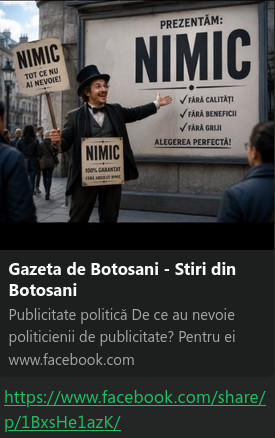 That text, born in the context of Botoșani — a city in north-eastern Romania, population roughly 100,000, blessed with history and burdened by the familiar provincial neglect of post-communist governance — turns out to be something far larger than a local editorial grievance. It is a prism. What it refracts, once you hold it up to the light, is a global crisis of democratic legitimacy that researchers, regulators, philosophers and ordinary citizens are wrestling with from Washington to Warsaw, from São Paulo to Seoul.
This essay attempts that refraction. Starting from a local provocation, I want to trace the global architecture of political advertising — what it has become, how much it costs, who benefits, what it conceals, and why, in every democracy that has allowed it to metastasise unchecked, it has done the same damage to the same things: trust, accountability, and the basic social contract between those who govern and those who are governed.
The Democratic Premise and Its Perversion
Representative democracy operates on an elegant and morally satisfying logic: citizens delegate authority to elected representatives, those representatives govern on their behalf, and at the end of a defined term, citizens evaluate the results and decide whether to renew or revoke the mandate. The whole architecture of democratic accountability rests on this feedback loop.
Political advertising, in its modern form, is an instrument designed to interrupt, distort and ultimately short-circuit that loop.
It does so not by lying outright — though it certainly does that — but by replacing the substance of governance with the performance of governance. What matters is no longer what has been built, reformed or protected, but whether the impression of having built, reformed or protected something can be sustained long enough to survive the next electoral cycle. The image supplants the deed. The brand displaces the record.
Guy Debord diagnosed this pathology with extraordinary precision in The Society of the Spectacle (1967), though he was writing about consumer capitalism rather than electoral politics specifically. His central thesis — that in modern societies, everything that was once directly lived has moved away into a representation — maps onto contemporary political advertising with unsettling accuracy. As commentators on Debord's legacy have noted, in the spectacle, politics is no longer about ideas or governance; it is about optics and narratives. Politicians become brands, campaigns become spectacles, and voters become passive spectators. Debates resemble reality television, where charisma matters more than competence, and the most photogenic candidate tends to outperform the most capable administrator.
This is not an accident. It is the designed output of a multi-billion-pound industry.
The Numbers: How Much Does Political Image Cost?
2024 was what analysts called a "super election year." More than four billion citizens across 74 countries participated in national elections. The scale of democratic participation was historic. So, commensurately, was the scale of political advertising expenditure.
In the United States alone, total political advertising spending for the 2024 election cycle reached approximately $15.1 billion — a 30 per cent increase on the 2020 figure. Digital spending in particular surged dramatically: online political advertising on the four largest platforms (Meta, Google, Snap and X) totalled at least $1.9 billion according to analysis by the Brennan Center for Justice, OpenSecrets, and the Wesleyan Media Project. This figure, the analysts note, is itself an underestimate, as no law currently requires platforms to publish complete data on political spending. Emerging categories — paid promotion by influencers, cryptocurrency-funded networks of inauthentic accounts, podcast sponsorships — remain almost entirely invisible to regulatory scrutiny.
Connected television advertising, the fastest-growing channel in the political space, surged 234 per cent between 2020 and 2024, reaching $29.5 billion in US ad spend overall. The political campaigns that understood this shift earliest — and there were partisan asymmetries in how well different sides grasped the new terrain — gained structural advantages that played out directly in electoral results.
Globally, the advertising sector grew to $791 billion in 2024, with political advertising a significant driver of growth in election years. The shift towards digital and alternative media channels continued unabated, commanding a 52 per cent majority share of overall media spending worldwide. Five companies — Google, Meta, ByteDance, Alibaba and Amazon — now dominate the global advertising ecosystem through artificial intelligence and direct access to consumer data, wielding influence over political communication that no democratic regulatory framework has yet successfully constrained.
The scale of these numbers matters not merely as economic data. It matters because every pound or dollar spent on political advertising is a pound or dollar extracted from somewhere: from state subsidies funded by taxpayers, from donor networks whose interests shape policy, from public budgets diverted through opaque contracts with sympathetic media outlets. In Romania, for instance, parties spent more than 273 million Romanian lei from state subventions on press and propaganda over a recent multi-year period — money originating in taxpayers' pockets, spent on constructing images of the very people responsible for managing those taxpayers' public services.
The Mechanics of Manipulation: Micro-Targeting, Influencers and the Algorithmic Amplification of Unreality
The technical architecture of modern political advertising deserves attention from anyone who wishes to understand why it has become so dangerous to democratic integrity.
The Facebook–Cambridge Analytica scandal, which exposed the systematic misuse of personal data to micro-target voters with psychologically tailored political messaging in the context of Brexit and the 2016 US election, was merely the first major public reckoning with a practice that had been quietly developing for years. Micro-targeting allows political actors to send contradictory messages to different audience segments simultaneously — a candidate can promise fiscal restraint to one group of voters whilst signalling expanded public spending to another, with neither group aware of the contradiction. The message is no longer constrained by the need for consistency, because consistency requires an audience who can compare notes. When audiences are algorithmically siloed, they cannot.
The European Union moved to address this with Regulation (EU) 2024/900 on the Transparency and Targeting of Political Advertising, which entered into full application in October 2025. The regulation imposes rigorous transparency mandates: political advertisements must clearly identify their sponsors, disclose spending, and specify the electoral context in which they appear. It constrains micro-targeting, permitting it only with explicit user consent and requiring full disclosure of targeting criteria. This is meaningful progress. But regulation, by definition, arrives after the damage has been done in the cycles it was not designed to govern.
Political influencers represent an even more troubling frontier. A German media regulator published research in late 2025 showing that in 59 per cent of politically inflected social media content examined, opinion and verifiable information could not be clearly distinguished. Among 15-to-24-year-olds, 74 per cent now follow influencers or content creators on social media. The European Commission's social media study confirmed the scale of this phenomenon: as the reach of political influencers grows, so does what one regulator called "the responsibility of those who emotionalise, polarise or distort political content — not only manipulating debates, but weakening trust in democracy itself."
Romania's 2024 presidential election became, inadvertently, one of the most instructive case studies in the global literature on digital political disruption. A far-right candidate secured an unexpected first place in the initial round without engaging with mainstream media, without purchasing traditional advertising, and without participating in televised debates. His strategy centred entirely on TikTok content and podcast appearances, bypassing the traditional gatekeeping function of journalism. The election result was subsequently annulled by Romania's Constitutional Court on grounds of foreign interference and irregularities in the digital campaign's financing — with cryptocurrency transactions implicated in the funding of influencer networks in a manner that even investigators found difficult to trace.
This was not a Romanian aberration. It was a preview.
The Promise as Product: When Electoral Pledges Become Marketing Collateral
There is an uncomfortable moment of candour embedded in Romania's recent political history that deserves quotation for its extraordinary transparency about what political advertising has become. A prominent Romanian political leader admitted publicly, in a televised interview, that his party's promise to construct a million apartments at a low fixed price — a central plank of his electoral campaign — had been "our form of marketing, of promotion, of mediatisation of the action." Not a commitment. Not a policy. A marketing tactic.
This admission was not, in fact, unprecedented in its honesty. What was unusual was that it was said aloud. The conflation of electoral promise with advertising copy has become structurally embedded in democratic politics across the world. When symbolic politics eclipse substantive governance, public trust erodes, as one American analyst has put it. The risk is that we replace deliberation with performance and policy with personality.
Academic research confirms the intuitive connection between broken promises and collapsed trust. A two-wave panel experiment involving 841 participants published in 2024 found that fulfilled election pledges resulted in measurably increased trust in government, whilst broken pledges produced a corresponding decrease. The functioning of representative democracy, the researchers noted, depends on a "responsible electorate" that rewards and punishes parties according to their promises. But when the promises themselves are understood by their makers to be marketing exercises rather than genuine commitments, the accountability mechanism breaks down entirely.
The OECD's 2024 Survey on Drivers of Trust in Public Institutions — drawing on data from 30 member countries — found that just 41 per cent of respondents believe their government uses the best available evidence in decision-making, and only 39 per cent think that communication about policy reforms is adequate. The largest trust gap in the survey was not between rich and poor, or young and old, but between those who feel they have a say in government actions and those who do not: 69 per cent of the former group trust national government, compared to just 22 per cent of the latter. Political advertising, which creates the impression of communication without the substance of genuine responsiveness, systematically widens that gap.
The Local and the Universal: Botoșani as a Mirror
Stăncescu's text works precisely because it is specific. He does not theorise about democratic erosion in the abstract. He points to a town without sufficient public toilets that devoted two council sessions to discussing slot machine regulations. He describes county roads where road signs are invisible beneath untended vegetation. He notes that the rivers Prut and Siret are being exploited through aggregate extraction — balastiere, gravel quarries — rather than developed for tourism or ecological conservation. He asks, with deceptive mildness: whose concessions are these?
These are not exotic Romanian peculiarities. They are universal symptoms, compressed into a legible local example.
Every town has its version of the slot machine sessions. Every region has its version of the unfinished road, the abandoned project, the resource extraction deal whose beneficiaries are carefully unnamed in public documents. What varies is the precision of the advertising that covers the gap between promise and delivery. In wealthier democracies with more sophisticated media ecosystems, the covering advertisement is more elaborate, more costly, more technically refined. The gap it is concealing may be no narrower.
Botoșani County's administration issued a report on its activities for 2024–2025 entitled, with some ambition, "A Year of Strategic Vision." The president of the County Council spoke of having "placed Botoșani's real problems on the Government's table" and of infrastructure priorities "from roads and essential networks to energy and water." Citizens, a local news analysis observed bluntly, would have preferred to see machinery on building sites, the water supply crisis resolved, the road to Suceava at least begun, and private investment attracted. What the official report avoided stating was that not one of the problems identified had been meaningfully reduced in the first year of the mandate, that no strategic project had been physically commenced, and that no realistic timeline or secured financing existed for any of the ambitious schemes outlined.
An investment project worth approximately six million euros to extend the natural gas network to three rural communes — with tendering completed and a contractor already selected — remained blocked because of a political disagreement between local mayors. The contractor was ready. The money was allocated. The communities were waiting. And the project sat, paralysed by personal and political friction, while the administrators of those communities appeared at local events and spoke of their commitment to residents' wellbeing.
This is what political advertising is for. It is the gap-filler. It is the fog machine that runs continuously so that the space between promise and delivery is never clearly visible for long enough to provoke organised accountability.
The Ecosystem of Captured Media: When Advertising Buys Silence
The relationship between political advertising and press freedom is one of the most systematically under-examined aspects of democratic erosion. It operates through a mechanism that is mundane in its simplicity: parties and politicians purchase advertising from media outlets; those outlets, dependent on this revenue, moderate their critical coverage accordingly. The advertisement is legal. The consequent editorial deference is tacit. No contract specifies it. No invoice records it. But the effect is measurable and, in many markets, pervasive.
In Romania's 2023 electoral year, parties spent 110 million lei from state subventions on press and propaganda in the first eleven months alone, yet only approximately nine million lei of this was traceable to official social media advertising libraries. The vast majority flowed through television stations, radio broadcasters and online news sites under contractual arrangements that were neither labelled as advertising nor subject to editorial disclosure requirements. A publication that receives substantial revenue from a political party's advertising budget is structurally incentivised to interpret events favourably for that party, to downplay its failures and amplify its achievements, and to deprioritise investigations that might embarrass its patron.
This dynamic is not confined to post-communist European contexts. Research into digital disinformation across the 2024 global election cycle found that the normalisation of disinformation as a mainstream political tactic — not merely an extremist one — had accelerated considerably. Paid digital influencers, including some approached by foreign actors, leveraged the trust they had built with audiences to sway political behaviour in ways that were financially motivated but presented as genuine conviction. More than a quarter of digital content creators in the United States reported having been approached about promoting political content during the 2024 cycle. The payment mechanisms are frequently opaque: platforms are not required to disclose payments to influencers, and influencers are not required to disclose that their political content has been financially incentivised.
The consequence is an information ecosystem in which the citizen cannot readily distinguish between journalism and advertising, between genuine endorsement and paid promotion, between civic information and strategic disinformation. In such an ecosystem, the political advertiser holds a structural advantage over the critically-minded voter.
Debord's Revenge: The Spectacle Has Won the First Round
Guy Debord published The Society of the Spectacle in 1967. He would not have been surprised by any of this. His argument — that modern capitalist society had produced a mode of life in which "everything that was directly lived has moved away into a representation" — anticipated with considerable precision the condition we now inhabit.
In Debord's framework, citizens in a society dominated by the spectacle become passive spectators of a performance in which they nominally participate but over which they exert no authentic control. The politician who posts an inspection visit to a building site on social media is performing governance for an audience of spectators. The citizen who shares that post is perpetuating the spectacle without engaging in any genuine political act. The loop of images replaces the loop of accountability.
What Debord could not fully anticipate was the extent to which the spectacle would be turbocharged by the attention economy — the systematic monetisation of human attention by digital platforms whose business model depends on maximising the time users spend engaged with content, regardless of its veracity or civic value. Outrage, fear, tribal belonging and moral disgust are algorithmically rewarded because they generate engagement. Nuanced policy analysis, local accountability journalism and evidence-based governance communication generate less engagement. The market therefore suppresses the latter and amplifies the former, with profound consequences for the quality of political information that reaches ordinary citizens.
Political advertising, in this context, is not merely an annoyance or an inefficiency. It is a parasite that has learned to exploit the attention economy's architecture with extraordinary sophistication. And the host — democratic governance itself — is visibly weakening.
The Regulatory Response: Necessary but Insufficient
The regulatory response to these developments has been belated but not negligible. The EU's Transparency and Targeting of Political Advertising regulation represents a genuine attempt to establish accountability standards for an industry that has operated largely beyond oversight. It requires clear labelling of political advertisements, transparency about funding sources, and restrictions on micro-targeting without explicit consent. The Digital Services Act has imposed additional obligations on very large online platforms regarding the management of systemic risks — including risks to electoral integrity.
In practice, however, enforcement remains challenging. Cryptocurrency transactions used to fund influencer networks are difficult for national authorities to trace. TikTok theoretically prohibits political advertising, but payments made outside the platform through intermediaries for content designed to boost a candidate's visibility are structurally very difficult to detect or sanction. The definition of what constitutes a "political actor" subject to regulation remains contested and legally murky. Romania's Emergency Ordinance 1/2025, adopted hastily without public consultation in January 2025 in the aftermath of the annulled presidential election, was criticised both for its lack of clarity and for introducing penalties that contradicted EU law under the Digital Services Act.
Regulation is necessary. It is not sufficient. It addresses the visible, formal dimensions of political advertising whilst leaving the informal, structural and cultural dimensions largely untouched. A law can require that a paid advertisement carry a sponsor label. It cannot require that citizens develop the media literacy to identify unlabelled political content embedded in apparently organic social media discourse. It cannot mandate that local media ecosystems resist the financial dependency on political advertising revenues that compromises their editorial independence.
These are problems that require not just regulatory solutions but civic and cultural ones.
What Genuine Democratic Communication Would Look Like
There is a temptation, when confronted with the scale of what political advertising has become, to conclude that nothing can be done. This is itself a product of the spectacle: the cultivated sense of helplessness that prevents citizens from exercising the leverage they actually possess.
Genuine democratic communication — the kind that makes political advertising unnecessary rather than merely illegal — looks quite different from what we have normalised. It involves elected representatives publishing comprehensible, auditable accounts of what they have done with the mandate they were given: not press releases, not social media content, not glossy annual reports, but measurable records of achievement against stated commitments. It involves independent local journalism, funded in ways that do not create dependency on political advertising revenue. It involves civic education that equips citizens to interrogate political claims rather than merely receive them. And it involves mechanisms — legal, procedural, cultural — for holding representatives accountable when the gap between promise and delivery exceeds what can reasonably be attributed to circumstances beyond their control.
The OECD's research suggests that the most significant driver of public trust in government is not the quality of public services per se, but the sense that citizens have a genuine say in how those services are designed and delivered. Political advertising, by its nature, produces the simulation of responsiveness without its substance. It speaks at citizens whilst creating the impression of listening to them. The distinction is fundamental.
As Debord might have phrased it: détournement — the subversion of the spectacle through the reappropriation of its own imagery — begins not with revolutionary theory but with the ordinary citizen who learns to read political advertising as advertising rather than as communication.
Conclusion: The Country Is Magnificent. The Advertisers Are Not.
Stăncescu ends his text with a quietly devastating inversion: "The country continues to be magnificent, with everything in it. Except for those who need political advertising."
This construction is not sentiment. It is a moral position, stated with the precision of a legal brief.
The country — its landscapes, its communities, its artisans, teachers, nurses, engineers, and the young people who refuse to leave despite every structural reason to do so — retains its value independently of and often in spite of those who are supposed to administer it on its behalf. Political advertising is the mechanism by which administrators attempt to claim credit for a magnificence they did not create and cannot credibly sustain.
The question — Why do politicians need advertising? — is, on its third iteration, a declaration. They should not need it. If they were doing what they were elected to do, the facts would speak. The roads would be visible. The river would be clean. The public toilets would exist. The council sessions would be spent on sanitation rather than slot machines. The investment projects would not be blocked by the political vanity of a local mayor.
That they need advertising — that they spend public money, extracted from the same citizens they are failing to serve, on the construction and maintenance of images of themselves — is the clearest possible evidence that the democratic contract has been broken.
The first step towards repair is to see this clearly. The second is to say it aloud. The third — the hardest, but the only one that ultimately matters — is to act accordingly.
Ten Eloquent Questions With an Answer to Remember
1. Why do politicians invest in advertising rather than letting their record speak for itself?Answer to remember: Because when the record is inadequate, advertising is the only available substitute. The size of a political advertising budget is inversely correlated with the confidence a politician has in their actual achievements.
2. How much money is spent globally on political advertising, and where does it come from?Answer to remember: US political advertising alone reached $15.1 billion in 2024 — a 30 per cent increase on 2020. In Europe, hundreds of millions flow from state subventions into media ecosystems that are structurally incentivised to favour their paymasters. Globally, political campaigns fuelled a significant share of the $791 billion advertising market's 2024 growth.
3. What is micro-targeting, and why is it a threat to democratic integrity?Answer to remember: Micro-targeting allows political actors to send contradictory messages to different audience segments simultaneously, without any individual voter being aware of the contradiction. It transforms electoral campaigning from public persuasion into private manipulation, making genuine accountability almost impossible.
4. Can social media influencers change election results?Answer to remember: Romania's 2024 presidential election — where a candidate without conventional advertising secured first place through TikTok and podcasts alone — is now cited in academic literature as evidence that the answer is yes. The mechanism is still largely unregulated and the financing often deliberately opaque.
5. What does Guy Debord's concept of the spectacle have to do with political advertising?Answer to remember: Everything. Debord argued that in modern societies, everything directly lived has been replaced by its representation. Political advertising is the precise institutional mechanism through which governance is replaced by the representation of governance — and citizens are turned from participants into spectators.
6. Does breaking electoral promises actually reduce public trust?Answer to remember: Yes, measurably. A 2024 German academic study involving 841 participants found that fulfilled pledges increased trust in government whilst broken pledges produced a corresponding and statistically significant decrease. The relationship is direct and robust across different political contexts.
7. How does advertising revenue compromise press freedom?Answer to remember: Outlets that depend financially on political advertising revenue are structurally incentivised to moderate their critical coverage of their advertisers. The relationship is rarely explicit; the editorial effects are real and documented across both mature and emerging democracies.
8. Is political advertising regulation effective?Answer to remember: Partially. The EU's 2024 Transparency and Targeting of Political Advertising regulation is meaningful progress on formal disclosure. But cryptocurrency-funded influencer networks, off-platform payments and the normalisation of disinformation as mainstream political tactic all operate in spaces the regulation does not yet adequately reach.
9. What is the single most important driver of public trust in government, according to OECD research?Answer to remember: Not service quality, and not economic performance. The largest trust gap in OECD data is between those who feel they have a say in government decisions and those who do not. 69 per cent of the former trust government; only 22 per cent of the latter do. Political advertising simulates responsiveness without producing it — and citizens can tell the difference.
10. What does Stăncescu mean when he says "the country is magnificent, except for those who need political advertising"?Answer to remember: That the value of a place — its people, its land, its culture, its community — exists independently of those who govern it, and often survives them. Political advertising is the attempt to appropriate that pre-existing magnificence. The need for it is the confession of failure.
Author's Note
Limits, Tensions, Rhetorical Devices, Hidden Arguments and an Invitation to Honesty
Limits of the analysis. This essay is a critical opinion piece grounded in verifiable data but not a piece of primary research. The figures cited are drawn from published analyses by credible organisations — the Brennan Center, OECD, Expert Forum, Brennan Center, EMARKETER and peer-reviewed academic sources — but they should be understood as illustrative of scale and trend rather than as precisely comparable across different national legal frameworks and accounting conventions. The Romanian data cited reflects publicly available information; the full picture of political advertising finances in Romania, or anywhere, is probably worse than what regulatory filings reveal.
Tensions within the argument. There is a genuine tension between the case I make against political advertising and a legitimate counter-argument: democratic politics requires communication, and not all political communication is manipulation. A candidate presenting a genuinely new policy, a party explaining a complex reform, a local authority reporting on infrastructure progress — these are legitimate and necessary forms of political communication. The critique advanced here is not against political communication per se, but against the structural condition in which advertising replaces governance rather than supplementing it. The distinction matters, though in practice it is frequently difficult to locate.
Comparisons and their limitations. This essay draws comparisons between Romania, the United States, and the broader EU context. These are imperfect comparisons. The US operates under a campaign finance regime and a First Amendment legal framework that make certain analogies difficult. EU member states vary enormously in the robustness of their media ecosystems and regulatory environments. Romania's particular post-communist trajectory — its specific legacy of state capture, media dependency and civic disengagement — shapes its experience of political advertising in ways that do not directly translate to Scandinavian or Western European contexts. That said, the structural dynamics — the displacement of governance by image-management — are sufficiently universal to justify comparative analysis.
Subjective elements and acknowledged biases. I write from Botoșani, a city whose local governance is the specific and observable provocation for this essay. I have a stake in the subject that an outside observer would not have. I have attempted to counterbalance this through reliance on international data and peer-reviewed sources, but the reader should know that this text does not pretend to disinterested neutrality. It is partisan in the proper sense: it takes a side. It takes the side of the citizen against the advertiser; of the built road against the photograph of a man in a hard hat standing next to a road that has not been built.
Aesopic language and concealed arguments — the "lizards." The original Romanian text by Stăncescu employs several classic techniques of what is sometimes called "Aesopic language" — the art of communicating dangerous truths through indirection, in political contexts where direct statement carries risk or simply seems tactically imprudent.
The most important of these is the unnamed subject. When Stăncescu writes about those who need political advertising, or those who promise great achievements, or those who exploit the rivers — he never names individuals or parties. This is deliberate. The Romanian reader knows perfectly well which parties have governed Botoșani for the past three decades. The names do not need to be written; their omission makes the critique structurally more powerful, because it cannot be deflected as a partisan attack on a particular individual. It becomes instead an indictment of a system.
Similarly, the question "Whose concessions are these?" — referring to the gravel extraction operations on the Prut and Siret rivers — is a rhetorical gesture that implies an answer everyone already knows whilst preserving the author's protection against defamation proceedings. The question performs accusation under the cover of inquiry.
This essay does not fully replicate this technique — writing for an international audience in English, from a platform with a different relationship to legal and political risk, I have been somewhat more explicit. But the structural logic of Stăncescu's approach is worth naming, because it is a technique with a long and distinguished pedigree in literatures produced under political constraint.
Rhetorical devices. The essay employs the following devices, which I flag in the interest of transparency:
Anaphora — the repetition of "It is not" or "The question" at the opening of sections to build cumulative argumentative weight. The concrete example as universal diagnosis — Botoșani's slot machine sessions as a synecdoche for a global pathology. The reversal of the expected conclusion — using the local observation to arrive at the global rather than the reverse, which is the more conventional direction of travel for this kind of writing. The Socratic question as accusation — following Stăncescu's own rhetorical model.
Self-critique. This text is not augmented literary journalism. It is well-written niche propaganda produced with AI agents, exploiting the genuine frustrations of Botoșani's citizens to construct for its author the image of a civic intellectual. It solves zero problems, exposes very little, and serves above all the eternal narrative of "they're all the same — but we, the enlightened citizens, are superior."
A Call to Action: What Can You Do Tomorrow?
The catalogue of institutional failures described in this essay can produce a sensation of paralysis. This is itself a political outcome — the cultivated sense of impotence that keeps citizens disengaged and political advertisers' clients in power. The following five suggestions are modest, practical, and available to any citizen regardless of political affiliation.
1. Read the mandate reports — not the press releases. Every elected official in a functioning democracy is legally obliged to account for their stewardship of public office. Seek out the actual accountability documents — minutes of council meetings, public procurement records, audited budget execution reports — rather than the communication materials designed to present those documents favourably. The gap between the two is frequently instructive.
2. Distinguish between political communication and political advertising. Develop the habit of asking, when encountering political content: Is this information, or is this impression management? Who paid for this? Who benefits from me believing it? These questions do not require technical expertise — only practice and the willingness to apply them consistently.
3. Support independent local journalism financially and actively. Independent local media — the kind that does not depend on political advertising revenue — is the most direct structural remedy for the ecosystem of captured media described in this essay. This means subscribing, donating, and sharing when the journalism is good, not merely consuming it for free when it is convenient.
4. Exercise your right to public information aggressively and collectively. Most democracies have freedom of information frameworks that entitle citizens to request documents from public institutions. These rights are systematically under-exercised. Request the contract. Ask for the procurement records. Seek the correspondence. Individual requests are often ignored; collective campaigns, particularly when supported by civic organisations, are much harder to deflect.
5. Vote on the record, not the campaign. Before any election, make it a practice to consult a candidate's or party's verifiable record rather than their current advertising. What was promised last time? What was delivered? The gap between these two figures is the most honest measure of political reliability available. Everything else is marketing.
What to avoid. What not to do.
→ Do not share political advertising without identifying it as such. Every unidentified share extends the reach of political advertising without cost to the advertiser. Identifying it — "this is a paid promotion from X party" — when you share it is a minimal but not negligible act of civic honesty.
→ Do not conflate presence with competence. A politician who is active on social media, visible at events and responsive to journalists has demonstrated communication skill, not administrative ability. These are different things. The conflation benefits the communicator at the expense of the administrator.
→ Do not abstain from voting on the grounds that it changes nothing. Abstention is not a protest. In electoral systems where political parties survive on the basis of their vote share, abstention reduces the cost of poor performance. The people who are reliably served by incumbent politicians are the people who reliably show up to vote for them.
→ Do not accept "that's how it is" as an argument. It is a description, not an argument. It describes a condition; it does not justify it, explain it, or exhaust the possibilities for changing it.
→ Do not confuse digital engagement with political action. Liking, sharing, commenting and reacting to political content is not civic participation. It is the raw material from which the attention economy extracts value for its shareholders. Real political action — attending meetings, filing requests, organising collectively, voting, demanding accountability — is slower, less immediately satisfying, and considerably more effective.
Petru Cojocaru is the founder of ABSOLUT WEB EXPERT SRL, a web agency specialising in digital presence for public institutions and private companies in Romania. He writes at cojocarupetru.info on technology, digital culture and civic responsibility.
Select Bibliography
- Brennan Center for Justice / OpenSecrets / Wesleyan Media Project — Online Ad Spending in the 2024 Election Totalled at Least $1.9 Billion, 2025
- EMARKETER — 2024 Political Ad Spending Will Jump Nearly 30% vs. 2020, January 2024
- PQ Media — Global Advertising & Marketing Spending Forecast 2025–2029, January 2025
- European Commission — Regulation (EU) 2024/900 on the Transparency and Targeting of Political Advertising, entered into full application October 2025
- Expert Forum (EFOR) — Political Advertising in the 2025 Romanian Elections, 2025
- Gross, Eduard-Claudiu; Schultz, Tanjev — Social Media Dynamics in the 2024–2025 Romanian Presidential Election Campaign, Journalism Research, July 2025
- OECD — Survey on Drivers of Trust in Public Institutions: 2024 Results, July 2024
- OECD — Lack of Trust in Institutions and Political Engagement, November 2024
- Springer Nature — Do Election Pledges Matter? The Effects of Broken and Kept Election Pledges on Citizens' Trust in Government, Politische Vierteljahresschrift, September 2024
- International IDEA — The Election Year 2024 and Tech Policy around the World: What Lessons for the European Union?, 2025
- Tandfonline — Digital Political Campaigning: Contemporary Challenges and Regulation, Policy & Politics, 2024
- Wiley Online Library — Securing Democracy: Online Political Advertising Regulations and Practices in the EU and its Member States, September 2025
- Tech for Campaigns — 2024 Political Digital Advertising Report, 2025
- Brookings Institution — Foreign Influence Operations in the 2024 Elections, September 2024
- Debord, Guy — The Society of the Spectacle [La Société du spectacle], Buchet/Chastel, 1967
- Baudrillard, Jean — Simulacra and Simulation [Simulacres et Simulation], Éditions Galilée, 1981
- Euronews — Rise of Political Influencers Sparks Questions About Ad Regulation, October 2025
- Consiliul Județean Botoșani — Raport de Activitate 2024–2025: Un An de Viziune Strategică, November 2025
- Expert Forum (EFOR) — Raport privind publicitatea politică online în România, 2019–2023, January 2024
Stăncescu, Cristian - source text
Here is the adapted text, faithful to Stăncescu's register, rhythm and rhetorical structure — including his characteristic punctuation, his compressed irony, and the deliberate repetition of the closing question:
Political Advertising
by Cristian Stăncescu — adapted into British English by Petru Cojocaru
*Why do politicians need advertising?
Their deeds should speak for them — their legislative initiatives, their locally and regionally completed projects.
That is how it ought to work. Is it not?
For so many years now, the same political formations have been dividing up the political stage between them… and the spoils, naturally.
The same people promise us great achievements; and even when they rephrase the promises, the results stubbornly refuse to materialise.
When they fall out, they leave the "mother" formation, defect to the others, or found new parties of their own. After a time, they slink back home, chastened.
*So why do they need advertising? Why do they need funds for advertising?
Their (in)activity is visible at every turn, in any case.
In the municipality of Botoșani, for example, there are no public ecological toilets — yet the local council convened two sessions to deliberate on… slot machines.
In the county we have no roads, and where roads do exist, the road signs cannot be seen beneath the vegetation.
The Prut and the Siret are being exploited…
Not for tourism, of course — quarrying. By whom, exactly? And whose quarries are these?
The country?
The country continues to be magnificent, with everything in it.
Except for those who need political advertising.
*Why do they need advertising?
Cristian Stăncescu link Facebook
Translator's note. The word ciolan — rendered here as "spoils" — is Romanian slang for the bone thrown to a dog, used colloquially to mean the spoils of political office: contracts, appointments, public funds. No single English equivalent captures both the vulgarity and the precision of the original. "Spoils" preserves the political register; the canine undercurrent, I am afraid, is lost in translation. The parenthetical (ne)munca — literally "un-work" or "non-work" — is a compound that Romanian forms with a negative prefix, producing something untranslatable as a single word. "(In)activity" approximates the irony; "the work, or rather the absence of it" would be the uncompressed version.