AI - a tool

“The future belongs not to the most technical, but to the most human - to those who know how to use technology to amplify their humanity, not to replace it.”

"Algorithms are like people: they give you what you think you want, not what you really need." - Rand Fishkin, founder of Moz

Featured

They passed the exam

The Table. A Narrative


The library closed at nine. They had been there since two.

Eight of them, arranged around the long table on the second floor — the one beneath the window that never closed properly, the one that let in, depending on the season, either cold air or the smell of the linden trees from the courtyard below. It was October. Cold air.

Rareș had claimed the corner seat, as always. His laptop was open but the screen faced the wall. He did this deliberately, so no one could see what he was doing, though everyone knew he was doing the same thing they were all doing: asking the AI to explain thermodynamic cycles in plain language, then reading the answer twice and pretending he had understood it himself.

This was 2025. The AI had a name — several names, depending on the platform. On TikTok it appeared in sixty-second clips, speaking with a voice that was warm and unhurried, explaining photosynthesis or the French Revolution or the causes of anxiety, and always ending with: Does that help? Let me know if you want me to go deeper. The phrase had become a joke among them. Teodora said it now whenever someone asked her anything. Does that help? Let me know if you want me to go deeper. She said it without smiling, which made it funnier.

But tonight no one was laughing.

The exam was in three days. Biochemistry, second year, Professor Anghel, who had failed thirty per cent of the previous cohort and seemed to consider this a reasonable outcome.
Featured

Specific Indicators and Analytical Tools for AI-Generated Traffic

Measuring What Can No Longer Be Seen — Metrics and Platforms for the Age of Synthesised SearchSpecific Indicators and Analytical Tools for AI-Generated Traffic


"The future belongs not to the most technical, but to the most human — to those who know how to use technology in order to amplify their humanity, not to replace it."


There is a moment in the history of any discipline when the old instruments can no longer measure a new reality — yet nobody wishes to be the first to say so aloud. It happened when television audiences met the internet. It happened when click-through rates on banner advertisements collapsed as people learned, almost unconsciously, to look straight through them. It is happening now with traditional analytics, confronted with traffic that artificial intelligence generates on its own terms.

This is not a catastrophe. It is a recalibration. But any honest recalibration demands that we acknowledge — openly, without the usual professional reluctance — that Google Analytics 4, an excellent and well-constructed instrument used by tens of millions of websites, was never designed for a world in which the answer to a user's question appears directly inside ChatGPT, without that user ever clicking on your link.

You might be cited ten times a day in the responses of an AI assistant. Your authority in your field might be growing organically, in real time, on a genuinely global scale. And GA4 would still display the same flat graph, unmoved and unremarkable. Not because the data is wrong — but because it is measuring something other than what is actually taking place.

This article is a map. Not a perfect one, nor a final one — the ecosystem moves far too quickly for that — but a useful one for anyone who manages a website and wants to understand which instruments they are working with, what those instruments actually measure, and what, in the end, slips silently through their fingers.

Featured

ChatGPT — The Recommended Prompt Model for Eloquent Responses

A good tool does nothing on its own.

a href="/ro/component/content/article/chat-gpt-modelul-recomandat-de-cerere-prompt-pentru-a-obtine-raspunsuri-elocvente?catid=29:ai-o-unealta&Itemid=373" title="Chat GPT - modelul recomandat de cerere prompt pentru a obține răspunsuri elocvente">ChatGPT — The Recommended Prompt Model for Eloquent Responses

My father was a car mechanic. Not the kind who works in a dealership, armed with diagnostic software and touchscreen interfaces, but the kind who could read an engine by its sound — by the tremor he felt through the palm of his hand resting on the bonnet, by the smell of warm metal. I would sometimes watch him stop mid-task, in the middle of something entirely routine — tightening a bolt, cleaning a filter — and hold a spanner still for a moment longer than was strictly necessary, as if he were speaking to it. I was a child and thought it an odd habit. Now I understand it for what it was: a form of attention. A good tool does nothing on its own. The hand that holds it must know what it wants.

A sharp axe does not fell the forest by itself. In 2026, that expression is further nuanced by the question of human intent: the delegation of responsibility.

I thought of him for the first time when I realised that the poor responses I was getting from ChatGPT had nothing to do with the model's limitations. The problem was mine. I was asking badly.

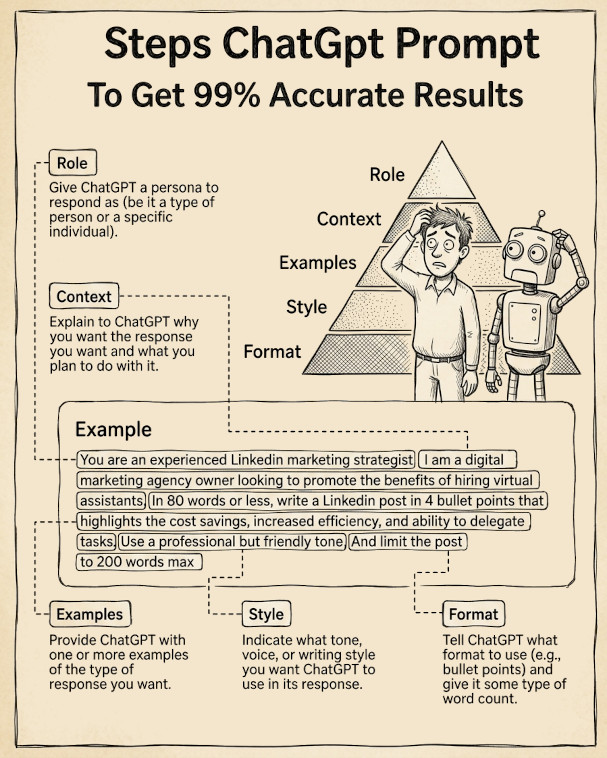
ChatGPT represents a genuine shift in the way we interact with technology and access information. Its model allows users to formulate clear, detailed requests in order to receive precise, substantive responses. A well-structured prompt opens the door to nuanced, personalised explanations. The model's adaptability makes it effective across a wide range of questions and informational needs. Every interaction underscores the same truth: clarity and context are not optional extras — they are the work itself.

In the digital age, this instrument has become increasingly indispensable, precisely because of its precision. The recommended prompt model maximises the quality of dialogue and the accuracy of results. With it, communication becomes fluent and intuitive in a way that earlier tools rarely managed. This article explores how a well-considered prompt transforms the experience of using ChatGPT — and why that transformation matters for anyone who takes their work seriously.

"ChatGPT is an essential tool in the digital age, offering eloquent responses through a precise interpretation of well-formed requests." The quality of the interaction, it turns out, depends almost entirely on the quality of the question.

The model performs best when guided by clarity, specificity, and complete context. A structured prompt helps organise ideas and gives the model a coherent framework within which to operate. Worked examples and stated expectations shape the final output to match actual needs. A request to flag uncertainties reduces the risk of receiving confident-sounding misinformation. All of this points to the same conclusion: a well-constructed prompt is the key to a productive dialogue with advanced AI. This approach transforms the interaction into something genuinely iterative and adaptive — and that distinction, between mere use and real engagement, is what separates adequate results from excellent ones.

Featured

Utopian Demands: What Users Want, What Technology Can Do, and What the Gap Between Them Reveals About Us

There is a particular moment — I recognise it the instant it begins — when someone describes what they want from their website and I try not to blink. Not from professional coldness.Utopian Demands: What Users Want, What Technology Can Do, and What the Gap Between Them Reveals About Us I am not the sort who looks down at clients from behind a parapet of technical superiority, confusing that posture with actual competence. I try not to blink because something in me reaches instinctively towards the person sitting across from me, and that instinct insists on patience. Because the person is not lying. They are not exaggerating for effect. They are not attempting to deceive me or themselves. They simply believe. They believe, with a disarming sincerity, that somewhere in the vast universe of plugins and modules and extensions and Joomla versions, a solution already exists that does everything. A solution that thinks on their behalf, optimises without being asked, translates without misreading the nuance, protects without needing to be told why, sells without requiring the owner to understand the economics of selling. A solution that, if asked politely enough, would probably also make the coffee.

I have been working in web development for eight years. I have built websites for local councils and hospitals in Botoșani County, for schools only just discovering they needed an online presence, for private firms dreaming large on modest budgets, for entrepreneurs who confused enthusiasm with feasibility. I have seen requests of every conceivable variety. I have delivered projects I am proud of and a handful I would approach quite differently now. And throughout all of it, the most consistent thread running through the work has not been PHP, has not been PSR-4 architecture, has not even been Joomla in any of its versions. It has been the distance — sometimes enormous, always revealing — between what users believe technology can do and what it actually does.

I am writing this not to scold anyone. Not because users are less intelligent or less capable than those who build. I am writing it because I recognise myself in that same naivety whenever I wander into territory I have not properly studied. And because understanding this gap — with humility, without exasperation — is, in itself, the first movement towards genuine digital maturity.

Featured

What Is Artificial Intelligence? Definition and Core Principles

There are moments when you realise the world you live in no longer resembles the one you grew up understanding. It isn't a dramatic shift — no announcement, no fanfare. What Is Artificial Intelligence? Definition and Core PrinciplesIt's slow, almost insidious: the kind you notice when your son stops looking for answers in books and turns instead to a dialogue box on a screen, and that dialogue box answers him more quickly, more articulately, than you ever could. That is artificial intelligence in our actual lives. Not an academic abstraction. A presence that has already set up its desk in the middle of our everyday existence — uninvited, unannounced, entirely at home.

What follows is my attempt to explain what this technology actually is. Not as a Stanford engineer might explain it, nor as a DeepMind researcher would. But as an ordinary person who has come to live alongside it, trying to understand what, exactly, he is cohabiting with.


What Is Artificial Intelligence, Really?

The European Union, through its 2024 Artificial Intelligence Act — the first major legal framework in the world dedicated to this technology — defines an AI system as "a machine-based system designed to operate with varying levels of autonomy, that may exhibit adaptiveness after deployment and that, for explicit or implicit objectives, infers, from the input it receives, how to generate outputs such as predictions, content, recommendations, or decisions that can influence physical or virtual environments."

It is a cold, juridical definition. Useful for legislators. For anyone who wants to understand the thing itself, I would put it more plainly: artificial intelligence is the capacity of a computing system to imitate human cognitive processes — to learn from experience, to recognise patterns, to make decisions, to generate content — without being explicitly programmed for every individual situation it might encounter.

We are not talking about a single technology. We are talking about a vast field that encompasses machine learning, neural networks, natural language processing, computer vision, recommendation systems, and, more recently, generative models capable of producing text, images, music, or software code at a quality that, ten years ago, would have been unimaginable.