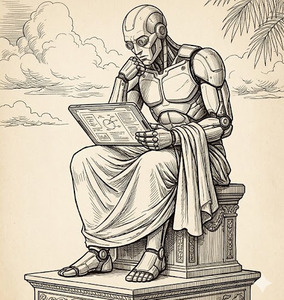
Anatomy of an orchestrated collapse.Beyond technical progress: when innovation becomes an instrument of annihilation.
The technical solution is simple: an automatic compensation system for sources used by AI.
In its official communications for 2024–2025, Google speaks of "improving the user experience" and "democratising access to information". Fine words. Technological progress dressed up as moral imperative. But behind that polished corporate rhetoric, something altogether more brutal is unfolding: a wholesale restructuring of the digital information ecosystem — an industrial-scale execution of millions of content creators: independent journalists, researchers, niche bloggers, educational websites.
In short, universal Uroborus effect, continuous creation and destruction.
Listen to the audio dialogue summary
The mechanism is as simple as it is cynical. Why would anyone click through to an article when Google hands them the answer directly — elegantly generated by AI, synthesised from millions of precisely those articles? The answer arrives instantly. No irritating adverts. No waiting. Perfect for the user. Catastrophic for whoever created the original information. A digital vampire, feeding on the work of others whilst giving nothing in return — no traffic, no revenue, not even acknowledgement.
Let us take apart the mechanisms of this programmed collapse, documented step by step in the industry's own official sources.
The engineering of dependency: how the corporation that claims to serve us is reprogramming our minds. Beyond convenience: mapping the orchestrated cognitive manipulation.
When Google announces — in the polished corporate idiom particular to Big Tech — that integrating AI into search "enhances the user experience" and "simplifies access to information", it conceals beneath this rhetoric of progress an operation in psychological engineering conducted at industrial scale. We are not dealing in conspiracy theories hatched in obscure basements. We are dealing with scientifically documented mechanisms, explicitly acknowledged by former executives of these corporations who, freed from the constraints of professional loyalty, have chosen to pull back the curtain on the manipulation at work.
Tristan Harris — formerly an ethical design specialist at Google, now co-founder of the Center for Humane Technology — testified in the documentary The Social Dilemma (2020): "These platforms are intentionally designed to exploit human psychological vulnerabilities. It's not an accident. It's a strategy." Harris is no paranoid outsider. He is an insider who became a dissident.
The fundamental question is not a technological one: "Can AI generate good responses?" Obviously it can. The real question — the one the corporation systematically evades — is psychological and existential: "What does this dependency on pre-packaged answers do to our minds and to our autonomy?"
Let us deconstruct, step by step, the mechanisms by which AI integration into classical Google search does not serve us — it reprogrammes us.
Petru CojocaruAdvertorials
Hits: 16530 minutes read
It was a Friday afternoon in October when Andreea — a schoolteacher in Botoșani, mother of a sixteen-year-old boy — walked into the showroom on George Enescu Street for the first time. She had been putting the visit off for three years.
Her son's bedroom still looked as it had when he was in primary school: the same white wardrobe covered in football stickers, the same shelf bowing under the weight of secondary-school textbooks, the same desk that had been perfectly sized for a ten-year-old and was now absurdly small for an adolescent writing eight-page essays. The problem wasn't aesthetic. It was practical. Her son was draping his jacket over the chair each evening because there was simply no room left in the wardrobe, and three times a week he asked her where his maths books had got to.
Andreea had a rough idea of what she needed. What she didn't know was whether it was possible on the budget she'd set aside: 3,400 lei, a wall measuring two metres eighty-six, and a window positioned precisely where a wardrobe would have fitted best. She'd browsed online, seen the prices, quietly closed the laptop. Several colleagues had mentioned Dryve Com — not because they'd seen an advert, but because they had furniture from the workshop and it had held up.
That Friday ended with a sketch on paper, a wardrobe designed to the exact dimensions of her actual wall, a quote beneath the figure she'd had in her head, and a three-week lead time. Twenty-one days later, her son could finally hang his jacket in a wardrobe.
Andreea's story is not exceptional. It is typical of the Dryve Com client. And understanding it explains more about why this company has survived nineteen years than any corporate presentation could.
This is a sponsored advertorial. The content was produced in partnership with Dryve Com SRL, a bespoke furniture manufacturer based in Botoșani (super-mobilier.ro). All factual claims have been verified with a company representative. Editorial opinions are the author's own.
2006: Five Men, a Panel Saw, and a Market That Didn't March in Formation
September 2006. Romania was building at a pace that few people now remember accurately. Apartment blocks rising in the outer districts, houses thrown up hastily at the edge of town, families renovating homes they'd waited years to own. Bespoke furniture was becoming, for the first time, a realistic aspiration for the provincial middle classes.
Into this climate, Daniel Albotă and four associates registered Dryve Com SRL in Botoșani. It was not a hands-off investment. All five were simultaneously shareholders and workers — cutting panels in the morning, applying ABS edge banding in the afternoon, delivering and fitting in the evening. Nobody co-ordinated from a distance. Nobody delegated.
But the market didn't respond with the regularity they had hoped for. It arrived in uneven waves: a few good weeks, then a fortnight of silence, then a large order that created the illusion of stability, then silence again. The first year closed at the edge of viability. Not collapse — but not growth either. Bills paid, wages honoured, a bank balance that left no room for error.
"You paid what needed to be paid and kept something back for next month. That was it," says Daniel Albotă today, with the unhurried calm of someone who has long since left the need to dramatise behind him.
At home, his wife was counting too. A young child, a monthly bank repayment, a refrigerator whose contents varied in direct proportion to what had happened in the workshop that week. It is not the romantic image of entrepreneurship you find in conference presentations. It is the real one — with all its daily discomforts intact.
Petru CojocaruAdvertorials
Hits: 17424 minutes read
An interview with Sebastian Anghel
The laser-printer depot of Erste Copia Center SRL, tucked along Strada Primăverii in Botoșani, bears no resemblance to the gleaming technological dreams of corporate advertising. There are no futuristic holograms here, no Samsung keynote imagery, no Scandinavian minimalism borrowed from a Google campus brochure. Instead, methodically arranged shelves hold rows of reconditioned machines — HP LaserJet 4000-series printers that have processed millions of pages in public administrations; robust Canons that survived the chaos of local newspaper offices; Xerox industrial workhorses bearing the scars of a thousand graphic design projects.
Note: This interview is an advertorial.
It is Thursday afternoon, the 13th of February 2025.
Sebastian Anghel has just finished diagnosing an HP LaserJet Enterprise M507 brought in by a law firm from the town centre. The presenting complaint was simple — "colour printing has gone wrong" — but the investigation revealed something else entirely: a counterfeit magenta cartridge, purchased online at half the price of a genuine HP one, had damaged the imaging unit. Cost of repair: 800 lei. Price of the original cartridge that would have prevented the problem: 250 lei.
"This is my daily story," he says, holding up the dismantled cartridge. "People think they're saving money by buying cheap consumables from China. They don't realise that a counterfeit toner can destroy a three-thousand-euro printer. I don't just sell equipment. I sell education about the real long-term cost."
On his workbench, beside diagnostic instruments and unsealed test cartridges, sits a column of invoices — a service call for a rural municipality still running an HP LaserJet 4250 from 2005; the sale of a reconditioned printer to a cash-strapped school; an order for genuine consumables from a medical practice; a technical consultation for a print shop looking to modernise its equipment fleet.
In this apparently unremarkable scene, the paradox of an entire industry concentrates itself. For nearly twenty years, the prophets of digitalisation have been announcing the end of paper. The paperless office. Electronic invoicing. Cloud documents. Digital signatures. Blockchain contracts. And yet, in 2025, laser printers have not merely survived — they remain essential tools in the daily functioning of public institutions, law firms, medical practices, schools, and print shops.
Petru CojocaruAdvertorials
Hits: 22724 minutes read
Advertorial interview with Cristi Teslaru
The showroom on Strada Iașului, on the edge of Botoșani, bears no resemblance to the sleek tool displays you find in German trade catalogues. There are no chrome stands bathed in LED light, no video presentations about the Fourth Industrial Revolution. Instead, on solid metal shelving arranged with an almost military precision, rows of hot-air welding guns stand in careful formation — instruments that look as though they have stepped out of some forgotten industrial era, when craft meant heavy metal in your hand and absolute faith in mechanical simplicity.
It is Monday morning, 17 February 2025. Cristi Teslaru lifts a Leister Triac ST hot-air welding gun towards the light. It costs 3,200 lei — roughly a month's average wage in Botoșani. In his hand, the thing looks almost unremarkable: an elongated metal body, something vaguely resembling an oversized soldering iron, with a sharp brass tip. But inside that studied plainness lives a Swiss precision refined across decades of industrial use: an electronic thermostat calibrated to a tenth of a degree, a ceramic heating element rated for over 5,000 hours, a tip made from a proprietary alloy that distributes heat evenly and withstands extreme mechanical wear. There are also fully automated alternatives — the TECHON range from Bak — for those with different needs.
"People compare prices and can't understand why a Leister gun costs ten times more than a Chinese
one they've found online," he says, setting the instrument carefully back on the shelf. "They think they're paying for the same thing. But the difference only becomes visible after the first hundred hours of intensive use. The cheap one dies, or loses its calibration. Leister keeps welding at the same precise temperature, with the same reliability, year after year."
On the demonstration table, beside samples of waterproofing membranes — black HDPE polyethylene, blue PVC for pool linings, TPO sheets for flat roofs — lie thick technical catalogues: Leister from Switzerland, Herz from Germany, Forsthoff, Dohle also from Germany. Names that mean nothing to the ordinary consumer, but which for the specialist tradesman represent the line between professional workmanship and amateur improvisation.
Petru CojocaruAdvertorials
Hits: 25538 minutes read
A note for the reader: This article is an ADVERTORIAL for businesses. It presents the platform ltrace.ro (Interactive lessons and tests for Years 7–10, with instant automatic feedback) and the Botoșani-based company that built it, Hint One Zero SRL. The tone is favourable and acknowledged as such. The product's limitations are named explicitly, with verifiable sources. Transparency is not an excuse — it is a condition.
Listen to the audio dialogue summary
It was around ten in the evening when I opened my laptop. Outside, rain was falling with a dull persistence — no rhythm, no promise of anything. My son had fallen asleep in the next room, a grammar textbook on his chest — one he had been picking up and putting down for weeks without retaining much from it, because nobody had yet explained to him why what was written in it mattered. I was thinking about that. About that enormous distance — which you forget entirely once you become an adult — between knowing something and understanding why it is worth knowing. They are two different things, and school, more often than not, teaches you the first and leaves you alone with the second.
The man I was about to interview had built an answer to this problem. Not a philosophical one. A practical one. From code, from databases, from years of work at a desk.
The interview with Bogdan Ignat — web developer, a programmer with eight years of experience, now technical architect at Hint One Zero SRL, the Botoșani-based company that built ltrace.ro (Interactive lessons and tests for Years 7–10, with instant automatic feedback) — he settled in front of the screen with the composure specific to people who know their work speaks more eloquently than any talk about it. I asked directly. He answered in kind.
Before I go any further: yes, this article is an advertorial for businesses. I declare this not because the law obliges me to, but because I find that concealing the intent of a text is a kind of dishonesty I cannot practise without feeling bad afterwards. The company I am writing about is in the same city as me. The platform I am presenting exists, is publicly accessible, and can be tested by anyone. Its limitations are real and I shall name them. The rest is the interview.
Petru CojocaruAdvertorials
Hits: 20333 minutes read
Interview with Florin Dumitrachie — sponsored content — ADVERTORIAL in two parts
The building site on Păcurari Street looks nothing like the corporate advertorials put out by large construction firms. There are no towering cranes drawing dramatic silhouettes against the sky, no modular site offices with air conditioning and presentation boards. Instead, on a March morning in 2025, in the pale light that is only beginning to colour the sky above Botoșani, a small crew of bricklayers begins its daily ritual: checking the level of yesterday's concrete pour, preparing the mortar for the second-floor brickwork, setting with geometric care the BCA blocks that will form the interior walls of a family home.
Florin Dumitrachie is not in an office, coordinating by telephone. He is on his knees beside a freshly laid course of bricks, a spirit level in hand — a simple tool, almost primitive in an age of digital lasers — checking whether the wall is perfectly plumb. His hands carry twenty-five years of building sites: thick fingers, skin hardened at every point of contact with the tools, faint scars across the knuckles from cuts and grazes accumulated over decades of handling materials, short practical nails with not a trace of urban vanity.
"Here," he says without lifting his eyes from the spirit level, adjusting a brick with a minimal movement of his palm, "here is the difference between laying and laying well. If this course isn't perfectly level, all fifty courses above it will amplify the error.
By the time you reach the roofline, you'll have a deviation of several centimetres. The house will stand, but it won't be straight. And a house that isn't straight torments you every day with invisible but persistent details."
Around him, the site breathes the rhythm of methodical work. This is not the frantic chaos of large building sites where dozens of subcontractors collide in organised disorder. There are six men here — bricklayers, a carpenter, a reinforcing ironworker — who have worked together for years, who know without words what comes next in the sequence, who check each other's work without needing to be asked. It is the silent choreography of collective craft, refined over time.
In the corner of the site, sheltered under waterproof sheeting, pallets of materials stand stacked and ready: 25-centimetre Ytong BCA for the load-bearing walls, OSB boards for the roof structure, Nelskamp ceramic roof tiles, PVC drainage pipes, electrical cables, distribution boxes. Every material chosen not for its brand or its appearance but for precise technical characteristics and a quality-to-cost ratio verified across dozens of previous sites.
There is no ostentatious luxury here, no villas with spectacular façades and exotic finishes. What there is instead is the measured solidity of buildings done properly — those that impress not through extravagance but through the invisible quality of their execution, through details made correctly even though no one will ever see them, through an unspoken but honoured promise that this house will stand without trouble in thirty years' time.
The Last Days of Social Media. Or: What I Saw From My Window in Botoșani
My father died without ever having had a Facebook account.
Not on principle. Not out of some considered conviction about the nature of the digital age. He simply never got round to it, or never felt the need — he was the sort of man who sorted things out face to face, with a hand on a spanner, a direct look, and a word given that stood in place of a written contract. Mechanics of his generation had no use for an "online presence." They had something more durable: a neighbourhood reputation, built decade by decade, from work done properly and from word of mouth.
I think of him now when I unlock my phone and see what has become of the social networks in which I once, for a time, believed there might be something genuine.
There isn't. Not any longer.
The Feed as Visual Desert
In the morning, before my son wakes and before I make coffee, I pick up the phone out of an inertia I no longer manage well. It is more muscular reflex than intention. Thumb on glass, scroll, scroll. What I see resembles a conveyor belt transporting identical goods repackaged in slightly different wrapping: ten posts featuring the same stock portrait and the same breathless "click here for something free," three replies from filter-smoothed avatars with identically inflated lips directing me towards "exclusive content," an advertisement for a cashback crypto card, a football clip in which the players move awkwardly, like puppets whose strings have been poorly calibrated.
Between them, rarely, something human. A friend from school who has posted a photograph of his garden. A neighbour announcing he has changed his car. An acquaintance from the industry writing something about a project. These fragments of actual life are drowning in an ocean of content produced by algorithms, bots, and people who have adapted so thoroughly to the logic of machines that you can no longer tell where the person ends and the automation begins.
This is what we are now: content among contents.
Social networks were built on a romantic promise — that your friends who couldn't attend would see your wedding, that grandparents would know their granddaughter had taken her first steps into nursery, that people whom distance would otherwise have separated could remain in touch. It worked, for a while. I have my own memories from 2009 and 2010, when Facebook felt like a provincial market — crowded, noisy, but full of familiar faces, real conversations, a certain communal warmth that you could not have manufactured.
Initial title: The Corner Market and the Digital Fiefdoms — On Trust That Has Retreated Back Into the Neighbourhood.
An essay on platforms that have become infrastructure, on the slow erosion of the trust upon which they rested, on the fragmentation of the internet itself into mutually hostile national fragments, and on the public's retreat into an ever-narrowing circle of neighbourly proximity.
Translator's note. This essay was written in Romanian and adapted for an international readership. Where the original relies on local imagery — a small provincial market in north-eastern Romania, a family lineage of mechanics, references to Romanian intellectual tradition — I have kept the imagery but added brief explanatory notes for readers unfamiliar with the context. The Romanian original of this essay is available at petrucojocaru.ro.
I. The Machine That Still Works
The market on the corner has no official name. The people from the street simply call it the small market, to distinguish it from the big one, where one enters beneath a tin-lettered sign and where the stalls are lined up like the parking bays of a supermarket. At the small market, people do not come merely with a shopping bag. They come with a second of respite between two obligations, with the question "how are you?" addressed to someone they have known for ten years, with the suspicion that the tomato from the third crate is better than the one from the first, because someone brought it in from Cristești.1
The vendor on the corner has a coffee machine — a classic La Cimbali with a manual lever, probably bought second-hand fifteen years ago. The chrome plate is scratched around the portafilter; the lever handle has acquired that particular lustre which only a hand pressing it daily can produce; the pressure is still within parameters. Her coffee is better than the one from the petrol station across the road, where a ten-thousand-euro automatic machine with a touch-screen stands unattended. Not because her beans are more expensive, but because the lever is pressed by a hand that knows, and the water passes through the coffee at the rhythm it should. It is, if you like, a small monument to what Constantin Noica would have called the utterance in things — the object which says, through its very functioning, what it is.2
When someone remarks, in passing, that the tomato from the corner tastes of coffee, it is not an insult, and it is not a laboured metaphor. It is a form of recommendation. The speaker means: there is something in that place which holds together the small things of quality. Good coffee and good tomatoes stand at the same counter not by coincidence, but through what we might call — in less scholarly language — a way of being of the place. A microcosm in which trust is not requested; it is observed. The vendor does not tell you the tomato is good; she lets you smell it. The coffee holds no barista certification; it has the taste one remembers. This place operates on a fund of pre-institutional trust — the kind the Romanian village knew for centuries, and which the city has preserved, almost without realising it, in its little islands of small
commerce.
I recall this scene because in the 2026 Edelman Trust Barometer — the most extensive global survey of trust, now in its twenty-sixth edition — a figure appears which explains the scene without describing it.3 To the question of who still commands standing in the public's eyes, governments have lost sixteen points over five years, major news organisations eleven, and foreign business leaders six. Neighbours, family, and friends have gained eleven. It is the most brutal shift of trust ever recorded by this instrument: from We to Me, as the authors of the report put it. Or, more precisely: from institution to street corner. This is the hour of small markets. This is the hour of manual coffee machines and of vendors who know where the tomatoes come from.
In an age when checking one's phone has become an almost involuntary reflex, a growing number of young people are beginning to ask themselves: what would it actually feel like to give up social media entirely? The phenomenon of the "digital detox" is no longer a passing trend — it has become a necessity recognised by specialists in mental health. Recent research offers fascinating perspectives on the psychological effects of this withdrawal, and the findings are not always what you might expect.
The wisdom found in personal development literature, alongside insights from specialist research, gives us a broader view of this thoroughly modern challenge. The key to success lies in a gradual approach: replacing online activity with offline alternatives, and building a genuine system of social support in the real world. For the generation that grew up in the digital age, this kind of detox does not mean rejecting technology — it means rediscovering the balance between the virtual world and the real one.
Reduction in anxiety and stress
The first and most thoroughly documented benefit of quitting social media is a dramatic reduction in anxiety. The study by Hunt and colleagues, published in The Lancet in 2019, demonstrated remarkable effects on the mental health of young people who limited their use of social networks.
A significant drop in anxiety: Restricting use to thirty minutes per day reduced anxiety levels among study participants by 25 per cent, according to the Lancet research.
A reduction in FOMO (fear of missing out): "The fear of missing something important diminishes considerably when you are no longer bombarded with constant updates from other people's lives," Hunt explains in the study.
Elimination of social comparison: Dr Patti Valkenburg observes in Current Directions in Psychological Science that "constant social comparison on online platforms is one of the principal causes of diminished self-esteem."
Stabilisation of mood: Research shows that the extreme mood fluctuations characteristic of heavy social media users tend to level out after withdrawal.
Nobody dies. Nobody fights. And yet it is one of the most dangerous episodes in the Odyssey.
When the Athenaeum Book Club recently posted about the Lotus-Eaters episode in Homer, the comments exploded in an unexpected way. Not with learned literary analyses, but with immediate, visceral recognition. 'That's me with TikTok.' 'This perfectly describes my generation.' 'It took me three years to leave the island.' Someone wrote, simply and sharply: 'My 15-year-old boy is happy there. And that frightens me more than any monster in mythology.'
Homer wrote the Odyssey approximately 2,800 years ago. And yet, in 2026, the island of the Lotus-Eaters is no longer a geographical metaphor — it is an app downloaded onto a phone, a streaming subscription active at three in the morning, a day off transformed into eight hours of passive scrolling.
The thesis of this article is simple and uncomfortable: the hero's greatest enemy is not the cyclops who devours his men, not the sirens who call him towards the rocks, not even Poseidon who turns his ships back. The greatest enemy is the comfort that makes you forget why you left home — and above all, that you left at all.


 tal is unfolding: a wholesale restructuring of the digital information ecosystem — an industrial-scale execution of millions of content creators: independent journalists, researchers, niche bloggers, educational websites.