Google

Practical: "Google only loves you when everyone else loves you first" - Wendy Piersall
Mystical: "An algorithm has to be seen to be believed" BrainyQuote

Featured

Google Unifies AI Overviews with AI Mode: When Technology Decides for You

The story of 'simplified' things that complicate our lives. Have you ever watched a magician on stage?Google Unifies AI Overviews with AI Mode: When Technology Decides for You He shows you his right hand, makes sweeping gestures, keeps your eyes fixed on a coloured balloon — while his left hand, out of sight, pulls the strings you never see. That is precisely how Google's announcement about "unifying AI experiences" works: it draws your gaze towards "simplification", whilst behind the curtain it quietly assumes control.


Let me tell you something rather amusing. A few months ago, a friend of mine tried to find an apple pie recipe on Google. He typed the simple question: "how do I make a pie." Google responded with an entire essay on the history of European desserts, an AI conversation about nutrition, and only somewhere around the fifth result did the actual recipe appear. He looked at his phone and said: "Mate, I wanted to cook, not become a culinary historian." And that, precisely, is the problem — the system had decided for him what he "needed to know."


A Father's View from the Doorway

As a father who watches you spend hours in conversation with your phone, I find myself returning to a few simple observations. When you talked to your mother about your day at school, she listened and let you finish your thought. When you asked your sister for advice, the two of you went back and forth until you found the answer together. When your grandfather showed you how to fix your bicycle, he walked you through it step by step — he let you try, let you get it wrong, let you learn. And now? An algorithm decides what question you actually asked, what answer you deserve, and when you ought to dig deeper. I think of the tradesman who came to fix our tap — I asked him something about plumbing and he said: "Sir, a trade is learned with your hands, not from reading online." He was right. Google gives you information; it has stolen the process of learning.

Featured

The Illusion of Digital Stability: Eight Perspectives on Continuous Change

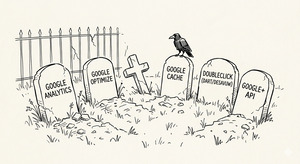
This is a documented constant, not a naivety — and that is precisely what makes the situation so treacherous for anyone attempting to build something lasting within Google's ecosystem.The Illusion of Digital Stability: Eight Perspectives on Continuous Change

Google operates according to the principle of "perpetual beta" — a term that sounds innovative, even exciting, but which conceals a rather brutal reality for the developers, content creators, and businesses that depend on its platforms. Search algorithms change hundreds of times a year — Google officially reports between 500 and 800 updates annually — whilst policies governing YouTube, AdSense, and Google Analytics are routinely revised without substantial notice, or with transition periods so compressed they are effectively meaningless.


I am sitting at my desk in Botoșani. It is somewhere past midnight. I am watching Google Search Console display a 40 per cent drop in traffic compared to the previous month. Nothing I have written has changed. The content is the same. The effort is the same. Something invisible shifted somewhere in a data centre in California, and now I sit here trying to understand the rules of a game no one has ever fully explained to me. My son is asleep in the next room. Gri, the cat, is asleep on my spare keyboard. And I am trying to make peace with the idea that years of work can be reconfigured overnight by an algorithm that does not know I exist.

The naivety is not in believing that Google changes its rules. The naivety lies in building a strategy entirely dependent on Google — in believing that your relationship with a platform that pays you nothing for your content, yet earns everything from the attention you generate, is something resembling an equitable partnership.

Featured

Google Analytics 4: A Complete Guide for Teenage Beginners

I still remember the first time I opened the dashboard of a web analytics platform. It felt like stepping onto the bridge of a spacecraft — indicators blinking, graphs animating, figures that seemed written in a foreign tongue. From artificial intelligence and indexing to personalisation and behavioural signals. Discover how Google processes billions of daily searches and decides the order of results — explained accessibly for teenagers.Perhaps you felt something similar when you first heard about Google Analytics 4: that particular mixture of curiosity and overwhelm. And yet, beneath the apparent complexity of this platform lies something genuinely fascinating — the capacity to understand how real people interact with the digital world we are busy building.

Google Analytics 4 — GA4, as we shall call it throughout — is not merely a technical tool for marketing specialists. It is a window onto human behaviour in the online environment; a way of uncovering the stories concealed behind every click, every visit, every conversion. The transition from its predecessor, Universal Analytics, represents far more than a routine software update. It is a paradigm shift in how we understand and measure the digital experience.

For you — a teenager perhaps just beginning to explore the world of digital marketing, entrepreneurship, or the workings of the internet behind the scenes — this guide will serve as a companion for the journey. We shall not simply navigate buttons and settings; we shall discover together the logic behind these tools, the philosophy of measurement, and the importance of truly understanding your audience. Whether you dream of launching your own blog, building an online business, or simply making better sense of the technology that shapes your daily life, fluency in GA4 will offer you a precious vantage point over the digital landscape.

Featured

When Google Takes the Tool from Your Hand — the Pattern Nobody Wants to Acknowledge

The morning the graph stopped making sense.

There is a moment every serious data professional has experienced at least once: you look at a graph you know as well as your own handwriting, and something does not add up. Not a dramatic collapse, not a red alarm — just a slight disproportion, a number that seems too round, a curve that flows too smoothly. An instinct before it becomes a conclusion.When Google Takes the Tool from Your Hand — the Pattern Nobody Wants to Acknowledge

In September 2025, thousands of SEO specialists across the world experienced this sensation simultaneously. Impressions in Google Search Console had dropped sharply — by 20, 30, sometimes 50 per cent — with no change to content, no algorithmic penalty, no official announcement. Clicks remained stable. Revenue from organic traffic had not shifted. Real positions in search results were identical to the day before.

What had disappeared was not the actual visibility of those websites. What had disappeared were impressions fabricated by bots and scrapers which had, for years, been systematically inflating one of the central indicators of SEO reporting — without Google ever flagging the problem.

And that was only the second act.

The first act had ended in silence, in January 2024, when Google withdrew a tool that had existed in Search Console for fifteen years — the Crawl Rate Limiter — with a two-paragraph note and no public discussion worth mentioning. The third act, the most serious of the three, would only be uncovered on 30 March 2026, by an Australian consultant who had noticed something strange in desktop impression spikes. Four days later, Google confirmed it: a logging error had caused Search Console to misreport impressions for fifty consecutive weeks.

A year. Nearly a full calendar year of compromised data. Discovered not by Google, but by the community.

This is not an article about a bug. It is an article about a pattern. A pattern Google repeats with a consistency that should, at some point, serve as a genuine warning to anyone who builds business decisions on data furnished by its platforms.


Featured

Who Checks the Checker?

When the algorithm becomes the censor and people forget they are allowed to ask questionsWho Checks the Checker?


My father never knew how to use a search engine. He repaired engines — engines from Dacias, AROs, agricultural machinery that came to him from all around Botoșani, each with a wrong sound or a wrong silence. He could tell from the sound alone where the problem lay. He needed no manual, no computer. He needed attention. And years of accumulated attention.

I think of him now, when I open Google and see that the search engine I have used for twenty years has changed. Not radically, not visibly — but subtly, insidiously. A layer has grown over the results. A voice that belongs to no one. An answer before the question.

Google calls it AI Overview. I call it something else. I call it the problem of who checks the checker — and it took me a long time to understand why it disturbs me so profoundly.