


My father never asked questions. He simply fixed things. 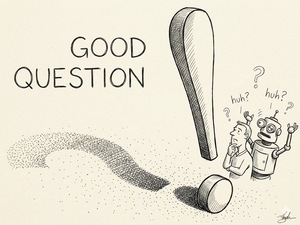 I can still see him, bent over an engine with his head all but buried in the innards of a Dacia 1300, both arms blackened to the elbow, listening. He never asked the customer anything. He never said "describe the sound to me" or "when exactly does the problem occur?" He listened to the engine directly, laid his palm flat against the block as though taking someone's pulse, and within a few minutes he knew. He diagnosed without questionnaires, without forms, without protocol. His knowledge was tactile — accumulated across years of mistakes and corrections — and it operated through resonance rather than interrogation.
I inherited from him a fascination with mechanisms. What I did not inherit was that gift for direct listening. I write. I formulate. I build questions and rebuild them whenever the answer that comes back is wrong — which means the question was not properly put to begin with.
And it was precisely that thought which came to me one evening and refused to leave: artificial intelligence works in the opposite direction to my father. It needs you to formulate correctly. If the question is vague, the answer is vague. If the question is formal, the answer is formal. If the question resembles the language of an official who has copied from another form that was itself copied from a third, the answer will read like a planning notice from 2004.
And yet — people do not ask good questions. Not because they are incapable, but because they do not know how to translate anxiety into clear prose. When someone types "can I get the increased child benefit?", they are not conducting a legal enquiry. They are making a survival gesture. They are looking for confirmation. They want to hear: yes, you can.
The FAQ — the Frequently Asked Questions section of a website — ought to be the place where that translation happens. In reality, it is, more often than not, the place where official language finds its most comfortable and least scrutinised refuge.
What an FAQ is in 2025 — and what it has ceased to be
We are no longer talking about lists. We are talking about contracts with the machines that read.
For the better part of twenty years, FAQ sections existed as a kind of polite appendix to a website. "We answer your most frequently asked questions" — a sentence which, in practice, translated as: "here is what we have decided you want to know." It was a monologue dressed up as dialogue. A press release with question marks appended to the ends of sentences.
Things have changed — decisively and quickly. Not because anyone suddenly awoke with a newfound love for their users, but because search engines — and generative artificial intelligence systems in particular — began reading these sections with an attention that no human reader had ever granted them. Pages carrying FAQPage markup are 3.2 times more likely to appear in Google AI Overviews, and AI-referred sessions rose by 527% in 2025. These figures are not marketing copy. They are evidence of a paradigm shift that will not reverse itself.
What does this mean in practice? That a well-structured FAQ can become, in 2025, the single most valuable section of a website — not on account of its design, not its photographs, not its JavaScript animations, but on account of its visibility within AI-generated search. When ChatGPT, Perplexity or Google AI Overview assembles a response for a user, it looks for clear, structured sources with well-delineated questions and answers. Without structured data, language models are forced to infer meaning from disordered HTML, which leads to misreadings and lost context.
Put plainly: if your website does not speak clearly to the machine, the machine will either ignore it or misunderstand it. And being misunderstood is worse than being ignored.
There is an irony in all of this which I note with some satisfaction: the very format that many considered the most pedestrian — question and answer, plain, dry, unadorned — has turned out to be the format most sought after by the most sophisticated natural language processing systems in existence. Perhaps because simplicity is not an aesthetic virtue. It is an epistemic one.
Natural language against official language — where the human being gets lost
Nobody asks "What are the eligibility criteria?" People ask "Can I get it?"
I have spent eight years working with public institutions — town councils, hospitals, schools, county authorities — across Romania. I have read hundreds of FAQs. And I can say with confidence that their official language is a form of communication which functions perfectly within the system and almost not at all outside it.
A civil servant in a social services department knows precisely what "eligibility criteria" means. She knows that the answer to "What are the eligibility criteria for Grade II disability allowance?" is to be found in the relevant legislation, with all subsequent amendments duly considered. But the person searching Google late at night, head in hands after a day spent receiving a third document they cannot decipher, is not looking for the paragraph of statute. They are looking for confirmation that a route exists.
Traditional search relied on short, fragmentary keyword queries; now users ask complete, complex questions and expect synthesised answers immediately. Furthermore, a 2025 study found that 54% of consumers had shifted to conversational search habits, preferring natural language over keyword strings.
My son searches differently from the way I searched at his age. He does not type phrases. He narrates. "Why does my head hurt when I look at a screen for too long?" is not a keyword search — it is a sentence spoken as though addressed to a person. And the machine, in 2025, understands that sentence better than it understands "headache screen digital causes." Because it has been trained on billions of human sentences, not on millions of official forms.
The practical consequence for anyone writing content is straightforward: the questions in an FAQ must reflect the way people actually speak, not the manner in which institutions prefer to be addressed. Not "What is the procedure for submitting the application?" but "How do I submit my application?" or, better still, "What documents do I need and where do I take them?" The difference seems small. It is not. One is the language of bureaucracy. The other is the language of survival.
There is an ethical dimension to this which I cannot in good conscience sidestep. When you write an FAQ for a public hospital or a town council, you are not writing for Google. You are writing for people who are, many of them, in situations of genuine vulnerability. The person searching "what do I do if my benefit claim has been rejected" is not conducting academic research. They are frightened. And they deserve an answer in their own language.
The anatomy of a good answer — what "self-contained" actually means
A good answer needs no context. It is an island, not a peninsula.
There is a rule I have arrived at over years of watching how content behaves in search engines, and I apply it to everything I write for the web: every unit of information must be able to survive on its own, pulled free of its page. An FAQ answer must work perfectly if you copy it into a WhatsApp message, read it aloud over the telephone, or have it appear in isolation inside a Google AI Overview with no surrounding context from the original page.
The technical term is "self-contained" — an answer that does not assume the reader has seen the rest of the page, knows who you are, or has read the introduction. Content which answers a specific question clearly, uses natural language, and can stand independently outside the page context — short paragraphs, explicit statements, descriptive headings — has a materially higher chance of being reused in conversational and voice search.
This is harder to write than it sounds. The natural tendency, when you are the author of a page, is to assume that the reader knows everything you know. That they have seen the header. That they have read the paragraph above. That they know you are a medical practice in Botoșani and not a clinic in London. But the machine reading the page does not know this. And the user receiving the answer via an AI assistant does not know it either. Your answer, stripped of its context, becomes either confusing or inapplicable.
The practical solution is this: write every answer as though it were the very first thing someone will ever read about you. The name of the organisation, the location where relevant, the type of service — all of this must be in the answer itself, not assumed from the parent page. "You can submit your application at the Botoșani Town Hall, [address]..." is more useful than "Applications are submitted at our offices."
There is an aesthetic tension in this which I acknowledge openly: between writing completely (for machines) and writing concisely (for human beings). Too long and the person stops reading. Too short and the machine fails to understand. The point of balance exists — somewhere between fifty and one hundred and twenty words per answer, sufficient to cover the substance without becoming an essay. And the most useful test I have found: read the answer aloud. If it sounds odd, it is too formal. If it stops abruptly without having actually answered the question, it is too short.
The strategic error — when an FAQ becomes disguised marketing
The worst FAQ I ever read answered questions that nobody had ever asked.
I saw it on the website of a building contractor. Their FAQ section was full of questions along the lines of: "Why are you the best company in the county?" and "How did you earn your reputation for excellence?" The answers, predictably, spoke of "professionalism," "over fifteen years of experience," and "our clients' satisfaction." This was not an FAQ. It was an advertorial in poor disguise, question marks standing in for quotation marks.
The problem with this approach is not merely aesthetic. It is functional. AI systems are not naive. They detect — not explicitly, but through relevance and authority signals — whether the questions in an FAQ reflect genuine user anxieties or have been constructed to validate a marketing message. Structured data alone does not establish authority and does not guarantee AI citations: language models require high-quality content, editorial links, and mentions from trusted third parties.
In other words: you can implement FAQPage schema in JSON-LD with technical perfection, follow every rule to the letter, and still appear nowhere in AI Overviews — if the content does not address questions that people actually ask.
Where do you find real questions? Three sources, tested and verified:
The first: questions received directly through your customer service channels — email, telephone, WhatsApp, Facebook messages. If the same question has arrived ten times in the past three months, it belongs in the FAQ. Without exception.
The second: internal site search data. If your website has a search function and you track what visitors type into it, you have direct access to their minds — not the minds you imagine they have, but the ones they actually possess.
The third: reviews — on Google Maps, Facebook, or elsewhere. People write in reviews things they would not dare to ask directly. "I didn't know I needed to bring the birth certificate as well" is information that should be in the FAQ, reformulated as an answer to "What documents are required?" The missing information in a negative review is precisely what needs to go in.
Question-led content with structured markup and clearly defined answer blocks appears more frequently in AI-generated results, according to the Moz Industry Report of September 2025. But this applies only when the questions are genuine. An FAQ built from institutional self-regard does not become more visible simply by acquiring the correct schema markup.
Strategic organisation — categories, updating, cadence
An outdated FAQ is worse than no FAQ at all. It is a false witness.
There is something particular about the relationship between public institutions and the information on their websites: it is updated rarely, usually after someone has already made three visits to an office and returned home each time without result. Deadlines change. Procedures are amended. Laws are revised. And the FAQ remains, with its data from two years ago, smiling serenely.
An FAQ carrying incorrect information is more damaging than no FAQ at all — because it generates false certainty. The person leaves believing they know what to do. They arrive at the counter and discover that reality diverged from the website some months ago. And they are right to be angry.
AEO — optimisation for answer engines — is not a one-time configuration; it is a continuous cycle of monitoring, testing, learning, and improvement. This means that an FAQ is a living document, not a monument. It must be reviewed at minimum every quarter, and every time a procedure, a piece of legislation, a deadline, or an eligibility condition changes.
Category organisation should follow the logic of the user, not the logic of the organisational chart. Not "Enquiries for the Public Relations Department" and "Enquiries for the Finance Directorate" — because the user has no idea that their problem belongs to the Finance Directorate. They know only that they want to pay a fee and do not know how. The correct organisation: "Payments and Fees," "Documents and Certificates," "Applications and Claims," "Social Programmes," "Urgent Matters and Complaints." Categories defined by need, not by administrative hierarchy.
There is a practical dimension here that matters particularly for institutions operating under frequently changing legislation: information that was accurate when published becomes actively harmful once it ceases to be true. An institution that leaves incorrect information on its website does not assist the public. It disorients them. And disorientation, in dealings with official bodies, carries a real cost — in time, in wasted journeys, in eroded trust.
The ethical dimension — the responsibility of the person writing for AI
When you write an FAQ, you are not writing for Google. You are writing for a person who has run out of patience.
I remember accompanying my son, some years ago, to a public office where we needed to submit some documents. I had been careful to check the website beforehand. The FAQ stated that four documents were required. At the counter, a fifth was requested — one the website had not mentioned anywhere. The official regarded us with that perfect neutrality of someone who has watched this scene play out a hundred times and has long since ceased to feel anything about it. "You should have known. It's in the regulations."
Perhaps it was in the regulations. But it was not in the FAQ. Which means that whoever wrote that FAQ was thinking about themselves — about how easy it is to list four items rather than five — and not about the person who would one day read it.
In conversational search, context accumulates — each exchange builds on the previous one, and the user moves through conversation towards an ever-clearer intention. This conversational evolution functions only if each answer is complete and accurate. An incomplete answer in the first exchange is not automatically corrected in the second: the user leaves with the wrong information and acts on it.
This is the ethical responsibility of the person who writes an FAQ: not to optimise for an algorithm, but to anticipate the real anxiety behind the question. What is the fear that generated the search? What missing piece of information produces that fear? How can the distance between the one who knows and the one who needs to know be reduced?
There is a concept in the Philokalic tradition — nepsis, watchfulness, the vigilant attention to one's own mind and to the other — which I find applicable well beyond its theological context. To write with nepsis is to write whilst present, conscious of the person you are addressing, without slipping into the automatism of official language that clothes indifference in formal dress. This is not a matter of style. It is a matter of intention.
An FAQ written without nepsis is a list of phrases. An FAQ written with nepsis is an act of service — small, technical, invisible, but real.
My father would have known how to write good FAQs. Not because he knew how to write — but because he knew how to listen first.
I return, as I generally do, to the opening image. My father with his hands inside an engine, listening. He did not ask questions because he had no need to — his knowledge was sufficiently fine-grained to read the signals directly. But if he had been required to write an FAQ for his workshop, he would have written it differently from the way a marketing consultant would have written it. He would have written: "When I hear a strange noise from the engine, what should I do?" — not "What are the preliminary diagnostic procedures?" He would have written from the position of the person asking, not from the position of the expert answering.
That, in the end, is all that the machines reading content today are asking of us: write from the position of the person who does not yet know, rather than from the position of the person who does.
A well-written FAQ is an act of listening, frozen in text. It is not a list of answers — it is a map of the anxieties of the people who turn to you. The machines reading content today are better at identifying those anxieties than many content authors — not because they are more intelligent, but because they have no ego to defend. They do not mind whether an answer is simple or complex, formal or colloquial. They care only whether it answers the real question.
We ought to care as well.
Questions
worth committing to memory, with considered answers
1. Why does the structure of an FAQ matter more than the text itself?
Structure is what allows an AI system to identify that a block of text constitutes a question and an answer, rather than a descriptive paragraph. Without clear structure — correct HTML markup, FAQPage schema in JSON-LD, clean visual separation — the language model must guess. And when it guesses, it errs. Your text may be excellent and yet remain invisible to AI if it is buried in unstructured HTML. Structure is not decorative. It is functional in the most direct sense: it determines whether you are cited or overlooked.
2. What is the practical difference between an FAQ built for SEO and one built for AEO?
A traditional SEO-oriented FAQ optimised keyword density and aimed for high positions in the search engine results page. An AEO (Answer Engine Optimisation) FAQ aims to become the source cited by AI when it generates a direct response. The practical difference: AEO demands self-contained answers, complete in themselves, that presuppose no external context — because AI extracts fragments of content and serves them in isolation. If your answer does not function without the surrounding page, it does not function in AEO.
3. How many questions should an ideal FAQ contain?
There is no magic number, but experience shows that between eight and twenty questions per page or section tends to be optimal for both AI processing and human usability. Fewer than five questions and the section appears incomplete and scarcely justifies structured markup. More than thirty and it becomes difficult to navigate, risking dilution of the relevance signals read by answer engines. The real rule is qualitative rather than quantitative: every question must reflect a genuine anxiety of a genuine user. If you cannot confirm that someone has asked or would ask that question, remove it.
4. How do I discover what questions my users are actually asking?
Three concrete and verified sources. First: the history of your internal site search — if you have a search function integrated into your website, track what visitors type into it; this is direct access to their minds as they actually are, not as you imagine them to be. Second: questions received via email, telephone, or social media — if the same question has arrived three times in two months, it is a definite candidate for the FAQ. Third: reviews on Google Maps or similar platforms — people mention in reviews the information they failed to find, or the documents they did not know they needed to bring. That missing information is precisely what belongs in the FAQ.
5. What happens if my FAQ contains incorrect or outdated information?
The consequences are twofold and cumulative. For the human reader: they receive incorrect information, act on it, arrive at a service unprepared, and generate frustration and distrust towards the organisation. For AI systems: generative search engines may cite incorrect information with exactly the same authority they would cite accurate information — there is no automatic correction mechanism. Once an error enters an AI-generated answer, it circulates. An FAQ with stale information is not a neutral document. It is an active false witness.
6. Does FAQPage JSON-LD schema guarantee appearance in Google AI Overviews?
No. FAQPage schema increases the probability of extraction and citation, but it does not guarantee visibility. Structured data helps machines understand content but does not replace the quality of that content. Language models seek sources with authority — demonstrated through editorial links, mentions by trusted third parties, and the consistency and depth of the content itself. A website without editorial authority, however perfectly it implements FAQPage schema, will continue to be overlooked in favour of one that has both authority and structure. Schema is a necessary condition, not a sufficient one.
7. What length should an ideal FAQ answer be?
Between fifty and one hundred and fifty words per answer — sufficient to cover the substance, insufficient to become an essay. The answer must be self-contained (presupposing no external context), must include the relevant entities (who, what, where, when, as appropriate), and must conclude with a clear statement or an actionable step. The simple test: read it aloud. If it sounds natural and complete, it is right. If it reads like an extract from a statutory instrument, or if it leaves the question essentially unanswered, rewrite it.
8. How should I organise categories in an FAQ for a public institution?
Follow the logic of the user, not the logic of the organisational chart. People do not know that their problem belongs to the Finance Directorate or the Planning Department. They know only that they want to pay a fee, obtain a certificate, or submit an application. Categories must reflect these needs: "Payments and Fees," "Documents and Certificates," "Applications and Claims," "Social Programmes," "Urgent Matters and Complaints." Each category should correspond to a real-life need, not an administrative compartment.
9. Can an FAQ be actively harmful if it is built as disguised marketing?
Yes — actively and measurably. An FAQ that answers questions nobody asks (of the type "Why are we the best in the county?") generates value neither for users nor for AI systems. Moreover, AI systems can detect relevance and authenticity signals: an FAQ built from institutional self-regard carries low semantic density on the questions users genuinely ask and will be deprioritised in favour of content that addresses concrete needs. The surest test: if the questions in your FAQ could function as headings for an advertorial, rewrite them.
10. How often should an FAQ be updated?
At minimum every quarter, and every time a procedure, a piece of legislation, a deadline, or an eligibility condition changes. For institutions operating under frequently amended legislation, the rate of regulatory change imposes a greater degree of vigilance than the European average. The healthy practice: designate one person responsible for maintaining the FAQ and establish a fixed review calendar. An FAQ last updated two years ago is not a digital asset. It is a reputational liability.
Bibliography
-
Frase.io — FAQ Schema and AI Search, GEO & AEO (November 2025) https://www.frase.io/blog/faq-schema-ai-search-geo-aeo
-
CXL Institute — Answer Engine Optimization (AEO): The Comprehensive Guide for 2026https://cxl.com/blog/answer-engine-optimization-aeo-the-comprehensive-guide/
-
The HOTH — Structured Data for AEO: What Still Matters and What Doesn't (January 2026) https://www.thehoth.com/blog/structured-data-for-ai-search/
-
Zensciences — AEO in 2025: Strategies to Win AI Searchhttps://zensciences.com/blogs/a-comprehensive-guide-to-answer-engine-optimization-aeo-in-the-generative-ai-era/
-
Finch — Generative AI: Reshaping Search Intent and User Behavior (October 2025) https://finch.com/blog/generative-ai-changing-search-intent/
-
Bloomreach / arXiv — LLM-based Semantic Search for Conversational Queries in E-commerce (2025) https://arxiv.org/html/2601.16492v1
-
iPullRank — User Behavior in the Generative Era: From Clicks to Conversations (February 2026) https://ipullrank.com/ai-search-manual/search-behavior
-
Mavlers — Conversational Search Optimisation: NLP Guide for AI Search (January 2026) https://www.mavlers.com/blog/nlp-and-conversational-search-optimization/
-
Geneo — Best Practices for Answer Engine Optimization (AEO) in 2025https://geneo.app/blog/best-practices-answer-engine-optimization-aeo-2025/
-
Amsive — Answer Engine Optimization (AEO): Your Complete Guide to AI Search Visibility (March 2026) https://www.amsive.com/insights/seo/answer-engine-optimization-aeo-evolving-your-seo-strategy-in-the-age-of-ai-search/
-
Medium / Baileylibei — How to Optimize FAQs and How-To Guides for GEO/AEO Engines (December 2025) https://medium.com/@baileylibei_84347/how-to-optimize-faqs-and-how-to-guides-for-geo-aeo-engines-1bc424e41ae0
Author's note
tensions, comparisons, rhetorical devices, and acknowledged limits
The tensions within this text:
The essay operates simultaneously across three registers, and the tensions this generates are consciously assumed. The first is the tension between the technical and the human: the data and statistics concerning AEO, schema markup, and AI indexing are real and necessary for credibility, but they risk transforming the text into an instruction manual. The counterweight is personal narrative — the mechanic father, the son searching Google, the encounter at the public office counter. Neither element is decorative; both are necessary for the text to function at both levels of readership: the reader who comes for technical substance and the reader who comes for meaning.
The second tension is between epistemic humility and firm recommendation. I do not know how AI algorithms will evolve in six months. No practitioner in the field does. And yet I must formulate practical recommendations that are useful now — not "perhaps" or "it might be the case that." The solution adopted: recommendations are firm where the data is clear (structure, self-containment, regular updating), and nuanced where genuine uncertainty exists (the guaranteeing of citation in AI Overviews).
The third tension is between critique of institutional communication and respect for the people who work within those institutions. The critique of institutional FAQs is real and documented from direct practice. But the civil servant who wrote a poor FAQ is not a malicious person — they are, in all likelihood, an overworked person with insufficient resources and no training in digital communication. The text attempts to name the problem without naming culprits.
Comparisons and analogies employed:
The mechanic father is the central narrative anchor — a man who diagnosed without questionnaires, through direct listening. The counterpoint to AI, which requires correct formulation, is not a criticism of AI but an invitation to awareness of a fundamental distinction: tacit knowledge against explicit knowledge. One cannot be transferred into the other without loss.
The island versus the peninsula — for the principle of self-containment — is a deliberately simple spatial metaphor, designed to be memorable. An island does not require a continent in order to be an island. A good answer does not require its page in order to be useful.
The false witness — for an FAQ carrying outdated information — is an intentionally severe legal comparison. A false witness does not always lie deliberately; sometimes the falseness comes from inertia, from failure to update. The effect is the same.
Nepsis (Philokalic watchfulness) — employed as a reference to the hesychast tradition, not as ornament. The concept of vigilant attention to one's own mind and to the other is applicable in any act of conscious communication. I did not force the connection; I encountered it in the course of writing and allowed it to remain.
Acknowledged limits of this essay:
This text does not cover the technical implementation of FAQPage JSON-LD schema — there are dedicated resources for that, better suited to the task than anything an essayistic piece can offer. It does not cover the specific differences between AI platforms — the ways in which Perplexity behaves differently from Google AI Overview, which behaves differently from ChatGPT Browse. And it offers no original quantitative data: every figure cited derives from external sources, each of which has been verified and included in the bibliography above.
There is also a deeper limitation, which I state plainly: I write as a practitioner, not as a researcher. Eight years of work with public institutions and private companies in Romania give me a perspective that many content authors on this subject do not possess — but what I lack is academic distance. This text does not pretend to be a study. It pretends to be the useful reflection of someone who has read enough poor FAQs to know what a good one looks like.