


On the importance of semantic markup and metadata for the correct interpretation of your content — a practitioner's view, without technocratic illusions.
Why AI Does Not "Read" the Way You Do.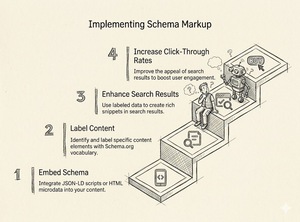 There is a comfortable illusion that lives inside most people who publish on the web: that a well-written text will, by the force of its own clarity, be understood. That if you say something true and say it plainly, the world — including the world of machines — will grasp it. I lived inside that illusion for a while myself, writing, publishing, waiting. Until I understood that machines do not read. They process.
The difference is larger than it appears. When you read, you bring context, memory, emotion, inference. You know that a reference to a local council means a public institution, that "opening hours" refers to when someone will actually answer the telephone, that the author of the text is a person with a name and a history, not an abstract generating function. An AI system, if it is not told explicitly, guesses. Sometimes it guesses well. Sometimes it transforms you into something you are not.
Unstructured data — plain text, images, video — is accessible to people but disorderly for machines. AI models need labelled, structured data in order to analyse, categorise, and deploy information in their responses. Without that labelling, your content exists in automatic translation — and the translation may be wrong in ways you will never see.
Schema markup is the answer to this problem. Not an SEO trick, not a technical hack to be applied on a rainy afternoon. It is the language through which you tell the machine: this is an organisation. This is the author. This is a question and this is its answer. It is, if you want a more human metaphor, the difference between introducing your father to someone who has never met him — "this is my father, a mechanic, a man of concrete things" — and leaving him to be interpreted by whoever happens to be looking.
My father was a mechanic. He repaired engines for a living. Whenever someone brought him a car he did not know, he would open the bonnet and ask, before touching anything: do you have the paperwork? Not out of bureaucratic habit — because the paperwork told him what the engine had been through, what had already been changed, who had worked on it before. Without documentation, he was guessing from cold. With documentation, he was working with knowledge.
Schema markup is the documentation of your website. It does not make your content better than it already is. But it makes everything that is good in it legible to a machine that would otherwise be guessing from cold.
What Schema Markup Is — the Vocabulary AI Understands
The Origin and Legitimacy of the Vocabulary
Schema.org is not the product of a single market actor pursuing its own advantage. It was created in 2011 through a rare agreement between Google, Microsoft, Yahoo, and Yandex — four competitors who chose, on this one matter, to build a shared language for the web. The vocabulary describes entities: people, organisations, products, articles, events, places, questions, and answers. It is the de facto standard of the semantic web.
More recently, Microsoft announced NLWeb — an open initiative led by RV Guha, the very person who created schema.org — built on structured data, enabling conversational AI interfaces through which users and AI agents can query website content in natural language. The infrastructure you build today with schema markup does not merely serve tomorrow's search engine. It serves the agentic web that is beginning to take shape at the horizon: a web in which AI systems do not just retrieve information but act upon it, on your behalf or someone else's.
The Official Confirmations of 2025
Until 2024, the utility of schema markup for AI systems was partly speculative — plausible, well-argued, but not publicly confirmed by the platforms themselves. In 2025, that changed. Both Google and Microsoft declared publicly that they use Schema Markup for their generative AI features. Google stated explicitly that structured data is critical for modern search because it is efficient, precise, and straightforward for machines to process. Not suggestions. Not optional best practice. Declared infrastructure.
Concretely: Fabrice Canel, principal product manager at Microsoft Bing, confirmed in March 2025 that schema markup helps Microsoft's LLMs understand content for Copilot. ChatGPT confirmed that it uses structured data to determine which products appear in its results. The AI ecosystem has voted: if you want to be cited, you need to be structured.
There is something clarifying about this moment. The conversation moved from should we bother to how do we do it properly. That is where this article lives.
The Available Formats: the Choice Is Not Dramatic, but It Matters
There are three formats for structured data: Microdata, RDFa, and JSON-LD. Microdata and RDFa are woven into the visible HTML of the page — any template modification risks breaking the markup in ways that are not immediately obvious. JSON-LD is inserted as a separate <script> block, does not touch your visible HTML, can be generated programmatically from a CMS, and is the format Google explicitly recommends.
If you work in Joomla — and I have worked in Joomla for eight years — JSON-LD is the only rational choice. You can inject it from a system plugin, modify it without touching the template, version it independently, and generate it dynamically from article metadata. It is, technically speaking, clean. And clean matters, because messy implementations break quietly and are found only when someone notices that the structured data has been wrong for six months.
How It Works — from Code to AI Citation
Entities, Attributes, Relationships
Think of a web page as a statement: this page is about X. Schema markup transforms that vague statement into something precise: this page is a BlogPosting, written by the author Petru Cojocaru, published on 30 July 2025, belonging to the category Website Development, part of the organisation cojocarupetru.info. Every property is a relationship. Relationships form a network.
Schema markup allows websites to identify important entities clearly — products, services, brands, people, locations — and to explain how these entities relate to one another, removing ambiguity for AI systems. Without markup, AI infers. With markup, AI knows. The distance between inferring and knowing is where errors live.
From Rich Results to Trust Signal
For years, schema markup was discussed primarily in terms of rich results — those visually enhanced fragments in Google search with star ratings, prices, breadcrumbs. That framing is now insufficient. Google's AI Mode — powered by Gemini — uses schema markup to verify claims, establish relationships between entities, and assess the credibility of a source during the synthesis of answers. AI Mode does not display schema as a rich result. It reads schema to understand what the page is about, who wrote it, and whether it merits citation.
This is the paradigm shift I feel in my own practice of building websites. I no longer optimise for a visual display in the search results page. I optimise to be understood correctly by a system that will decide, in a few milliseconds, whether my information is worth passing to a human being. The stakes have not increased — they have changed in kind.
The Internal Knowledge Graph — Your Coherent Digital Identity
When schema is implemented with stable @id values and a structured @graph, it begins to behave as a small internal knowledge graph. AI systems no longer have to guess who you are and how your content connects, because they can follow the explicit links between your brand, your authors, and your subjects. Every article you write, correctly linked to its author, its organisation, its topic, builds a coherent digital identity — not a scatter of disconnected pages, but a recognisable voice.
When data is connected across an entire site, it forms what is called a Content Knowledge Graph: a machine-readable layer that shows how an organisation's content, brand, and offerings relate to one another. Knowledge graphs are not the exclusive property of Wikipedia or Google. You can build one on your own domain, with patience and method. The tools are public. The vocabulary is free. The work is yours.
The Schema Types with Maximum Impact on AI Citations
FAQPage — the Direct Answer
This is the schema type I explain first to clients from public institutions, because it is the one they grasp immediately: a question and an answer, marked semantically. AI systems parse FAQPage schema to extract concise answers that correspond directly to user queries. The optimal answer length sits between 40 and 60 words. FAQPage schema improves AI citation rates by an average of 30%. If you have a page that addresses questions like how do I submit a planning application or what documents are required, FAQPage is the obvious choice — and, frequently, the most neglected one.
HowTo — the Structured Instruction
HowTo schema structures step-by-step instructions in a format that AI systems can process and cite with ease. If a service page already contains a usage guide — numbered steps, concrete actions — HowTo markup transforms that content from ordinary text into a formal, citable, reusable instruction. The content does not change. Its legibility to the machine changes entirely.
Article, Person, Organisation — the Authority of Authorship
The key schema types for editorial content are Article, Person, and Organisation. Linking an article to its author through an explicit Person object — with sameAs properties pointing to verifiable profiles: LinkedIn, Wikidata, other sites belonging to the same author — transforms anonymous text into attributable content. Attributable content carries more weight in AI evaluation because it can be cross-referenced, verified, traced.
By referencing external authorities such as Wikipedia or Wikidata, you build what is called a trust network through semantic linking. The difference between an isolated node and a connected node in the web graph is precisely this: one speaks into a void, the other speaks into a conversation that has already been happening for years.
BreadcrumbList — Navigation as Contextual Signal
A detail that many overlook: BreadcrumbList is not merely a user interface convenience. It strengthens site navigation for machine understanding as much as for human orientation. When an AI system sees that an article belongs to the category Website Development, within the subdomain cojocarupetru.info, it understands the editorial context without inference. The context is explicit. Explicit is better — not because machines are stupid, but because ambiguity is expensive, and the machine will spend that cost somewhere you did not intend.
The Holistic Approach — Beyond JSON-LD in the Header
Semantic HTML as Foundation
There is a common error I encounter in websites I inherit for restructuring: JSON-LD implemented correctly, but the visible HTML in disorder. <div> stacked on <div>, important content buried in anonymous containers, H2 headings used for visual effect rather than to mark the actual hierarchy of argument. An AI system reads the HTML too, not only the structured data script.
The tags <header>, <nav>, <main>, <article>, <section> are not decorative. They are semantic signals. The H1–H2–H3 hierarchy is not a typographic preference — it is the logic of the text made formally visible, followed literally by the crawler. An H2 that reads why choose our services followed by five H3s with concrete benefits communicates to the machine exactly the same structure it communicates to the reader: a thesis and its supporting arguments.
Structure, in other words, is an argument about what matters. When you get it wrong, the machine draws wrong conclusions. When you get it right, you are not merely serving the machine — you are making your own thinking legible to yourself.
Structured Content vs. Fluid Content
Not everything should be forced into schema. There is narrative content — the essay, the confession, the long argument — that does not submit to rigid labelling and should not be pressed to do so. There is factual content — services, contacts, procedures, frequently asked questions — that gains enormously from structuring. Discerning between the two is a skill, not an algorithm.
A local council needs GovernmentOrganization, LocalBusiness, OpeningHoursSpecification. A philosophical essay needs Article and Person. A hospital needs MedicalOrganization, with MedicalSpecialty, contactPoint, and address properties completed in full. Each type of content has its appropriate schema. The error is either to structure everything indiscriminately, forcing narrative content into taxonomic cages it was never built for, or to structure nothing and leave factual content invisible to the machines that millions of people now use to find it.
The Trap of Abuse — What Must Not Be Done
Google's core update of March 2026 reduced rich result display for several schema types that had been widely abused: FAQ, Review, and How-To on pages where that content was not the primary purpose. Sites that implemented schema aligned to the genuine intent of their content — not as a search result manipulation tactic — retained and in many cases improved their rich result rates. Sites that did not, paid a price.
The rule is simple and admits no clever exceptions: schema must describe what exists on the page, not what you wish to appear to have. Markup fabricated or misaligned with content is not a shortcut. It is a liability. The machine has been learning, for years, to tell the difference.
The Specific Case: Public Institutions and Private Companies
What Structured Data Matters for Councils, Hospitals, Schools
I have worked for years with Romanian public institutions: town halls, county councils, hospitals, schools. These organisations share a specific profile of need. Citizens search for opening hours, addresses, contact details, services offered, administrative procedures. Precisely these are the pieces of information most easily structured and, at present, most difficult to find — because no one has told the machine what they are.
The relevant types are GovernmentOrganization for public bodies, MedicalOrganization for hospitals and clinics, EducationalOrganization for schools. To these one adds concrete properties: openingHoursSpecification for working hours, address with all fields completed, contactPoint with telephone and email, hasOfferCatalog for services. Information that often exists on the site — somewhere — but which is invisible to AI because no system has told the machine what it means.
This is not an abstract optimisation problem. A citizen who asks an AI assistant what are the opening hours of the local council will receive the correct answer if the data is structured — or will receive silence, redirection, or an incorrect answer extracted carelessly from an unstructured page. The difference is not technical. It is a failure of civic communication.
The Difference Between Being Cited and Being Ignored
The figures are direct: sites with correctly implemented structured data are cited in AI responses 3.2 times more often than those without. Content with appropriate schema markup has a 2.5 times higher chance of appearing in AI-generated answers. Organisations that understand this will be present in AI responses. Those that do not will be replaced by third-party pages that describe them — correctly or otherwise.
For a private company, this is a competitive question. For a public institution, it is something closer to an obligation. The information belongs to the public. Making it findable is part of the job.
Practical Implementation in Joomla
Joomla offers several extensions that add JSON-LD at component level. None of the publicly available solutions covers the full granularity required for public institutions — which is why, in my own practice, I generate custom JSON-LD blocks directly in the template through layout overrides, or through bespoke system plugins. Validation is done with the Google Rich Results Test (search.google.com/test/rich-results) and the Schema Markup Validator (validator.schema.org). Nothing goes live without prior validation. A single malformed or missing property can invalidate the entire block — silently, without error messages, and for months if no one thinks to check.
Measurement and Verification — How You Know It Is Working
Immediate Verification Tools
Before measuring impact, you verify correctness. The process is straightforward and does not require advanced expertise.
Google Rich Results Test (search.google.com/test/rich-results) — analyses a URL or a code snippet and tells you whether the schema is valid, what rich results you are eligible to receive, and which properties are absent. Errors are classified as critical (the markup is invalid) or warnings (optional properties are missing but the core structure holds).
Schema Markup Validator (validator.schema.org) — the official schema.org tool, more permissive than Google's, useful for verifying schema types that do not appear in the Google Rich Results Test.
Google Search Console, section Enhancements — shows you, over time, how many pages are eligible for rich results, how many have errors, and the trend across weeks. It is the only source of real production data about how Google sees your markup once it is live.
Monitoring Citations in AI Platforms
Google Search Console does not show citations in AI Mode, ChatGPT, or Perplexity. For these, monitoring is manual or semi-automated: direct queries in ChatGPT, Perplexity, and Google AI Overviews using questions your content should answer, checking whether your site is cited as a source. Third-party tools — Semrush AI Toolkit, Ahrefs AI Visibility — are beginning to track AI citations, but the market for these instruments is still forming and the data is not yet robust enough to rely upon exclusively.
From my own practice: after correct FAQPage schema implementation on service pages, citations in Perplexity appear within a few weeks. Not guaranteed. Not for every topic. But measurably more frequent than before.
Conclusion: Infrastructure, Not Trick
Schema markup is infrastructure. It is not a magic bullet, not a shortcut, not a favour the machine does you in exchange for a correctly formatted script block. It is one of the few things you can control that the major AI platforms — Bing, Google AI Overviews — explicitly acknowledge using. The real opportunity does not lie in schema in isolation. It lies in the combination: structured data, correct entity relationships, authoritative content, clear identity signals, and the strategic use of @graph and @id to build coherent connections between the entities that constitute your presence on the web.
My father asked for the paperwork before he opened the bonnet. Not because he could not work without it — he had been repairing engines for thirty years and could diagnose a great deal from sound and smell alone. But documentation allowed him to work with knowledge rather than inference, to confirm what he suspected, to avoid repeating work that had already been done badly by someone else.
The machine that indexes your site will work with or without your schema markup. It will make inferences, extract what it can, construct a representation of you from whatever signals are available. Sometimes the representation will be accurate. Sometimes it will not, and you will never know.
Schema markup is the documentation you offer the machine before it opens the bonnet. It does not guarantee anything. But it narrows the distance between what you are and what the machine believes you to be. In a world where that machine is increasingly the first place people look, that distance matters.
Questions with Memorable Answers
1. What is schema markup and why does it matter for AI? Schema markup is a standardised vocabulary of metadata — created through an agreement between Google, Microsoft, Yahoo, and Yandex — that allows websites to describe their content explicitly: people, organisations, products, questions, instructions. It matters for AI because generative systems do not infer meaning from context the way humans do. They need clear labels. Without markup, the AI guesses what you are. With markup, it knows.
2. What is the difference between Microdata, RDFa, and JSON-LD? Microdata and RDFa are embedded within the visible HTML of the page — any template modification risks breaking the markup without warning. JSON-LD is a separate <script> block that does not touch visible HTML, can be generated programmatically from a CMS, and is the format explicitly recommended by Google. For anyone working with a content management system — Joomla, WordPress, Drupal — JSON-LD is the only choice that survives template upgrades intact.
3. Have Google and Microsoft confirmed that they use schema markup for AI? Yes. In March 2025, Google declared that structured data is critical for modern search — efficient, precise, and straightforward for machines to process. Microsoft Bing confirmed that schema helps their LLMs understand content for Copilot. ChatGPT confirmed that it uses structured data to determine which products appear in its results. This is no longer speculation. It is declared infrastructure from the platforms themselves.
4. What is a Content Knowledge Graph and how do you build one? A Content Knowledge Graph is a layer of connected data describing all the entities on a site and the relationships between them: authors, articles, categories, organisations, services. It is built through the consistent use of @id and @graph properties in JSON-LD, through the systematic linking of authors to articles and articles to categories, and through referencing verifiable external entities such as Wikidata and Wikipedia. It is not built in a day. It accumulates, article by article, page by page, until the site speaks with a coherent and cross-referenced voice.
5. Which schema types have the greatest impact on AI citation rates? FAQPage (increases AI citation rates by approximately 30%, optimal answer length 40–60 words), HowTo (step-by-step instructions), Article with Person (attributes content to a verifiable author), Organisation or LocalBusiness (identifies the entity), BreadcrumbList (contextualises each page within the site structure). For public institutions: GovernmentOrganization, MedicalOrganization, EducationalOrganization with completed contact and opening hours properties.
6. Can schema markup penalise you if implemented incorrectly? Yes. Google's March 2026 core update reduced rich results for sites that had implemented FAQ, Review, or HowTo markup on pages where that content was not genuinely present — markup used as search result manipulation. The rule is straightforward: schema must describe what actually exists on the page. Correct markup on authentic content carries no risk. Fabricated or misaligned markup carries real risk of penalisation, and the penalty arrives quietly, without announcement.
7. How many more times are sites with schema cited in AI responses? Research from 2025–2026 indicates that sites with correctly implemented structured data are cited in AI responses 3.2 times more frequently than those without. Content with appropriate schema markup has a 2.5 times higher probability of appearing in generative AI answers. Pages with specific FAQPage schema see approximately a 30% increase in AI citation rates compared to the same pages without markup.
8. How do you verify that your schema is working correctly? Three essential tools: Google Rich Results Test (search.google.com/test/rich-results) — immediate validation of any URL, classifying errors as critical or advisory; Schema Markup Validator (validator.schema.org) — official schema.org validation, more permissive, useful for types not covered by Google's tool; Google Search Console, Enhancements section — production data, showing trends over time and the number of eligible versus error pages. Nothing should be published without prior validation.
9. Which schema types are priorities for a local council, hospital, or school? GovernmentOrganization or MedicalOrganization as the primary entity type, with address completed in full, contactPoint with telephone and email, openingHoursSpecification for working hours, hasOfferCatalog for services offered. FAQPage on guidance and procedure pages. BreadcrumbList on all pages. Article with Person on every press release or news item. These are precisely the data points that citizens search for in AI assistants. If they are not structured, the answer will be absent, incorrect, or sourced from a third party with no accountability.
10. Is schema markup sufficient for AI visibility? No. Schema is necessary infrastructure, not sufficient infrastructure. Real impact comes from combining structured data with: demonstrable topical authority and content quality; a clear entity identity with consistent brand signals across platforms; correct relationships between entities using @graph, @id, and sameAs; and authentic content that genuinely corresponds to the schema type applied. Schema without valuable content is a label on an empty box. The AI, like anyone else, eventually opens the box.
Bibliography
-
SerpZilla — Schema Markup for AI Search in 2026: Structured Data for Better AI Visibility https://serpzilla.com/blog/schema-markup-ai-search/ (accessed May 2025)
-
Search Engine Land — How schema markup fits into AI search — without the hype https://searchengineland.com/schema-markup-ai-search-no-hype-472339 (published March 2026)
-
SchemaApp — What 2025 Revealed About AI Search and the Future of Schema Markup https://www.schemaapp.com/schema-markup/what-2025-revealed-about-ai-search-and-the-future-of-schema-markup/ (published January 2026)
-
Medium / Vicki Larson — How Structured Data Schema Transforms Your AI Search Visibility in 2026 https://medium.com/@vicki-larson/how-structured-data-schema-transforms-your-ai-search-visibility-in-2026-9e968313b2d7 (published February 2026)
-
Digital Applied — Schema Markup After March 2026: Structured Data Update https://www.digitalapplied.com/blog/schema-markup-after-march-2026-structured-data-strategies (published March 2026)
-
Stackmatix — Structured Data AI Search: Schema Markup Guide (2026) https://www.stackmatix.com/blog/structured-data-ai-search (published March 2026)
-
Wellows — Schema & NLP Best Practices for AI Search Visibility (2026 Guide) https://wellows.com/blog/schema-and-nlp-best-practices-for-ai-search/ (published March 2026)
-
LangSync AI — Structured Data AI Search: Schema Markup & Best Practices for AI Models https://blog.langsync.ai/structured-data-ai-search-schema-guide/ (published December 2025)
-
Ignite Visibility — What Is JSON-LD Structured Data & Why Do You Need It? https://ignitevisibility.com/everything-to-know-about-json-ld-for-seo/ (updated 2026)
-
Schema Pilot — JSON-LD: The Complete Guide to Structured Data in 2026 https://www.schemapilot.app/blog/json-ld-guide/ (published March 2026)
-
Search Engine Zine — JSON-LD For Beginners: The Authority Guide to Structured Data Architecture https://searchenginezine.com/technical/schema/json-ld-for-beginners/ (published February 2026)
-
schema.org — Official vocabulary reference https://schema.org/
-
Google Developers — Understand how structured data works https://developers.google.com/search/docs/appearance/structured-data/intro-structured-data
Author's Note
Tensions Acknowledged in This Text
There is a tension I felt writing every section of this article, and which I chose not to resolve but to leave visible: the tension between the technocratic logic of structuring and the organic logic of authentic writing. Schema markup asks you to label, categorise, reduce to formal properties. Good writing — the essay, the confession, the long argument — refuses precisely that reduction. I have written this article as a functional text, not as an essay. I know the difference. Given the choice, I would have written an essay. But public institutions do not need essays. They need service pages with correctly marked opening hours.
The second tension: I have cited concrete figures — 3.2 times more citations, 30% improvement for FAQPage — sourced from studies produced by companies that sell schema markup and SEO solutions. There is a structural conflict of interest in these figures. I was unable to verify them independently. Any honest reading must treat them as directional indicators, not as academically validated data.
Comparisons and Rhetorical Instruments
I used the comparison with vehicle documentation deliberately — inherited from the vocabulary of my father, who spent his working life as a mechanic. It is not an accidental figure of speech. It translates an abstract logic — metadata, entities, graphs — into a concrete, reparative register: the world of a man who worked with real things and needed to know their history before he touched them. A car does not function without its records. Schema markup does not function without real content. The analogy has its limits: a vehicle's records are fixed, a site's schema is a living document that must be updated as the content evolves.
I also used rhetorical questions at several points — why does AI not read the way you read? — not as ornament but as an invitation to suspend the assumption that machines think as humans do. That assumption is the source of the most frequent errors I encounter in the sites I inherit.
Limitations of This Article
This article does not cover: Joomla step-by-step implementation with real code (a subject that warrants its own article); schema for e-commerce (Products, Offers, Reviews — a separate layer of complexity); the legal dimensions of markup (structured data can be used by AI systems without attribution, an unresolved question in European copyright law); or the acknowledged limits of schema for narrative and philosophical content, where forced labelling distorts rather than clarifies meaning.
Limitations are not apologies. They are invitations towards the articles that follow.