The Digital Mirror
It was a Thursday evening when I understood, with quiet unease, that TikTok knows me better than I know myself. 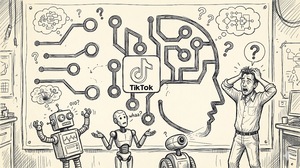 I was scrolling absently, hollowed out after a long day, when a video appeared about burnout in the creative industries. I had never once searched for that subject on the platform. I didn't follow anyone who talked about mental health. And yet the algorithm knew. It had registered that in recent days I'd been lingering on cat videos — my digital refuge when the world presses too close. It had noticed how I skipped past aggressive motivational content without pausing, but stopped at origami tutorials. Somewhere within its vast matrix of data, a map of my inner state was taking shape — one I hadn't consciously charted myself.
That feeling of being seen by an algorithm raises questions that cut deep. When a platform becomes so attuned to our emotional needs that it anticipates desires we haven't yet articulated, where does usefulness end and addiction begin?
The Anatomy of the Algorithm — How It Learns to Know Us
The First Encounter
The TikTok algorithm is, in essence, a learning system that evolves alongside us. In those first moments of interaction, the platform casts a wide net, testing the waters of our preferences with a calculated diversity of content. It is rather like a first conversation with a stranger — polite, exploratory, unburdened by assumption.
In this phase, every gesture counts. Watching a video to the end signals interest. A rapid scroll communicates indifference. A replay suggests fascination. The algorithm catalogues each micro-decision, assembling the first rough sketches of our digital profile. It is a subtle dance of revelation and discovery — one in which we believe we are exploring the platform, whilst all along it is quietly exploring us.
The Refinement of Taste
As interactions accumulate, the algorithm begins to detect patterns. Not merely in the broad categories — comedy, education, lifestyle — but in the fine grain of our preferences. It may observe that we prefer absurdist humour at weekends but gravitate towards educational content on Monday mornings. That we linger over animal videos when it is raining outside. That we have a weakness for acoustic covers of nineties songs, though only when sung by women.