On the importance of semantic markup and metadata for the correct interpretation of your content — a practitioner's view, without technocratic illusions.
Why AI Does Not "Read" the Way You Do.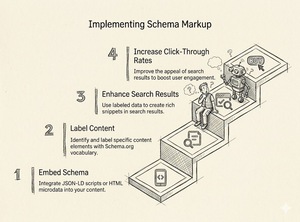 There is a comfortable illusion that lives inside most people who publish on the web: that a well-written text will, by the force of its own clarity, be understood. That if you say something true and say it plainly, the world — including the world of machines — will grasp it. I lived inside that illusion for a while myself, writing, publishing, waiting. Until I understood that machines do not read. They process.
The difference is larger than it appears. When you read, you bring context, memory, emotion, inference. You know that a reference to a local council means a public institution, that "opening hours" refers to when someone will actually answer the telephone, that the author of the text is a person with a name and a history, not an abstract generating function. An AI system, if it is not told explicitly, guesses. Sometimes it guesses well. Sometimes it transforms you into something you are not.
Unstructured data — plain text, images, video — is accessible to people but disorderly for machines. AI models need labelled, structured data in order to analyse, categorise, and deploy information in their responses. Without that labelling, your content exists in automatic translation — and the translation may be wrong in ways you will never see.
Schema markup is the answer to this problem. Not an SEO trick, not a technical hack to be applied on a rainy afternoon. It is the language through which you tell the machine: this is an organisation. This is the author. This is a question and this is its answer. It is, if you want a more human metaphor, the difference between introducing your father to someone who has never met him — "this is my father, a mechanic, a man of concrete things" — and leaving him to be interpreted by whoever happens to be looking.
My father was a mechanic. He repaired engines for a living. Whenever someone brought him a car he did not know, he would open the bonnet and ask, before touching anything: do you have the paperwork? Not out of bureaucratic habit — because the paperwork told him what the engine had been through, what had already been changed, who had worked on it before. Without documentation, he was guessing from cold. With documentation, he was working with knowledge.
Schema markup is the documentation of your website. It does not make your content better than it already is. But it makes everything that is good in it legible to a machine that would otherwise be guessing from cold.