The morning the graph stopped making sense.
There is a moment every serious data professional has experienced at least once: you look at a graph you know as well as your own handwriting, and something does not add up. Not a dramatic collapse, not a red alarm — just a slight disproportion, a number that seems too round, a curve that flows too smoothly. An instinct before it becomes a conclusion.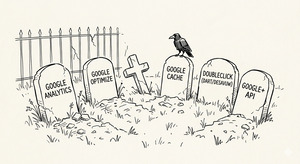
In September 2025, thousands of SEO specialists across the world experienced this sensation simultaneously. Impressions in Google Search Console had dropped sharply — by 20, 30, sometimes 50 per cent — with no change to content, no algorithmic penalty, no official announcement. Clicks remained stable. Revenue from organic traffic had not shifted. Real positions in search results were identical to the day before.
What had disappeared was not the actual visibility of those websites. What had disappeared were impressions fabricated by bots and scrapers which had, for years, been systematically inflating one of the central indicators of SEO reporting — without Google ever flagging the problem.
And that was only the second act.
The first act had ended in silence, in January 2024, when Google withdrew a tool that had existed in Search Console for fifteen years — the Crawl Rate Limiter — with a two-paragraph note and no public discussion worth mentioning. The third act, the most serious of the three, would only be uncovered on 30 March 2026, by an Australian consultant who had noticed something strange in desktop impression spikes. Four days later, Google confirmed it: a logging error had caused Search Console to misreport impressions for fifty consecutive weeks.
A year. Nearly a full calendar year of compromised data. Discovered not by Google, but by the community.
This is not an article about a bug. It is an article about a pattern. A pattern Google repeats with a consistency that should, at some point, serve as a genuine warning to anyone who builds business decisions on data furnished by its platforms.