Romanian legislation has established precise standards for structuring and organising information on the websites of public institutions. The stated aim is accessibility and transparency in the relationship between citizens and the administration — with particular emphasis on the sites of local councils and educational establishments.
This article does not set out to be an investigation in the journalistic sense of the word: all the reference documents are publicly available to anyone on legislatie.just.ro. What it offers instead is a systematic reading of those documents — one that will prove useful to anyone who builds, audits, or maintains a public institution's website.
In the context of the digitalisation of public administration and growing demands for transparency, Romanian legislation (Government Decision 830/2022) has established standards for the structuring and organisation of information on public institution websites. This detailed regulation is aimed at ensuring a high degree of accessibility and transparency in the relationship between citizens and public administration — with particular relevance to the creation of school websites and local council websites.
Listen to the audio summary in Romanian and English
What follows is a mapping of the system by which Romania has transformed the relationship between citizens and public institutions through the regulation of how authorities present their information online. The documents examined reveal a profound shift in the very concept of administrative transparency.
The Behavioural Context of the Contemporary Digital Consumer — Too Long; Here's the Summary
On an ordinary Tuesday morning, Maria — a fifteen-year-old from Bucharest — wakes up and, within the first five minutes, checks three different apps. She scrolls, remembers she has history homework, opens an article, reads two sentences and closes the tab. Too long, she thinks. Then a notification appears: the same article, but rendered as a five-minute conversation between two people discussing the subject in an easy, unhurried way. She listens on the way to school. By the time she arrives, she knows the whole lesson.
"TL;DR — too long, didn't read — has become not just an internet joke, but a philosophy of life," observes a teacher who once sent his pupils a ten-page reading. Nobody read it. When he converted it into a short dialogue podcast, everyone listened.
This is where the story of a fundamental shift begins — a change in the way we consume information. It is not about laziness or superficiality. It is about how the very way our minds seek and process knowledge has been rewired in a world saturated with stimuli.
The Fragmented Attention Paradigm
"To be or not to be" — Shakespeare might ask today — "attentive to a single thing for more than eight seconds?" The contemporary answer appears to be an overwhelming no.
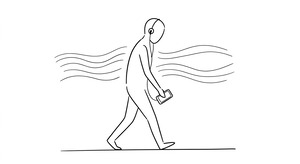
When our grandparents read the morning paper, their attention moved lineally, calmly, along columns of newsprint. Today, a teenager receives on average 237 notifications a day. Every ping, every vibration of the phone, every banner that appears from nowhere shatters attention into ever-smaller fragments. It is like trying to drink water from a cracked glass — theoretically possible, practically exhausting.
The phenomenon experts call scroll fatigue — the weariness of endless scrolling — has become the daily reality of millions of young people. The swipe left, swipe right gesture, once the exclusive property of dating apps, now defines our entire relationship with information. We see something, we assess in a fraction of a second whether it merits our time, and we either stop or move on. Most of the time, we move on.
The Official Email Address — Mere Formality or a Security Red Flag?
Have you ever been scrolling through your phone and received an email from, say, your local town council, only to find that the sender's address ended in @yahoo.com or @gmail.com? Perhaps you raised an eyebrow — or perhaps you didn't. But in today's digital world, where a single wrong click can open a Pandora's box full of security headaches, this small detail has become a VERY large conversation. It is not merely about 'looking the part'; it is about how secure our data actually is, and how seriously the institutions managing it take their responsibilities.
Listen to the audio summary in English
In the spring of 2023, Romania pressed the 'refresh' button on online safety by passing Law No. 58 on Cybersecurity and Cyber Defence. Suddenly, the way public institutions — from ministries down to the local primary school — manage their digital presence came under far closer scrutiny. This article is not a dry lecture on legislation; it is an exploration. What does the new law mean for the email accounts of public servants? Does it explicitly bid farewell to free platforms such as Yahoo or Gmail in the public sector? And, perhaps most importantly, why should any of this matter to you, a young person tuned in to the pulse of the online world? Let us untangle the threads.
The stakes are higher than you might think. We are talking about your personal data arriving at various virtual counters, about the efficiency with which you communicate with the state, and about the trust you can place in the institutions that, in theory, work for you. So pour yourself a coffee (or tea — no judgement here) and let us see whether the government's email is about to receive a serious security and image upgrade.
Not large — four metres by five, perhaps, with a wall of planks blackened by grease and smoke, and a shelf on which sat, in an order only he understood, keys of various sizes, rubber stoppers, screwdrivers with worn red handles, a cardboard box of screws sorted by length. It smelt of diesel, of warm metal, and of a thing I don't know how to name other than hard-won order.
That's where I watched him work whenever I had the patience to stay. Neighbours came with ailing cars, broken wheelbarrows, water pumps that would no longer start. He listened first — not to the engine, but to the man. He let the sentence finish, even when the sentence was long and imprecise and contributed nothing technical. Only after that did he put his hands on the engine.
I never heard him say he didn't know. He'd say "let's see" — and in his way of saying it, "let's see" was not a hesitation, it was a method. He said an engine will tell you itself what's wrong if you listen to it properly. That haste ruins any diagnosis. That the worst thing you can do is replace the part you suspect before checking the one next to it.
He died without knowing there were four equations that described exactly what he did.
Not in the workshop — there his intuition was precise. But in life. In decisions. In money. In health. In the choices he made without instruments, with common sense and the experience of a man who had lived in scarcity and who had learned that caution costs less than boldness.
Sometimes it costs less. Other times it doesn't.
Transparency note: This article was written with AI assistance. The biographical anchors, the judgements, and the voice belong to the author.
You know the story. You admire its elegance. You have probably retold it at a dinner party. And yet, today — almost certainly this very hour — you are repeating the exact error it was designed to prevent. This is an essay about why that happens, and what, if anything, can be done about it.
I. A Hungarian Mathematician Steps Into the Room
It is 1943. The United States Army Air Forces are losing bombers over occupied Europe at a rate that is becoming strategically untenable. The planes return — or rather, some of them do — pockmarked with bullet holes clustered along the fuselage, the wings, the tail sections. The cockpits and engines, by contrast, appear relatively unscathed. The obvious conclusion, the one reached by men of evident competence and reasonable intelligence, is to reinforce the areas under fire: bolt extra plating to the wings, add armour to the fuselage, protect the places that the data show are most vulnerable.
Then Abraham Wald walks in.
Wald is a Hungarian-Jewish mathematician who fled Austria in 1938 after the Nazi annexation — an act of exile that saved his life, given that almost his entire family would perish in the Holocaust. By 1943 he is a member of the Statistical Research Group at Columbia University, a wartime body tasked with applying mathematical rigour to military problems. He is so trusted, and his work so sensitive, that his secretaries had to physically remove notepaper from his hands the moment he finished writing — he lacked the security clearance to read back his own classified analyses. As Jordan Ellenberg recounts in How Not to Be Wrong: The Power of Mathematical Thinking (2014), there was a running joke in the Statistical Research Group about Wald's Kafkaesque situation: the man solving the problem was not permitted to know the solution.
What Wald tells the officers is this: armour the engines. Armour the cockpit. Reinforce precisely the areas showing the least damage.
The reasoning is as simple as it is devastating. The planes they are examining are the ones that came back. The bullet holes visible on those fuselages are not a map of danger; they are a map of survivability. The aircraft hit in the engines and the cockpit are not on the tarmac because they never returned. They are scattered across fields in France and Germany, unreachable and uncounted. The data set before the officers is not a sample of all planes hit by enemy fire. It is a sample, systematically biassed, of planes resilient enough to absorb damage in non-critical zones and still limp home.
The absence of bullet holes on the engines is not a sign that the engines were protected. It is a sign that planes struck in the engines did not survive to be counted.
Wald's original 1943 memorandum, "A Method of Estimating Plane Vulnerability Based on Damage of Survivors," was classified and circulated only internally. It was not published in the open literature until 1981, when the Center for Naval Analyses released it. By then, the insight it contained had migrated from military statistics into economics, finance, medicine, management theory, and psychology — becoming, arguably, one of the most consequential statistical ideas of the twentieth century.
And it has changed almost nothing about the way most people reason.
This essay would not exist without a Facebook post by Cristian Stancescu, published on 24 July 2026, on Romania's Border Police Day.
The post was brief, direct, without literary pretension. Someone had rung him that morning, whilst he was savouring his coffee. Come to the pitch, we've gathered for a kick-about. When he arrived, the teams were already warming up. Former colleagues from the Botoșani Border Police had organised a tournament. A fishing competition, football, chess, backgammon, tennis. It was lovely, a moment of stories, of "oh, what a team we had."
That was all.
But behind that oh, what a team we had lay something a Facebook post could not fully contain: the feeling of a man who looks at former colleagues and understands that his identity is larger than the function he once carried. That what remains after years of uniform and discipline is not nostalgia, but character.
That post was the spark. This text is the fire it lit.
A note for international readers: This essay grew out of a gathering held on Romania's Border Police Day — a national commemoration observed annually on 26 July. Former officers and current colleagues met on a football pitch in Botoșani, a city in north-eastern Romania, near the border with the Republic of Moldova. The event itself is incidental. What follows is not a report of that afternoon, but the essay it made possible.
Being a faithful and impartial account of the political anxieties of a country that had voted, forgotten it had voted, and was now being asked to vote again — with references to prior events and to devices that glow in the dark
Note. This text is an intentional fiction engaging with ideological and political concerns.Although it affects detachment, the tone is unmistakable: contempt for the current political class, for the "news" channels, for the "all-caps group chats," for the algorithms. The critique is partially warranted, but delivered in a manner that aspires to universality and ends up sounding rather like a disappointed grandfather holding forth — one who has, as he will tell you, seen it all before.
The citizen Gogonete Fănică, formerly a ticket inspector on the urban bus routes of Botoșani, retired on a second-grade locomotor disability pension acquired not in the line of duty but at a wedding in Cătămărești-Deal where he had danced too long and fallen into a ditch, was a man of exceptional goodwill and a profound understanding of public affairs, cultivated over the twenty-two years he had spent aboard the buses, where citizens speak freely because nobody of importance is watching.
On Gogonete Fănică's bedside table stood three objects: a glass of water, an agricultural almanac from 1987 which he had never read but kept out of respect for continuity, and a smartphone purchased for him by his son Cosmin from Italy, where Cosmin worked as a welder and sent money home with the regularity of a man who feels that filial duty can be discharged from a distance — perhaps more reliably than from close quarters. The smartphone was black, thin, and glowed in the dark with notifications about matters Gogonete Fănică had not requested and did not know how to stop.
Gogonete Fănică's grandfather, one Gogonete Haralambie, had lived in the same town forty years before his grandson and had possessed neither smartphone, agricultural almanac, nor glass of water on his bedside table, because the bedside table itself had been confiscated in 1940 along with the rest of the furniture by an administration whose reasons had never been fully explained, but which had produced the correct paperwork and two men in uniforms that looked official.
"The Matrix is everywhere. It is all around us. Even now, in this very room. You can see it when you look out your window or when you turn on your television. You can feel it when you go to work, when you go to church, when you pay your taxes." — Morpheus, The Matrix (1999)
A Letter Before We Begin
My son,
You will not read this today. You are probably scrolling. I know, because I can hear it — that particular silence you produce when the phone has you, the silence that is not rest but something more like suspension. The cat, Gri, hears it too. She curls up on the chair beside you and pretends not to notice, which is perhaps wiser than what I am about to attempt.
I am not angry. I am trying to understand something, and I think you might actually enjoy it if you give it half a chance.
Last week, I sat in front of my screen — as I do every day, because this is where my work lives — and I read something that made me laugh out loud. Cory Doctorow, an author and digital rights activist, described sitting on a panel in Toronto where the moderator called jailbreaking a smartphone "rampant theft of IP." Doctorow's jaw dropped. Mine very nearly did too, though I was alone in the room and there was only Gri to witness it.
I want to explain to you why that moment matters. Not because it is complicated, but because it is actually quite simple — and the simple things are the ones they prefer you never to figure out.
Inspired by the pedagogy of Maria Montessori, and informed by current research into adolescent development
I. My Own Fifteen Years
Before I can begin to understand how an adolescent matures, I must go back to my own fifteen years. Not to the pleasant memories, but to the murky ones — that age when my body was transforming faster than I could process my identity, when I woke each morning feeling I was someone different from who I had been the evening before. My father looked at me with a deep bewilderment, as though I had become an enigma he could no longer decipher. That look made me feel lonely in a way I could not articulate then, and which I understand only now, standing in the kitchen at dawn, a cup of coffee cooling in my hands.
Maria Montessori spoke of "planes of development" — periods during which the child reconstitutes itself entirely. I did not know, at fifteen, that I was reconstituting myself. I thought I was falling apart.
My father did not know what to do with me. Neither did I. That should have brought us closer. It did not.
Now I have a son. I stand in the same kitchen, with the same cooling coffee, and try not to repeat my father's silence. I do not know whether I succeed.
II. The Death of the Child I Knew
The little boy who ran to embrace me when I came home from work has disappeared. He disappeared gradually, without announcement, without a clear moment of rupture. In his place stands someone who closes the bedroom door. Who communicates in monosyllables. Who sometimes looks at me with barely concealed exasperation when I offer unsolicited advice.
I must accept this death in order to greet the young adult being born.
That is easier to write than to live. The loss of the certainty that I know what is best for him. The loss of the role of absolute protector. The loss of the illusion that I can control who he becomes. These are not abstractions — they are things I feel physically, as a pressure in the chest, on the days he walks out the door without looking back.
There is a particular kind of pain in watching your child become a stranger under your own roof. I know you sometimes find yourself searching your teenager's eyes for that child who once looked at you as though you were the centre of the universe – and finding instead a gaze that avoids contact, that seeks validation anywhere but from you.
You are not alone in this confusion. Thousands of parents navigate this same disconcerting experience every day: the feeling that everything has suddenly changed, that all the familiar rules no longer apply, that the relationship you built so carefully is unravelling before your helpless eyes.
But let me offer you a perspective that might change everything: this metamorphosis you are witnessing – however unsettling, however painful – is not a malfunction. It is exactly what is supposed to happen. And more than that, it is a process you are going through too, not just your teenager. You are both transforming, both learning a new way of being with one another.
The promise of this letter is simple: clarity about what is really happening in your teenager's mind and body, and scientifically grounded hope that this stage – however turbulent – can bring you closer, not further apart.
The light that never dies. A journey through the spring hills.
Every morning, Vicențiu Moga set out from Iași, his camera slung across his chest like an old talisman, a second heart beating in rhythm with his footsteps on the red-clay roads of the Moldavian hills. To him, the spring album was more than a mere collection of images: it was a confession, a visual liturgy he had carried in his soul for years—though he kept postponing it, for he understood, with the painful clarity of the true photographer, that spring does not give itself up easily. It yields only to those who know how to wait.
He had risen before dawn, when the sky above Iași still held that indecisive hue—neither night nor day—a faded blue-grey velvet in which the stars were extinguishing one by one, like vigil candles at the end of a wake. He had packed his satchel with a volume of Nichita Stănescu’s poetry—an old edition, its spine frayed and its page edges yellowed by many fingers—along with a few pieces of bread and a thermos of tea. He never forgot the tea. It was a habit inherited from his father, a quiet man who believed the world looked different when viewed over a steaming cup.
The evening before, he had read: “Of course, spring has burst from my temples,” and that line had not released him all night long.
He knew the road to Repedea Hill with every bend and pothole. Over the years, he had photographed these places in every season, but spring was different. In spring, the hills around Iași took on an almost unreal transparency, as if the light came not from the sky but from within the earth itself, from a slow, gentle fire smouldering beneath the roots of grass and trees.
In his journal, Vicențiu called this light from below, and he sought it with the same patience and emotion with which a pilgrim seeks a miracle-working icon.
The Fathers of the Philokalia wrote that pure prayer is that which springs from the heart without effort, like a spring that does not know it is springing. Vicențiu believed that true photography worked the same way—not as a violent capture of the world, but as a reception. You let the light enter you, and only then, in the moment when heart and eye align in silence, do you press the button. You do not take the photograph. You are photographed by what you love.


 The stated aim is accessibility and transparency in the relationship between citizens and the administration — with particular emphasis on the sites of local councils and educational establishments.